
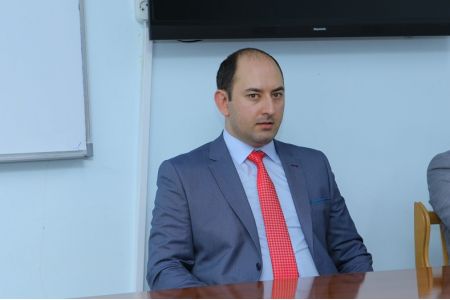
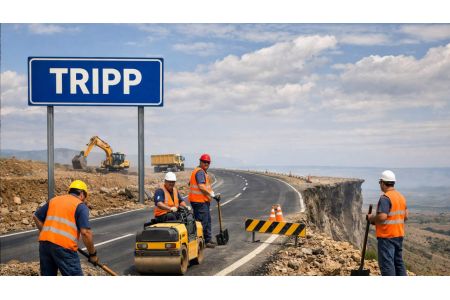
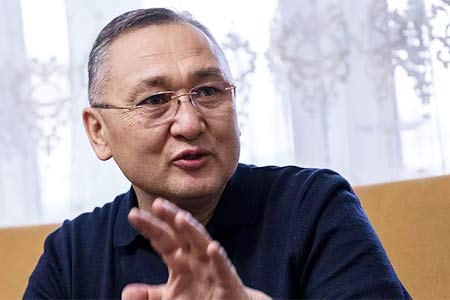
ArmInfo. The "Trump Route" project is eliciting a very interesting response from the Russian Federation. Political scientist and director of the Regional Center for Democracy and Security Tigran Grigoryan stated this during discussions on the TRIPP project.
According to him, in the recent past, when Western involvement in the region was growing, including through the European Union's civilian mission, Moscow's reaction was much harsher, more pointed, and more rude.
Currently, Russia remains a significant presence in the region, particularly in Armenia. This refers to Moscow's control over Armenia's infrastructure and trade. Against this backdrop, the TRIPP initiative is eliciting a somewhat different reaction from Russia. It seems Moscow understands that even if this program is implemented, it will continue to play an important role in the region. One of the key components of the "Trump Route" is the lack of reciprocity in relations between Armenia and Azerbaijan. Moscow's role in this matter could significantly increase. For example, this could occur through the supply of Armenian goods to Russia via Azerbaijan, or vice versa. "Obviously, Russian companies will perform this function," the political scientist said, noting Baku's intention to establish a direct land link with Ankara, despite Moscow's somewhat different perception of this connection. If the project is implemented, it doesn't take a rocket scientist to understand that Russia will still control this route. Moscow's pragmatic policy toward Washington, particularly US President Donald Trump, with whom it is attempting to establish normal relations, also plays a significant role in Moscow's participation in the TRIPP project. Against this backdrop, the political scientist noted, the European Union has become Russia's main adversary.
However, according to Tigran Grigoryan, the presented project is also rife with skepticism. If the conflict drags on and the Ukrainian conflict resolves, Russia's role in the region will significantly increase, and Moscow's involvement in the South Caucasus will become much more tangible. Once the Ukrainian conflict is over, Moscow will attempt to use its existing leverage over Yerevan, including economic, trade, and infrastructure. However, this influence will no longer be at the same level it was before the start of the Russian-Ukrainian war. Moreover, during this war, irreversible events occurred in the region: the exodus of the Armenian population from Nagorno-Karabakh, where Russian peacekeeping forces, which had been a significant influence on both Armenia and Azerbaijan, are no longer present. "Even in the long term, I don't see a scenario that would lead to a restoration of the status quo; that is, one lever of pressure is already missing. Unlike military-political cooperation between Armenia and Russia, which is experiencing a crisis, the economic situation is completely different.
This is, in fact, evidenced by the growth rate of bilateral trade, which has consistently shown significant growth since 2022.
Therefore, the economic component has become the most significant factor in Russia's relations with Armenia and other CIS countries.
"It would be a painful blow for Russia if Armenia decided to leave the Eurasian Economic Union, although both the republic's accession to the EU and its withdrawal from the EAEU appear unrealistic in the near future," the political scientist emphasized.
He added that he does not believe Moscow can apply the soft power policy it has employed against Yerevan over the past several years. The extent of this soft power is also already in doubt.
"Ultimately, one thing must be understood: Moscow should be far more concerned not by Yerevan's diversification of areas of cooperation, but by a significant loss of public opinion among Armenian citizens toward Russia," the political scientist concluded.









 Expert on protests in France: Civilizations fade when society loses a vision of the future
 Turkologist: Azerbaijan is not all-powerful—its vulnerabilities should become part of Armenia’s security strategy
 Opinion: The development of the Amulsar mine near the resort town of Jermuk is the beginning of an environmental disaster in Armenia
 Expert: The arrest of opposition figures in Armenia for social media posts is a systematic attempt to intimidate the public and suppress dissent.
 The Artsakh Public Council expressed outrage at the UN Secretary-General`s behavior
 Lukashenko called for Armenia to assume the CIS presidency in 2029
 Dmitry Medvedev predicted a Ukrainian-like fate for Armenia amid the country`s shift in foreign policy
 Russian Security Council: In Armenia, they want to force Russian asset owners to dispose of their assets
 Zakharova: Russia ready to discuss with Armenia the prospects for expanding military cooperation as part of a review of bilateral ties
 Tevanyan: Armenia, like Ukraine and Moldova, is being drawn into the EU’s global war
 Yerevan City Hall is considering introducing a valet parking system in the city
 Expert: The circus surrounding the “Albanization” of Armenian culture in the presence of foreign ambassadors in occupied Artsakh is genocide
 Political scientist: If Russian-Armenian relations are destroyed, Turkey will take Russia`s place
 Political scientist: The Armenian public is simply obliged to significantly change the entire content of public discourse and struggle
 Cross tattoos are being removed from the skin of Christian prisoners in Azerbaijan by fire, according to a human rights activist.
 Zakharova: Armenia`s likely introduction of visas with Russia will be a step against Yerevan itself
 Putin: Armenia`s recognition of Karabakh as part of Azerbaijan in Prague has given Russia`s position on this issue an ambivalent character
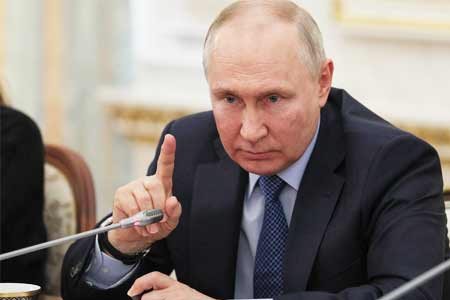 Putin: Armenia`s adoption of the law on EU accession means an announcement of its withdrawal from the Eurasian Economic Union