

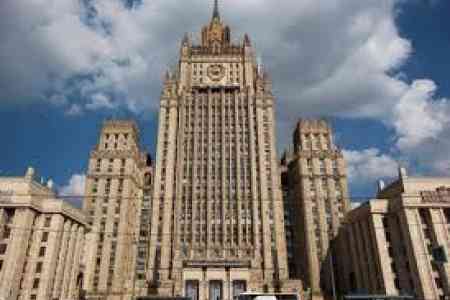
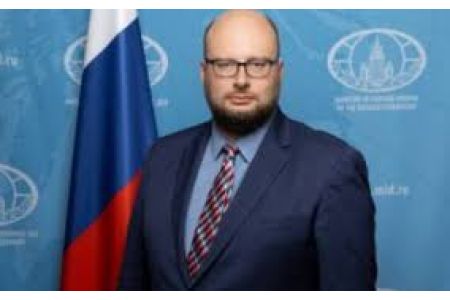
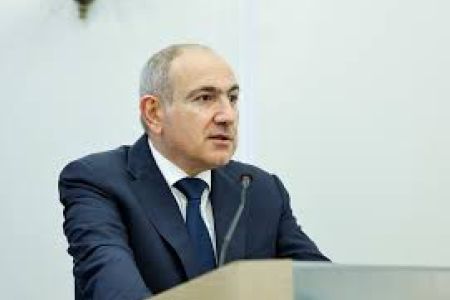
ArmInfo. The Armenian leadership's argument about the toxicity of interaction with Russia is being suggested by its Western interlocutors. This was stated by Mikhail Kalugin, Director of the Fourth Department of the CIS Countries at the Russian Foreign Ministry, regarding the sale of the Russian concession for Armenian railways.
"In pursuit of their geopolitical goals of ousting our country from the region, they are ready to promise mountains of gold: large-scale freight flows, investments in the construction and restoration of railway lines. Under these promises, Yerevan is essentially being forced to join illegitimate anti-Russian restrictions. The sanctions policy has already caused great damage to countries, primarily EU members, that adhered to it. "We are currently seeing public opinion in Europe clearly leaning toward adjusting this trend, as demonstrated by domestic political processes in the leading countries of the Union," he said in an interview with RIA Novosti.
Kalugin emphasized that fundamental factors such as geography and economics will determine the long-term fate of transport corridors in the South Caucasus. He added that parameters such as cost, timing, throughput, and the presence of additional customs procedures, which affect schedule predictability, are crucial for shippers.
"Today, the region's transport framework has already been largely established. It is formed by the main directions of existing and potential future freight flows. In the North-South direction, this is the route between Russia and Iran with access to India, as well as to the countries of the Middle East. In the East-West direction, this is primarily the supply of resources from Central Asia to Europe and Turkey. Potentially, there is also hope for increased reciprocal deliveries between China and Europe via the Middle Corridor. The region has already built and is actively developing the necessary infrastructure to service these flows. Armenia's competitors in the logistics sector are Georgia and Azerbaijan, along with Turkey. Moreover, these neighbors have made significant progress in building international transit segments on their railways," he noted. Kalugin noted that Azerbaijan is actively developing railway communications in Nakhchivan, which is planned to become a hub for three directions: to the mainland of Azerbaijan via Armenia's Syunik region, to Turkey via the Sadarak-Diluju line (already under construction, and it will be significantly shorter than the route to Kars via the Armenian network), and to Iran via the junction in Julfa. And, of course, the active development of the Russia-Azerbaijan-Iran route continues as part of the North-South Corridor, within which the Astara-Rasht link will be completed in the coming years.
Therefore, the diplomat continued, given geographic factors, as well as the higher level of readiness of most competing routes, Armenian railways are inferior in most respects to transit corridors in neighboring countries.
"In such a situation, counting on the goodwill of recipients and shippers of cargo, who would prefer Armenian railways at a loss, would be reckless. The conclusion is clear: only through cooperation with our country does Armenia retain a chance of further developing its national railway network. Russia is and will remain one of the largest generators of freight flows through the South Caucasus due to its geography, as well as the size and structure of its economy. We urge our Armenian partners to be guided not by the current agenda imposed by the West, but by a well-considered long-term economic calculation. Especially since, in the area using a 1,520-millimeter-gauge railway, there is and will never be a more competent transport organizer than Russian Railways," Kalugin concluded.
On August 24, Armenian Prime Minister Nikol Pashinyan, speaking from the parliamentary rostrum, called on Russia to show flexibility and sell the concession for Armenian railways to a friendly third party. He also announced a proposal to purchase the concession for $400 million. Pashinyan emphasized that if Russia were to manage the Armenian railway network under a concession, Armenia could lose its historic opportunity to integrate into the international railway network.
As a reminder, Armenian Prime Minister Nikol Pashinyan first voiced the proposal to sell the railway concession to Russia on February 13.
At that time, in a conversation with journalists, he stated that Russia's concessionary management of Armenia's railways created competitive problems for Armenia, and many international partners wanted to bypass Armenian territory when implementing infrastructure projects. In this vein, he suggested that Russia consider selling the concession to a third, friendly country. He suggested Kazakhstan, the UAE, or Qatar as examples.
Russia called Pashinyan's claims groundless and stated that it does not intend to sell the concession for Armenian railways.
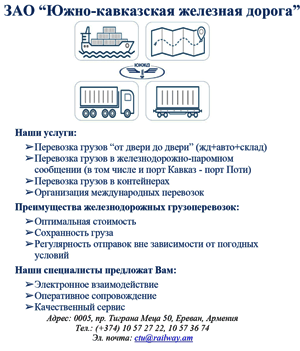
As a reminder, SCR CJSC is a wholly owned subsidiary of Russian Railways OJSC. On February 13, 2008, a concession agreement was signed in Yerevan between Russian Railways OJSC and the Republic of Armenia transferring the republic's rail transport system to the management of SCR CJSC. According to the agreement, the concession management term is 30 years, with the right to extend it for another 10 years after the first twenty years of operation by mutual agreement of the parties. SCR CJSC's responsibilities include include the modernization of the RA railway infrastructure, the development of cooperation with states neighboring Armenia, and the development of domestic and international passenger and freight traffic. The amount of investments made by the Company is $572 million. CJSC "SCR" began its activities on June 1, 2008.
















 Azerbaijani Studies Expert: While Azerbaijan Prepares Its Generation for War, Aliyev’s Aide Calls on Armenia to Prepare Armenian Society for “Peace”
 Turkologist: Azerbaijan will never, under any circumstances, stop pressuring the Armenian people
 Political scientist: We need to move away from the question of "when" and replace it with more important questions
 International Law Specialist: Azerbaijan intends to initiate legal proceedings against Armenia by sentencing Armenian prisoners
 Dmitry Medvedev predicted a Ukrainian-like fate for Armenia amid the country`s shift in foreign policy
 Russian Security Council: In Armenia, they want to force Russian asset owners to dispose of their assets
 Zakharova: Russia ready to discuss with Armenia the prospects for expanding military cooperation as part of a review of bilateral ties
 Tevanyan: Armenia, like Ukraine and Moldova, is being drawn into the EU’s global war
 Yerevan City Hall is considering introducing a valet parking system in the city
 Expert: The circus surrounding the “Albanization” of Armenian culture in the presence of foreign ambassadors in occupied Artsakh is genocide
 Political scientist: If Russian-Armenian relations are destroyed, Turkey will take Russia`s place
 Political scientist: The Armenian public is simply obliged to significantly change the entire content of public discourse and struggle
 Cross tattoos are being removed from the skin of Christian prisoners in Azerbaijan by fire, according to a human rights activist.
 Zakharova: Armenia`s likely introduction of visas with Russia will be a step against Yerevan itself
 Putin: Armenia`s recognition of Karabakh as part of Azerbaijan in Prague has given Russia`s position on this issue an ambivalent character
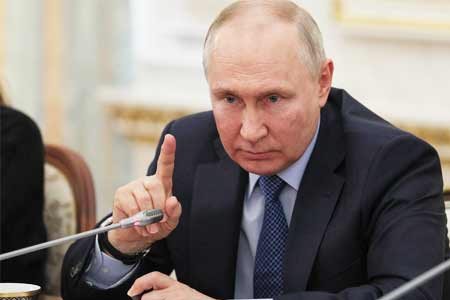 Putin: Armenia`s adoption of the law on EU accession means an announcement of its withdrawal from the Eurasian Economic Union
 Aram Vardevanyan: Public demands solutions, not apology scandals in Parliament
 Arrested Armenian oligarch on economy and new jobs