
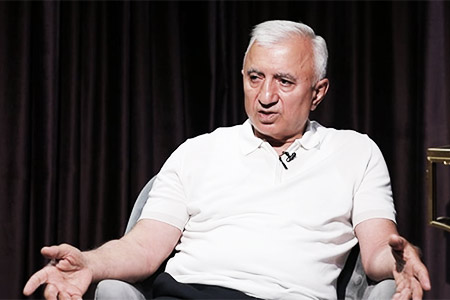
ArmInfo. It is much easier to control individual rulers than the entire nation. This is what Professor Gevorg Danielyan, a Doctor of Law, writes on his Facebook page, discussing the purposes and significance of referendums.
According to the professor, a referendum is essentially one of the unique indicators of the relationship between the principles of individual and democratic rule; it is a litmus test for the real and perceived legitimacy of any government. This has long been described as a very troubling legal and political phenomenon, especially among supporters of globalism, since it is much easier to control individual rulers than the entire nation. A striking example of this is the unconditional prior signing of the Constitutional Treaty on the European Union by European leaders, followed by the crushing referendums held in these countries.
“In fact, referendums on EU membership have not been accompanied by particularly high voter rates either. For example, Norway rejected EU membership twice: in 1972 and 1994, while in other countries this figure averaged 65 percent, such as Malta, Estonia, Latvia, and others. However, everyone understands perfectly well that the guarantee of long-term and stable policy is the referendum itself, not the ad hoc and highly volatile promises of those in power, and this explains such great interest in referendums. In the constitutional reform commission formed in 2013, I myself was involved in developing the constitutional and legal basis for the referendum. Moreover, I put forward incomparably accessible prerequisites, especially for citizen initiative.
However, in this regard, I encountered serious disagreements and discussions with international experts, who openly sought to downplay the role of the referendum at all costs, arguing that in the case of a professional parliament, it was unwise to leave responsibility for it to the people. This, of course, was a classic example of double standards, since they knew full well that in countries with a rich history of democracy, the exact opposite position prevails; in Switzerland alone, more than 500 referendums have been organized.
My position was that such reasoning was an ambition based solely on political calculations. However, with the support of several members of the commission, it was possible to establish that issues related to territorial border changes... Accession to and withdrawal from supranational international organizations are mandatory subjects of referendums. In the near future, I will try to examine in as much detail as possible the precise interpretation of the term "territory" and, at least once again, with additional arguments, clearly and unequivocally substantiate that Tigranashen cannot in any way be considered Azerbaijani territory.
Incidentally, in 1989, that is, during the Soviet period, I myself, as part of a delegation formed by Armenia, participated in an artificial territorial dispute in Tbilisi initiated by the Azerbaijani authorities regarding Tigranashen. As a result, it was once again decided that the Azerbaijani delegation's arguments were clearly unfounded, and therefore they will never raise the issue again. After this, we freely accommodated refugees forcibly displaced from Azerbaijan in Tigranashen,” Gevork Danielyan emphasized.


















 Political scientist: We need to move away from the question of "when" and replace it with more important questions
 International Law Specialist: Azerbaijan intends to initiate legal proceedings against Armenia by sentencing Armenian prisoners
 Russian Security Council: In Armenia, they want to force Russian asset owners to dispose of their assets
 Zakharova: Russia ready to discuss with Armenia the prospects for expanding military cooperation as part of a review of bilateral ties
 Tevanyan: Armenia, like Ukraine and Moldova, is being drawn into the EU’s global war
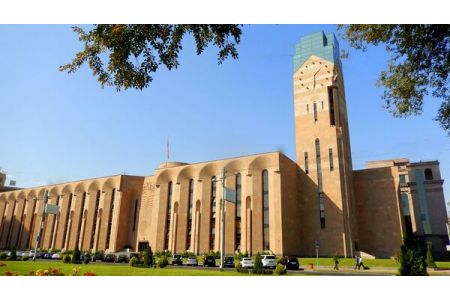 Yerevan City Hall is considering introducing a valet parking system in the city
 Expert: The circus surrounding the “Albanization” of Armenian culture in the presence of foreign ambassadors in occupied Artsakh is genocide
 Political scientist: If Russian-Armenian relations are destroyed, Turkey will take Russia`s place
 Political scientist: The Armenian public is simply obliged to significantly change the entire content of public discourse and struggle
 Cross tattoos are being removed from the skin of Christian prisoners in Azerbaijan by fire, according to a human rights activist.
 Zakharova: Armenia`s likely introduction of visas with Russia will be a step against Yerevan itself
 Putin: Armenia`s recognition of Karabakh as part of Azerbaijan in Prague has given Russia`s position on this issue an ambivalent character
 Putin: Armenia`s adoption of the law on EU accession means an announcement of its withdrawal from the Eurasian Economic Union
 Aram Vardevanyan: Public demands solutions, not apology scandals in Parliament
 Arrested Armenian oligarch on economy and new jobs
  "In Baku, we gave a worthy rebuff to the false claims regarding the past and present of our people" – Former Artsakh Parliament Speaker from Baku captivity