

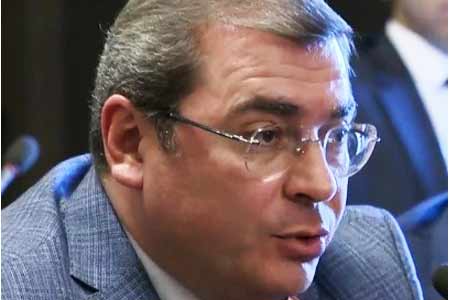
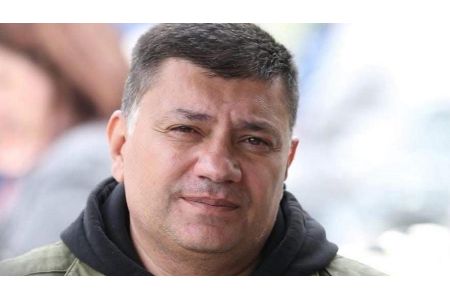
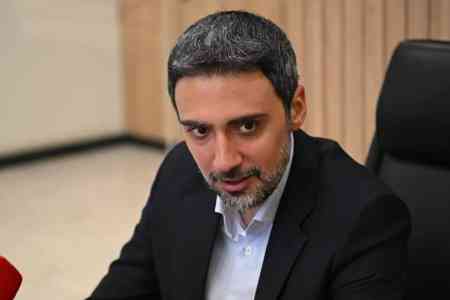
ArmInfo. The draft government program for 2026-2031 is not an ordinary five-year program of action, but a document designed to transform the current government's ideological concepts into state policy and restructure Armenia's national and state agenda. This is how David Ananyan, a member of the "Wings of Unity" party board and former chairman of the State Revenue Committee of Armenia, commented on the Armenian government's new five-year program.
"The most alarming feature of the program is the following asymmetry: wherever the government's powers are constitutionally limited—such as on matters concerning the leadership of the Armenian Apostolic Church and the adoption of a new Constitution—the rigid formulation 'must be ensured' is employed. Yet wherever the state bears direct responsibility, such as for the protection of the rights of the people of Artsakh, Armenians held in Baku, missing persons, cultural heritage, and international legal proceedings, the program says virtually nothing," the politician points out in a publication on his Facebook page.
According to him, the word "Artsakh" is not mentioned once in the full text of the program, and the word "Karabakh" appears only once, in the context of a program to provide housing for 10,000 families displaced from "Karabakh." Thus, Ananyan continued, the Artsakh issue is reduced from the political, security, and international legal levels to the issue of social housing, and the program itself contains no commitments regarding the right to safe return of Artsakh Armenians, the protection of property, cultural and church heritage, Armenians illegally detained in Baku, missing persons, or international legal proceedings.
"Meanwhile, the binding decision of the International Court of Justice imposes on Azerbaijan the obligation to ensure the safe, unimpeded, and prompt return of those who had left Karabakh and wish to return. The absence of the Artsakh issue from the state program does not legally negate these rights, but at the political level, it removes them from Armenia's priorities and reduces further state claims and opportunities for negotiations.
The second most serious issue is the section concerning the Armenian Apostolic Church. The government promises to ensure the "removal of the de facto head" of the Armenian Apostolic Church, the election of a vicar of the Catholicosate, and then a new Catholicos of All Armenians," the politician continued. He recalled that, according to the Constitution, religious organizations are separate from the state and granted autonomy, and the law on relations with the Armenian Apostolic Church recognizes the Church's self- governance within its hierarchy. Ananyan emphasized that no legal norm authorizes the government to remove the Catholicos or ensure the election of his successor. The politician acknowledged that the state can legally demand financial reporting, investigate suspected crimes, and protect public interests, but making a change in the Church's leadership the goal of a state program constitutes interference in its internal governance.
"Furthermore, the government declares the depoliticization of the Church, but it itself makes the issue of the Catholicos a subject of state and party policy. This could lead to internal schisms within the Armenian Apostolic Church, opposition from diaspora dioceses, legal disputes, and an attempt to subordinate one of the most important national institutions to political power," he continued.
The third key issue, according to Ananyan, is the new Constitution. He noted that the program presents its adoption as a priority, but does not explain which specific intractable shortcomings of the current Constitution require the adoption of an entirely new Constitution.
The politician believes it is necessary to directly ask the authorities: what exactly is being planned to change—the governance model, the connection with the Declaration of Independence, the constitutional status of the Armenian Apostolic Church, or the national, historical, and legal foundations that continue to trouble Azerbaijan. "This issue is all the more fundamental since the President of Azerbaijan is publicly presenting an amendment to the Armenian Constitution as a precondition for signing a peace treaty. Meanwhile, the published agreement makes no such requirement, and the Constitutional Court of the Republic of Armenia has already clarified that no territorial claims on Armenia's part flow from the current Constitution. Therefore, the need for a new Constitution has no legal basis yet. Instead, there is a reasonable suspicion that it meets an external demand and is being presented as Armenia's internal political initiative," Ananyan noted. At the same time, the politician noted that at the end of the program, it is announced that Armenia is entering the phase of the "Fourth Republic," but the legal and governmental content of this concept is not clarified. The politician believes that this ambiguity suggests that it is not only a matter of constitutional reform, but also a rethinking of the historical and political foundations of the Republic of Armenia, established in 1991. "Equally dangerous is the security formula that claims peace is the 'only effective and reliable guarantee' of security. Peace is a goal, but it cannot replace an army, deterrence, treaty enforcement, or mechanisms for responding to violations. Unguaranteed peace is not a security system, but a political hope," Ananyan asserted.
The politician emphasized that, overall, the program focuses state potential on the internal restructuring of national institutions, historical memory, and identity, while simultaneously weakening the Artsakh agenda, the rights of Artsakh Armenians, and external claims.
"This is not a balanced transformation of the state, but a dangerous program of geopolitical and domestic experiments. And for a state facing serious security challenges, the price of such ideological adventurism may prove far too high," Ananyan concluded.









 Opinion: The development of the Amulsar mine near the resort town of Jermuk is the beginning of an environmental disaster in Armenia
 Expert: The arrest of opposition figures in Armenia for social media posts is a systematic attempt to intimidate the public and suppress dissent.
 Azerbaijani Studies Expert: While Azerbaijan Prepares Its Generation for War, Aliyev’s Aide Calls on Armenia to Prepare Armenian Society for “Peace”
 Turkologist: Azerbaijan will never, under any circumstances, stop pressuring the Armenian people
 Political scientist: We need to move away from the question of "when" and replace it with more important questions
 Lukashenko called for Armenia to assume the CIS presidency in 2029
 Dmitry Medvedev predicted a Ukrainian-like fate for Armenia amid the country`s shift in foreign policy
 Russian Security Council: In Armenia, they want to force Russian asset owners to dispose of their assets
 Zakharova: Russia ready to discuss with Armenia the prospects for expanding military cooperation as part of a review of bilateral ties
 Tevanyan: Armenia, like Ukraine and Moldova, is being drawn into the EU’s global war
 Yerevan City Hall is considering introducing a valet parking system in the city
 Expert: The circus surrounding the “Albanization” of Armenian culture in the presence of foreign ambassadors in occupied Artsakh is genocide
 Political scientist: If Russian-Armenian relations are destroyed, Turkey will take Russia`s place
 Political scientist: The Armenian public is simply obliged to significantly change the entire content of public discourse and struggle
 Cross tattoos are being removed from the skin of Christian prisoners in Azerbaijan by fire, according to a human rights activist.
 Zakharova: Armenia`s likely introduction of visas with Russia will be a step against Yerevan itself
 Putin: Armenia`s recognition of Karabakh as part of Azerbaijan in Prague has given Russia`s position on this issue an ambivalent character
 Putin: Armenia`s adoption of the law on EU accession means an announcement of its withdrawal from the Eurasian Economic Union
 Aram Vardevanyan: Public demands solutions, not apology scandals in Parliament