

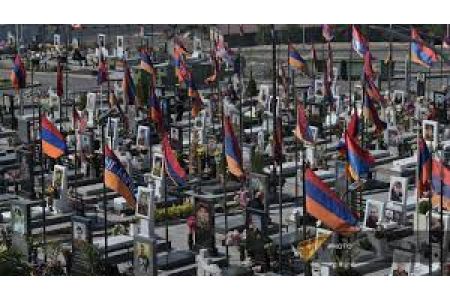
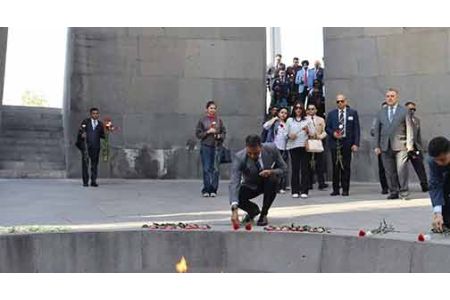
ArmInfo. On the occasion of the 10th anniversary of the four-day April War of 2016 around Artsakh, Armenian and Artsakh officials visited the Yerablur Military Pantheon and honored the memory of the sons of the Armenian people who gave their lives for the Motherland.
The fifth President of Artsakh, Samvel Shahramanyan, and the Speaker of the Artsakh Parliament, Ashot Danielyan, laid flowers at the memorials in Yerablur in memory of those who died for the Motherland. Speaking to journalists, Danielyan noted that today it is their duty to remember those who fought heroically in those days and to continue the work they left unfinished. "The Armenian authorities are currently trying to erase from our memory all the victories we achieved, which, I believe, was planned. At first, they told us, 'Artsakh is Armenia, period,' but today they call us 'fleeing.' There's no point in commenting on their lies and manipulations. Our people know what really happened," the Artsakh parliament speaker noted.
In turn, Shahramanyan called on the Armenian public, the relatives of the fallen soldiers, and personally those who contributed to the battle for Artsakh, not to succumb to the provocations being carried out by the Armenian authorities today. "The statements they make have one goal: to divide the Armenian people and create an atmosphere of intolerance within Armenian society. I don't want to return to such topics today, but I will say one thing: I want to remind those who spread false claims about 'fleeing Artsakh residents' that they were the country's political and diplomatic leaders in 2020. It is because of their actions that the Armenian people lost Artsakh, Armenian territories are occupied, and Azerbaijan continues to make demands that they are forced to comply with. The Armenian people must evaluate this," stated the fifth president of the NKR.
In turn, Gegham Manukyan, a member of the Armenian parliament from the opposition "Armenia" faction, noted that, unlike previous years, they experience completely different feelings today when visiting the Yerablur pantheon. According to him, in the current circumstances of Armenia, there is a sense of both pride and betrayal. "On such a memorable day, nothing is planned at the state level in Armenia today. Meanwhile, the martyrs of the four-day April War made their sacrifice and wrote another heroic page in history by preventing Azerbaijan's attempt at a large-scale occupation of Artsakh," the opposition leader noted.
The most important message of the April War, he said, was the unity demonstrated by the entire Armenian people-from the highest leadership to the most ordinary citizen, including journalists. "From the very first second, everyone felt it was their duty, and unlike the 44-day war of 2020, everyone knew their place. That's why we achieved the results we achieved, and the enemy was forced to ask for a ceasefire four days later," Manukyan emphasized.
Ten years ago, on the night of April 2, 2016, the Azerbaijani Armed Forces committed large-scale military aggression against Nagorno-Karabakh. The war was accompanied by war crimes, gross violations of the laws and customs of war, and international humanitarian law.
The April military actions were considered the largest since the May 1994 ceasefire agreement. During the fighting from April 2 to 5, all Armenian military units, including artillery, tank crews, and anti-tank units, performed exceptionally well. During intense fighting, units of the Artsakh Defense Army destroyed two Azerbaijani helicopters attacking Armenian positions, 26 tanks, as well as 14 drones, one BM-21 Grad rocket launcher, four infantry fighting vehicles, and one engineering unit.
During the fighting on the line of contact, the Armenian side lost 64 servicemen, 13 volunteers, and four civilians, and over 120 were wounded. Another nine servicemen were killed after the cessation of active hostilities, prior to April 13, and several died later in hospitals.
Based on State Department data presented in Vienna on May 16 that same year, it is clear that in addition to the 81 Armenian casualties, approximately 270 Azerbaijanis were killed. However, analysts from the international research group Bellingcat estimated Baku's losses at 400-500 soldiers killed.














 Expert: The arrest of opposition figures in Armenia for social media posts is a systematic attempt to intimidate the public and suppress dissent.
 Azerbaijani Studies Expert: While Azerbaijan Prepares Its Generation for War, Aliyev’s Aide Calls on Armenia to Prepare Armenian Society for “Peace”
 Turkologist: Azerbaijan will never, under any circumstances, stop pressuring the Armenian people
 Political scientist: We need to move away from the question of "when" and replace it with more important questions
 Lukashenko called for Armenia to assume the CIS presidency in 2029
 Dmitry Medvedev predicted a Ukrainian-like fate for Armenia amid the country`s shift in foreign policy
 Russian Security Council: In Armenia, they want to force Russian asset owners to dispose of their assets
 Zakharova: Russia ready to discuss with Armenia the prospects for expanding military cooperation as part of a review of bilateral ties
 Tevanyan: Armenia, like Ukraine and Moldova, is being drawn into the EU’s global war
 Yerevan City Hall is considering introducing a valet parking system in the city
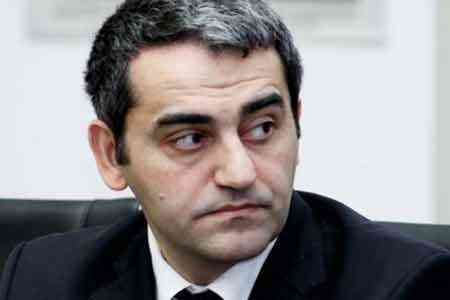 Expert: The circus surrounding the “Albanization” of Armenian culture in the presence of foreign ambassadors in occupied Artsakh is genocide
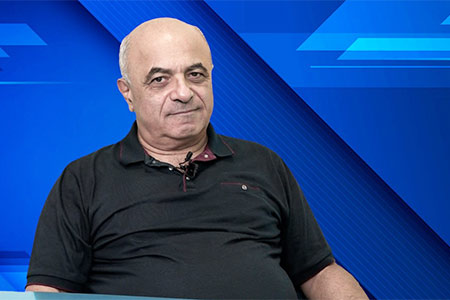 Political scientist: If Russian-Armenian relations are destroyed, Turkey will take Russia`s place
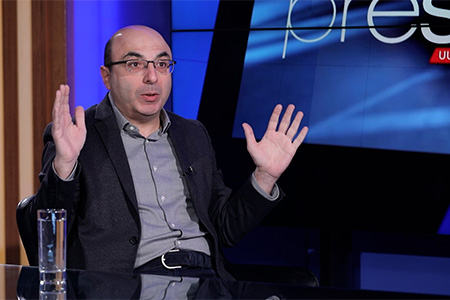 Political scientist: The Armenian public is simply obliged to significantly change the entire content of public discourse and struggle
 Cross tattoos are being removed from the skin of Christian prisoners in Azerbaijan by fire, according to a human rights activist.
 Zakharova: Armenia`s likely introduction of visas with Russia will be a step against Yerevan itself
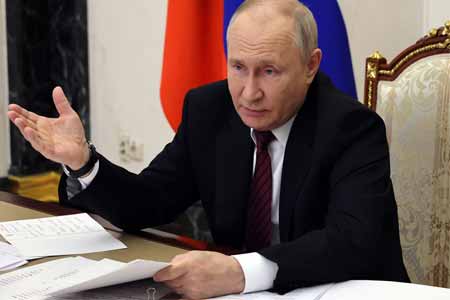 Putin: Armenia`s recognition of Karabakh as part of Azerbaijan in Prague has given Russia`s position on this issue an ambivalent character
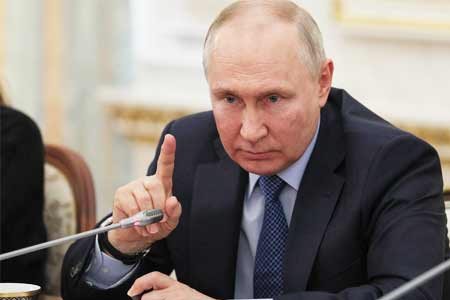 Putin: Armenia`s adoption of the law on EU accession means an announcement of its withdrawal from the Eurasian Economic Union
