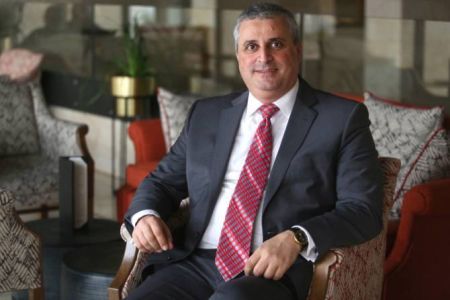
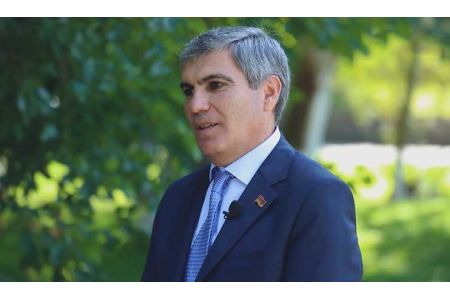
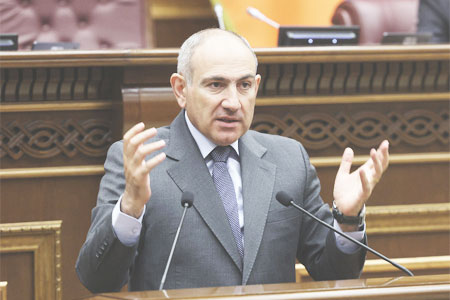
ArmInfo. Grigor Hovhannisyan, former Armenian Ambassador to the United States and Mexico and former Deputy Foreign Minister of Armenia, is confident that Yerevan can integrate into Europe without making the Armenian Apostolic Church a scapegoat.
In his article for Le Figaro, Hovhannisyan recalled that Armenian Prime Minister Nikol Pashinyan, speaking before the European Parliament, pointed to the Church's responsibility for the country's security instability.
"On March 11, 2026, during an official session of the European Parliament in the Louisa Weiss Hall in Strasbourg, the Armenian Prime Minister presented a familiar European narrative: peace, reconciliation, and the declared 'European choice' for his country. The scene was highly symbolic. However, behind this carefully orchestrated diplomacy, a disturbing subtext was perceptible: a speech that not only defended a political line but also viewed an important component of Armenia's moral and civic landscape as an adversary. It is not uncommon for leaders to confront their domestic critics abroad. What is unusual is that they do so by casting a shadow of suspicion on the country's main religious institution, one of the most influential European venues. In Strasbourg, the Prime Minister targeted the Armenian Apostolic Church-an institution that, regardless of political differences, enjoys exceptional public trust and significant social influence, as polls consistently show," the Armenian diplomat stated.
Hovhannisyan recalled that the Armenian Church is not a local group for common interests, but one of the oldest Christian institutions in the world, founded on the apostolic tradition of Saints Thaddeus and Bartholomew and rooted in the civilizational choices that predated the modern state. The diplomat added that its spiritual center is Holy Etchmiadzin, but its influence is global: historical patriarchal sees in Jerusalem and Constantinople; the Catholicosate of the Great House of Cilicia; dioceses and parishes throughout Europe, North America, the Middle East, and beyond; and ongoing participation in the ecumenical movement, particularly through membership in the World Council of Churches since 1962.
"This global dimension is crucial. What is said about the Church in Yerevan resonates in Paris, Marseille, Lyon, Milan, Geneva, London, Athens, Thessaloniki, Brussels, Amsterdam, Vienna, Bucharest, Sofia, Nicosia, Barcelona; in Toronto, Quebec, Washington, New York, Michigan, Chicago, Boca Raton, Houston, Phoenix, Los Angeles, San Diego-among countless other communities where citizens of Armenian descent, taxpayers, professionals, and voters remain attached to the Mother Church as a vector of identity, memory, and moral continuity," the diplomat noted.
According to him, the Church can support reconciliation while simultaneously affirming that peace cannot be based on silence and that displaced persons are not simply an appendage. "The governance of the Church is also often misunderstood. It is not a monolithic structure governed by authoritarian rule. Over the centuries, it has developed mechanisms of participation and accountability, including the participation of lay people alongside the clergy in major assemblies and in the elections of the Catholicos and Patriarch of the Armenian Apostolic Church. Whatever one's opinion of the relationship between Church and state, this institutional structure warns against any attempts to portray the Church as a single political actor, let alone as a secret faction," the diplomat added.
Hovhannisyan is certain that the Prime Minister's rhetoric in Strasbourg crossed precisely this line. He recalled that in the official minutes of the European Parliament, he stated that "some clergy" violated "all rules of spiritual decency" by making themselves "vulnerable to foreign intelligence services," asserting that "some of them are agents of the USSR State Security Committee," and asserting that these clergy have become standard-bearers of the "war party" in Armenia.
He went further, warning that "some are using the altar of Christ to preach conflict, war, and/or civil violence in Armenia," adding that such behavior is "unacceptable in any democratic country." "This is not simply political criticism. In the language of political science, this is tantamount to securitization: a process in which a social institution is redefined as a security threat, thereby justifying exceptional measures-investigations, restrictions, bans, detentions-in the name of "state stability." Once this structure is established, the law, as a rule, follows policy, and not the other way around," Hovhannisyan is confident.
"The context is clear. Armenia's recent history has been marked by the 2020 war, the collapse of Armenian autonomy in Nagorno-Karabakh, and the mass exodus following Azerbaijan's military operation in September 2023. The Parliamentary Assembly of the Council of Europe noted that more than 100,600 Armenians-the entire Armenian population of Nagorno-Karabakh-left the region in a matter of days, citing "well- founded allegations and suspicions" of ethnic cleansing. For many Armenians, this is not just a geopolitical blow, but a civilizational wound: the loss of homes, churches, cemeteries, manuscripts, and places where faith and history have been intertwined for centuries. At such moments, the voice of the Church is never purely "political"; it is pastoral and memorial, speaking on behalf of the displaced when official rhetoric turns cautious. The Church can support reconciliation while affirming that peace cannot be based on the erasure of memory, and that displaced persons are not just a footnote," Hovhannisyan concluded.









 Expert: Current process is not about peace, but implementing Azerbaijan`s wishlist
 Expert: Real peace unattainable until Armenia-Azerbaijan agreement is signed and ratified
 TRIPP`s proximity to Iranian border could slow its implementation - expert
  Who and why is sacrificing RA National Security Service`s reputation? - expert
  Tehran creating security environment in which sustainable shipping in Strait of Hormuz difficult to imagine without its direct participation - expert
  Arrested Armenian oligarch on economy and new jobs
  NA Vice Speaker candidate believes his wife`s salary as director of HayPost is the lowest in the company`s history
 RF Permanent Representative: There is no CSTO-Armenia conflict
 Moscow: NATO seeking to "Pull" Armenia away from CSTO Allies
  Political analyst: Russia intends to determine which "Camp" Armenia will choose through a referendum
 Narek Karapetyan will give up his parliamentary salary in favor of charitable contributions.
 Armenian analyst: Developing relations with Europe and the U.S. must not jeopardize relations with regional powers
 Armenia and France discuss further development of strategic partnership and EU cooperation
  To overcome risks Armenia must reduce domestic escalation - expert
  Zatulin: Pashinyan was eager to get back to Russia because he actually lost the elections
 Human rights activist Ruben Melikyan dismissed from YSU
 Pashinyan removed from INNOPROM guest list
 Zakharova: Armenia`s pro-EU pivot poses economic security risks to EAEU member states
 It`s time for South Caucasus countries to think of South Caucasus as single, unified region - RA premier
  Pashinyan: Armenia and Azerbaijan should leave each other alone