

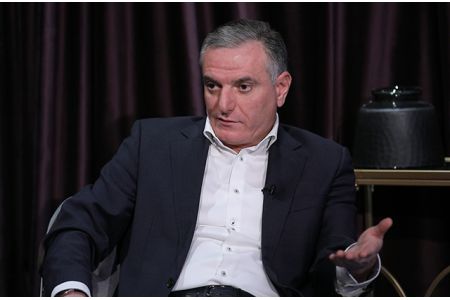
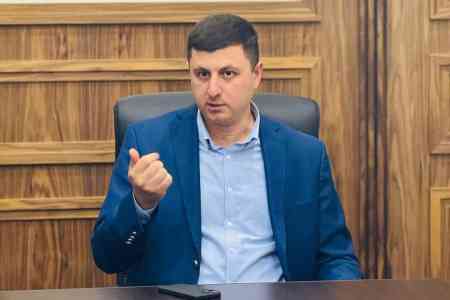
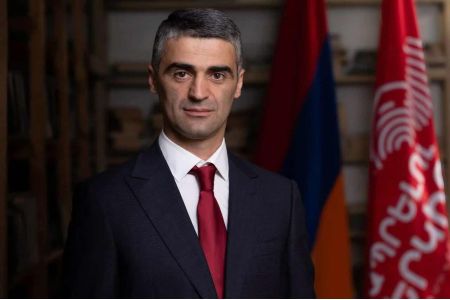
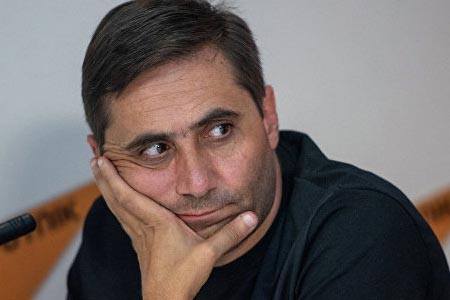
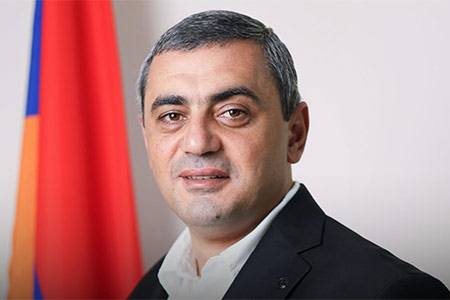
ArmInfo.The protracted conflict model in the Middle East proposed by Tehran could gradually undermine US dominance, while simultaneously facilitating China's expanding influence in global politics and economics. This opinion was expressed on his Facebook page by Artak Zakarian, a member of the board of the Republican Party of Armenia (RPA) and former Deputy Defense Minister.
He noted that, despite Washington's technological and economic superiority, Tehran has managed to engage it in a protracted, resource-intensive conflict. Zakarian believes that if this continues, the dynamics of the conflict and the conditions of warfare could soon change. "Traditionally, US strategy has been based on swift and localized actions aimed at achieving key results quickly. This model minimizes political and financial costs, avoiding protracted military engagement. However, Iran has chosen the opposite tactic, focusing on 'exhausting' the enemy's resources and expanding the geography of tension, including threatening the important energy route - the Strait of Hormuz," the politician explained.
As the politician noted, Iran is demonstrating a willingness to use control over shipping flows through the Strait as a tool to exert pressure on international markets, while simultaneously signaling a transition to yuan-denominated energy payments, which indirectly strengthens China's position.
"For Beijing, this dynamic opens up additional geopolitical opportunities. China is interested in weakening American influence on energy routes and developing an alternative payment system for raw materials. Growing instability in the Persian Gulf also increases Europe's dependence on logistics and financial systems, in whose development China seeks to play a major role," the politician explained.
According to Zakarian, Tehran's strategy relies not only on military instruments but also envisions a gradual increase in economic difficulties in Western countries. "Rising energy prices could increase pressure on the European economy, creating tensions in Western political systems. At the same time, Iran hopes for a change in the position of the Arab countries of the Persian Gulf. The current configuration of the conflict indicates that it is shifting from a military logic to a more complex geopolitical process," the RPA board member believes.
Therefore, according to the Republican, Iran is seeking to transform the confrontation into a protracted struggle, the main instruments of which will be energy resources, financial mechanisms, and regional alliances. "Overall, the protracted conflict model proposed by Tehran could gradually undermine US dominance while simultaneously facilitating China's expansion in global politics and economics. According to US Treasury Secretary Scott Bessent, due to the current situation, US President Donald Trump's visit to China, scheduled for March 31, may be postponed. It can be argued that the 'trade war' between China and the US continues, especially at this stage, at Iran's expense," the politician concluded.
As a reminder, on the morning of February 28, the US and Israel attacked Iran. In response, Iran is striking US bases in the Middle East. As a result of the US-Israeli aggression, Iran's Supreme Leader Ali Khamenei and several high-ranking Iranian military officials were killed. On March 8, the Iranian Council of Experts elected Ayatollah Seyyed Mojtaba Khamenei, the son of the late Ayatollah Ali Seyyed Khamenei, as the new Supreme Leader of the Islamic Republic of Iran.












 Expert: Economic pressure on Armenia may be virtually painless for other EAEU members, but not for Armenia itself
 Expert on protests in France: Civilizations fade when society loses a vision of the future
 Turkologist: Azerbaijan is not all-powerful—its vulnerabilities should become part of Armenia’s security strategy
 Opinion: The development of the Amulsar mine near the resort town of Jermuk is the beginning of an environmental disaster in Armenia
 Expert: The arrest of opposition figures in Armenia for social media posts is a systematic attempt to intimidate the public and suppress dissent.
 The Armenian Foreign Minister commented on the country`s return to work within the CSTO.
 The Artsakh Public Council expressed outrage at the UN Secretary-General`s behavior
 Lukashenko called for Armenia to assume the CIS presidency in 2029
 Dmitry Medvedev predicted a Ukrainian-like fate for Armenia amid the country`s shift in foreign policy
 Russian Security Council: In Armenia, they want to force Russian asset owners to dispose of their assets
 Zakharova: Russia ready to discuss with Armenia the prospects for expanding military cooperation as part of a review of bilateral ties
 Tevanyan: Armenia, like Ukraine and Moldova, is being drawn into the EU’s global war
 Yerevan City Hall is considering introducing a valet parking system in the city
 Expert: The circus surrounding the “Albanization” of Armenian culture in the presence of foreign ambassadors in occupied Artsakh is genocide
 Political scientist: If Russian-Armenian relations are destroyed, Turkey will take Russia`s place
 Political scientist: The Armenian public is simply obliged to significantly change the entire content of public discourse and struggle
 Cross tattoos are being removed from the skin of Christian prisoners in Azerbaijan by fire, according to a human rights activist.
 Zakharova: Armenia`s likely introduction of visas with Russia will be a step against Yerevan itself
 Putin: Armenia`s recognition of Karabakh as part of Azerbaijan in Prague has given Russia`s position on this issue an ambivalent character
 Putin: Armenia`s adoption of the law on EU accession means an announcement of its withdrawal from the Eurasian Economic Union