
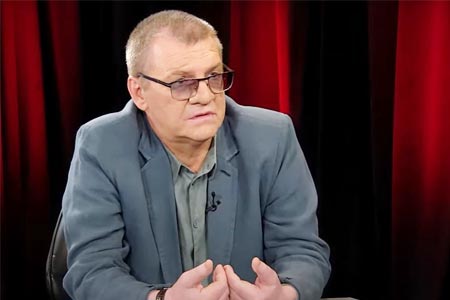
ArmInfo.Azerbaijani President Ilham Aliyev's harsh response to the "drone strikes" in Nakhichevan points to the possibility of a new hotspot in Syunik, Armenia, as stated by military and political analyst Alexander Tikhansky during a Minsk-Yerevan video conference "Will Trump Succeed in Drawing Turkey into a Conflict with Iran?"
In this regard, he noted that almost 40% of the Azerbaijani army is concentrated near the Iranian border. He also emphasized that the strikes are an obvious provocation, similar to the tactics used by Israel. "The issue of Syunik has become a pressing issue today. The provocation in Nakhchivan provides grounds for declaring the necessity to protect our compatriots and the possibility of occupying a 'corridor' under the pretext of a Gulf War. I'm not claiming this will happen. However, Aliyev's harsh response to the free riders indicates the possibility of another flashpoint emerging - in Syunik," the expert believes.
Speaking about the possibility of Turkey being drawn into the conflict at the initiative of US President Donald Trump amid these provocations, Tikhansky recalled that Turkey and Azerbaijan share the concept of "one nation, one state." However, he also noted that American interests in the region often conflict with Turkey's interests, particularly in the context of the Kurdish issue. "The US is prepared to arm Kurdish tribal leaders, who, by the way, have already firmly responded that they are not prepared to participate in this process. America's intention to draw them into the conflict runs counter to the interests of Turkey, for which the Kurdish issue is the number one domestic priority. In 2025, militants were trained in Iraqi Kurdistan to participate in protests and engage in armed action, but Kurdish intelligence agencies handed them over to Iran. This assistance from Turkey to Iran was indispensable, and played a significant role in suppressing these protests," the analyst recalled.
Nevertheless, he added that the Americans have the ability to galvanize Iranian Kurdistan and expressed conviction that such attempts will be made to win over certain forces to their side.
In turn, Alexander Kozlov, a PhD candidate in economics, noted that today even the Persian Gulf countries are expressing dissatisfaction with the US goals it pursued in establishing military bases on their territory. "They thought this would ensure security, but in reality, it became a magnet for problems. Today, the question arises about these countries' mistrust of the United States. In the next month, the situation could change dramatically: although the bombings continue and the rhetoric remains, active US assistance is not being provided. It is obvious, the messages the US sent to these countries-supposedly to maintain stability-are not true. This could result in countries beginning to turn away from the US, leading Turkey to align with countries more closely aligned with its interests," the expert concluded.
























 Analyst: The primary issue with Armenia`s new Parliament Speaker`s speech lies is its one-sided interpretation of the causes of the political crisis
 Expert: Gagik Tsarukyan embodies post-Soviet model of big business-state relations; this model is used in many other post-Soviet countries
 Expert: Azerbaijan promoting aggressive plans against Armenia at state level
 Iranologist: Baku`s propaganda of might masks the country`s inability to provide water to its own population
 NA Vice Speaker candidate believes his wife`s salary as director of HayPost is the lowest in the company`s history
 RF Permanent Representative: There is no CSTO-Armenia conflict
 Moscow: NATO seeking to "Pull" Armenia away from CSTO Allies
  Political analyst: Russia intends to determine which "Camp" Armenia will choose through a referendum
 Narek Karapetyan will give up his parliamentary salary in favor of charitable contributions.
 Armenia and France discuss further development of strategic partnership and EU cooperation
  To overcome risks Armenia must reduce domestic escalation - expert
  Zatulin: Pashinyan was eager to get back to Russia because he actually lost the elections
 Human rights activist Ruben Melikyan dismissed from YSU
 Zakharova: Armenia`s pro-EU pivot poses economic security risks to EAEU member states
 It`s time for South Caucasus countries to think of South Caucasus as single, unified region - RA premier
  Pashinyan: Armenia and Azerbaijan should leave each other alone
 Moscow sees situation with Armenia as attempt to attack Russia-involving integration associations - Russian presidential aid