
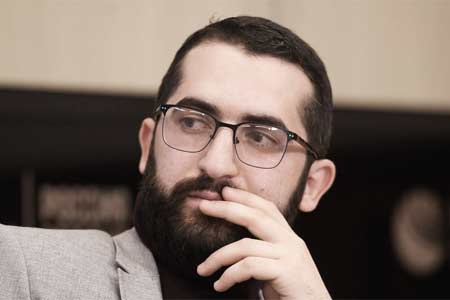
ArmInfo. Baku and Ankara continue to expand their instruments of influence over Iran, which could be used in the future. This opinion was expressed on his Facebook page by Varuzhan Geghamyan, a PhD candidate and Turkologist, considering the possible developments surrounding Iran, particularly in the context of potential actions by Azerbaijan and Turkey.
However, the expert noted that these are purely preliminary observations, which, if the situation changes, could lead to different consequences. Geghamyan expressed his conviction that military action against Iran at this stage cannot bring any real benefits to Azerbaijan, while at the same time creating numerous problems with potentially catastrophic consequences.
"Azerbaijan, geographically sandwiched between Russia and Iran, is incapable of waging a war against its southern neighbor on its own. Without Turkey's assistance, the country has extremely limited military capabilities, as evidenced by the war in Artsakh in 2020," the expert noted.
At the same time, the Turkologist continued, Turkish and Azerbaijani military systems have continued to integrate with each other in recent years, making any military operation impossible without cooperation and coordination with Turkey, especially against a state like Iran. According to Geghamyan, Turkey is also not interested in participating in military operations at this stage. "Pragmatic calculations show that, with limited options for action, Turkey expects to see Iran weakened by the war, not divided and fragmented. The latter, according to Turkish calculations, will be able to neutralize many problems, such as Kurdish separatism, but will be more dependent on Turkey," the Turkologist believes.
This strategic approach, as Geghamyan noted, forces both Turkey and Azerbaijan to act according to the unique logic of a "tactical pause": awaiting developments while preparing for possible scenarios, including ground operations on Iranian territory. The expert believes the latter scenario is currently unlikely, but he noted that it is entirely feasible if the Iranian central government is weakened.
Geghamyan then explained the two problems that the anti-Iranian rhetoric in Azerbaijan has been addressing in recent days. On the one hand, as the Turkologist noted, it is aimed at satisfying the high expectations of its own society that have developed since 2020, while on the other hand, to a certain extent, it serves the interests of external players, such as Israel.
"In this logic, new symbolic actions are possible, such as Iran's call to Azerbaijan (Iranian President Masoud Pezeshkian called Azerbaijani President Ilham Aliyev - ed.), which will further escalate tensions and deepen the conflict. At the same time, Baku and Ankara continue to expand their instruments of influence over Iran, which could be used in the future, for example, to demonstrate their capabilities among Iran's Turkic-speaking population," the expert noted, without specifying these instruments. In summary, Geghamyan noted that at this stage, he does not see any pragmatic calculations that would compel Azerbaijan to engage in military action against Iran in any format. However, he noted that there are also no signs that the situation will resolve in the coming days.
"On the contrary, it will worsen. Therefore, the situation may change, especially since it is impossible to completely control the growing tensions," the Turkologist concluded.
As a reminder, on the morning of February 28, the United States and Israel attacked Iran. In retaliation, Iran launched strikes against American bases in the Middle East. As a result of the US-Israeli aggression, Iran's Supreme Leader Ali Khamenei and several high-ranking Iranian military officials were killed.
On March 8, the Iranian Council of Experts elected Ayatollah Seyed Mojtaba Khamenei, the son of the late Ayatollah Ali Seyed Khamenei, as the new Supreme Leader of the Islamic Republic of Iran. On March 5, Azerbaijan accused Iran of a drone attack on Nakhchivan and threatened to take appropriate measures in response to this unfriendly move. Moreover, on March 6, Azerbaijan evacuated its diplomatic staff from Iran and closed the Azerbaijani-Iranian border for several days.
Iran denied any involvement in the attack on Nakhchivan. Furthermore, on the evening of March 7, a representative of the IRGC's Khatam al-Anbiya Central Command Center called on neighboring Azerbaijan to withdraw Zionists from its country and not to jeopardize the security of its own people and Islamic Iran, as well as to prevent the spread of instability in the region. At the same time, according to numerous analysts, Iran would never take irrational steps in the current situation, and the drone strike was most likely a provocation by a third party designed to create a pretext to draw Azerbaijan into the conflict.





















 Who and why is sacrificing RA National Security Service`s reputation? - expert
  Tehran creating security environment in which sustainable shipping in Strait of Hormuz difficult to imagine without its direct participation - expert
  Arrested Armenian oligarch on economy and new jobs
  NA Vice Speaker candidate believes his wife`s salary as director of HayPost is the lowest in the company`s history
 RF Permanent Representative: There is no CSTO-Armenia conflict
 Moscow: NATO seeking to "Pull" Armenia away from CSTO Allies
  Political analyst: Russia intends to determine which "Camp" Armenia will choose through a referendum
 Narek Karapetyan will give up his parliamentary salary in favor of charitable contributions.
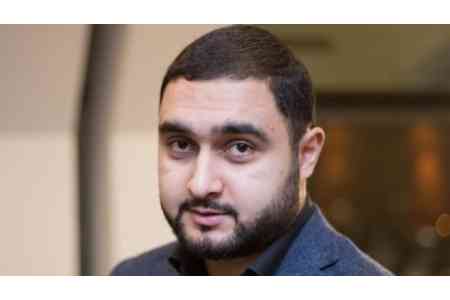 Armenian analyst: Developing relations with Europe and the U.S. must not jeopardize relations with regional powers
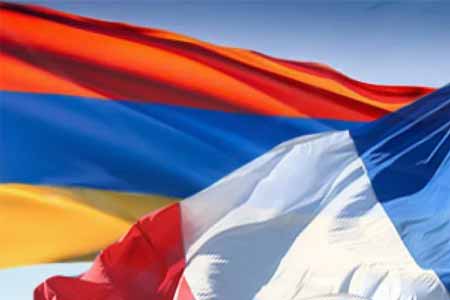 Armenia and France discuss further development of strategic partnership and EU cooperation
  To overcome risks Armenia must reduce domestic escalation - expert
 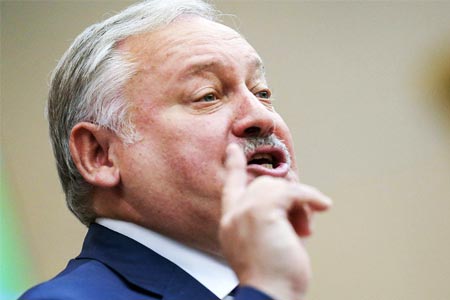 Zatulin: Pashinyan was eager to get back to Russia because he actually lost the elections
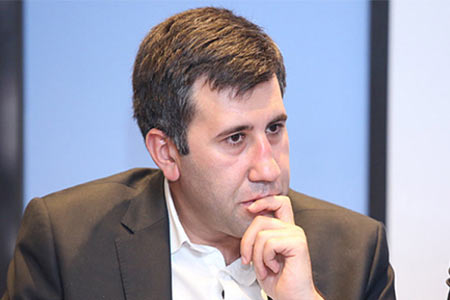 Human rights activist Ruben Melikyan dismissed from YSU
 Pashinyan removed from INNOPROM guest list
 Zakharova: Armenia`s pro-EU pivot poses economic security risks to EAEU member states
 It`s time for South Caucasus countries to think of South Caucasus as single, unified region - RA premier
  Pashinyan: Armenia and Azerbaijan should leave each other alone