

ArmInfo.The overwhelming majority of respondents in Armenia see a threat in Azerbaijan and Turkey, according to the results of a survey by the International Republican Institute (IRI).
When asked which country poses a political threat to Armenia's security, 80% of respondents indicated Azerbaijan, another 69% indicated Turkey, 29% indicated Russia, 10% indicated the United States, 6% indicated Georgia, 4% indicated Israel, 3% each indicated the EU, Ukraine, the UK, and Iran, 2% indicated Pakistan, and 1% each indicated France, Kazakhstan, China, and Belarus. 3% each indicated "nobody" and "I don't know."
When asked which countries they consider Armenia's most important political partners, 43% of respondents named Russia, 42% named the United States, 34% named Iran, 29% named the European Union, 27% named France, 21% named China, 18% named Georgia, 6% named India, 4% named the United Kingdom, 3% named Kazakhstan, 3% named Turkey, and 2% each named Azerbaijan and Ukraine. 2% gave a different answer, another 3% were undecided, and the remaining 3% said "none."
At the same time, when asked what Armenia's foreign policy should be, 17% stated only pro-European and pro-Western. Another 32% of respondents believe it should move toward the West but also maintain relations with Russia, 24% believe it should be pro-Russian but maintain relations with the EU and the West, 9% believe it should be pro-Russian, 5% gave a different answer, and 13% were undecided.
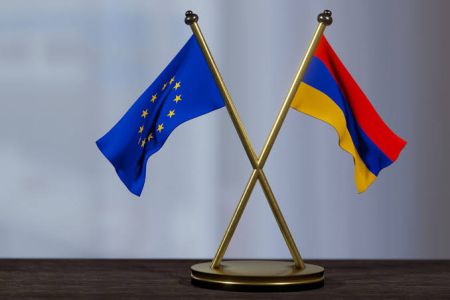
Regarding Armenia's European path, 33% said they fully support Armenia's EU membership, 39% said they partially support it, 14% said they partially oppose it, 10% said they oppose it, and 4% said they found it difficult to answer. Furthermore, 51% said they would vote for EU membership if there were a referendum next Sunday, 13% said they would vote against it, 32% said they would not participate in the elections, and 4% said they found it difficult to answer.
The survey was conducted by the International Republican Institute (IRI) Center for Survey Research and BREVIS (represented by IPSC LLC). Data were collected from February 3 to 13, 2026, using computer- aided telephone interviews (CATI). The sample consisted of 1,506 citizens of the Republic of Armenia over the age of 18 and former residents of Nagorno-Karabakh, forcibly displaced from Nagorno-Karabakh, who currently reside in Armenia (who may or may not be citizens). Citizens who have lived in Armenia for less than six months were not included in the sample. Telephone numbers were selected using random digit dialing (RDD). The survey response rate is 22%. The margin of error does not exceed +2.5 percentage points for the entire sample. The sum of numbers in the graphs may differ from 100 percent due to rounding.
























 Azerbaijani studies expert : Ruben Vardanyan’s wife threatened with arrest if she visits Baku
 Political scientist: The model of allied relations between Russia and Armenia has collapsed
 Expert: The defeated authorities` position on normalizing relations with the enemy should not affect the rights of Artsakh refugees
 Political scientist: If Russian-Armenian relations are destroyed, Turkey will take Russia`s place
 Political scientist: The Armenian public is simply obliged to significantly change the entire content of public discourse and struggle
 Cross tattoos are being removed from the skin of Christian prisoners in Azerbaijan by fire, according to a human rights activist.
 Zakharova: Armenia`s likely introduction of visas with Russia will be a step against Yerevan itself
 Putin: Armenia`s recognition of Karabakh as part of Azerbaijan in Prague has given Russia`s position on this issue an ambivalent character
 Putin: Armenia`s adoption of the law on EU accession means an announcement of its withdrawal from the Eurasian Economic Union
 Medvedev: Yerevan will never become an EU member, but it will permanently damage relations with the Eurasian Economic Union, including with Moscow.
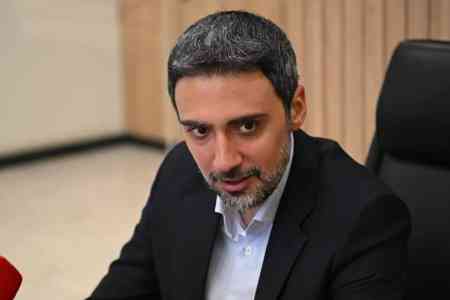 Aram Vardevanyan: Public demands solutions, not apology scandals in Parliament
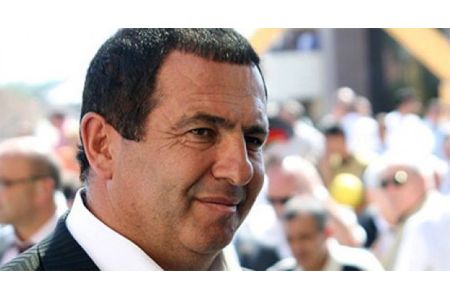 Arrested Armenian oligarch on economy and new jobs
 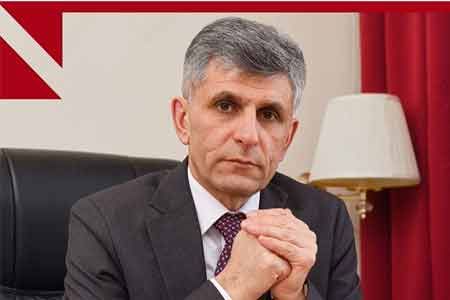 "In Baku, we gave a worthy rebuff to the false claims regarding the past and present of our people" – Former Artsakh Parliament Speaker from Baku captivity
 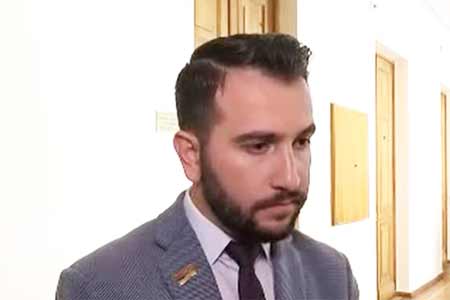 NA Vice Speaker candidate believes his wife`s salary as director of HayPost is the lowest in the company`s history
 RF Permanent Representative: There is no CSTO-Armenia conflict
 Moscow: NATO seeking to "Pull" Armenia away from CSTO Allies
  Political analyst: Russia intends to determine which "Camp" Armenia will choose through a referendum
 Narek Karapetyan will give up his parliamentary salary in favor of charitable contributions.