

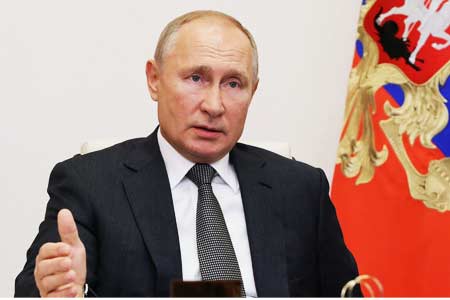
ArmInfo. Russia may halt gas supplies to EU markets early and reorient itself to more profitable buyers. Russian President Vladimir Putin stated this in an interview with VGTRK journalist Pavel Zarubin after talks with Hungarian Foreign Minister Peter Szijjarto.
He recalled that the European Union plans to impose restrictions on the purchase of Russian gas, including liquefied gas, in a month, and further restrict supplies in 2027, up to a complete ban.
"Perhaps it would be more profitable for us to stop supplies to the European market right now? To move to the emerging markets and gain a foothold there?" the Russian president wondered.
He noted that such a move would not have any political implications. "If they're going to shut us down in a month or two anyway, wouldn't it be better to stop now and go to countries that are reliable partners? And consolidate our position there," Putin said, adding that this isn't a finalized decision: he called it "just thinking out loud."
"The government still needs to work through this issue. At the same time, Russia will in any case continue supplying energy to countries that are reliable partners, such as Hungary and Slovakia," Putin stated.
He added that the recent surge in energy prices on the European market isn't directly related to supply restrictions, as the main suppliers (Algeria, the United States, Norway, and Russia) haven't reduced their volumes. "The reason, the president believes, lies in the EU authorities' misguided policies over many years, as well as the overall situation on global markets due to events in the Middle East and the closure of the Strait of Hormuz. Premium buyers willing to pay more have emerged, and suppliers are moving to higher prices. It's just business, that's all," the Russian leader concluded.
Following the joint US-Israeli attacks on Iran, Tehran's retaliatory strikes, and the rise in the geopolitical risk premium, oil and gas prices have accelerated.
Amid limited liquidity in global markets, the price of Brent crude jumped to $80.80 per barrel during the Asian session on March 2, a nearly 15-month high. WTI was at $73.71 per barrel at the same time.
According to the US Energy Information Administration (EIA) and market forecasts, if the conflict and disruptions in physical supply continue, strategic reserves will be able to only partially offset the global shortage, and oil prices could reach $85-$150 per barrel.
The sharp reduction in tanker transit through the strategically important Strait of Hormuz, through which approximately 20% of global liquefied natural gas (LNG) trades, increases the risk of disruptions and puts pressure on gas prices, particularly in Europe. In Europe, on the largest Dutch virtual trading platform, TTF, April contracts closed on February 27 at ?31.95 per megawatt-hour. Amid the escalating geopolitical situation, the price jumped 38.4% to ?44.50 on March 2. By March 3, the price had reached ?53.35 per megawatt-hour, an increase of 19.9%.







 Expert: The arrest of opposition figures in Armenia for social media posts is a systematic attempt to intimidate the public and suppress dissent.
 Azerbaijani Studies Expert: While Azerbaijan Prepares Its Generation for War, Aliyev’s Aide Calls on Armenia to Prepare Armenian Society for “Peace”
 Turkologist: Azerbaijan will never, under any circumstances, stop pressuring the Armenian people
 Political scientist: We need to move away from the question of "when" and replace it with more important questions
 International Law Specialist: Azerbaijan intends to initiate legal proceedings against Armenia by sentencing Armenian prisoners
 Lukashenko called for Armenia to assume the CIS presidency in 2029
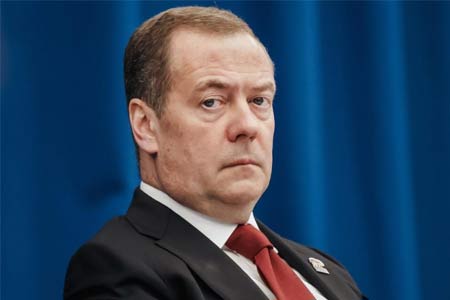 Dmitry Medvedev predicted a Ukrainian-like fate for Armenia amid the country`s shift in foreign policy
 Russian Security Council: In Armenia, they want to force Russian asset owners to dispose of their assets
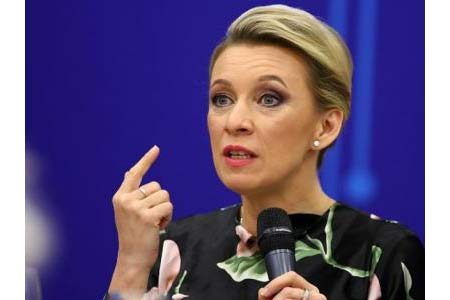 Zakharova: Russia ready to discuss with Armenia the prospects for expanding military cooperation as part of a review of bilateral ties
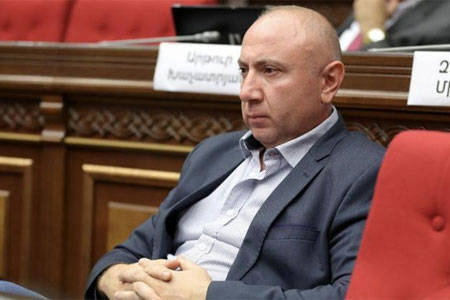 Tevanyan: Armenia, like Ukraine and Moldova, is being drawn into the EU’s global war
 Yerevan City Hall is considering introducing a valet parking system in the city
 Expert: The circus surrounding the “Albanization” of Armenian culture in the presence of foreign ambassadors in occupied Artsakh is genocide
 Political scientist: If Russian-Armenian relations are destroyed, Turkey will take Russia`s place
 Political scientist: The Armenian public is simply obliged to significantly change the entire content of public discourse and struggle
 Cross tattoos are being removed from the skin of Christian prisoners in Azerbaijan by fire, according to a human rights activist.
 Zakharova: Armenia`s likely introduction of visas with Russia will be a step against Yerevan itself
 Putin: Armenia`s recognition of Karabakh as part of Azerbaijan in Prague has given Russia`s position on this issue an ambivalent character
 Putin: Armenia`s adoption of the law on EU accession means an announcement of its withdrawal from the Eurasian Economic Union
 Aram Vardevanyan: Public demands solutions, not apology scandals in Parliament