

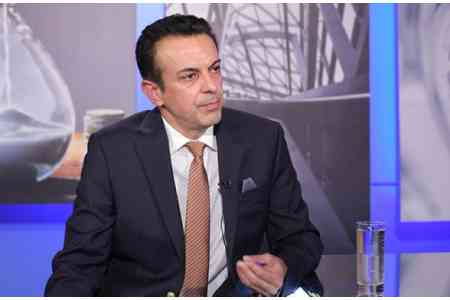
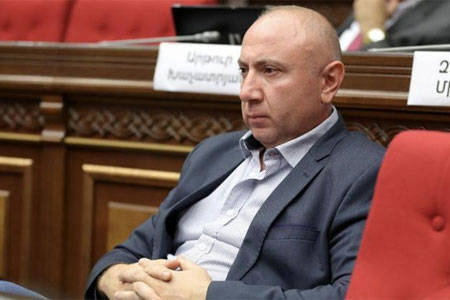
ArmInfo. In Iran, a repetition of the Syrian or Libyan scenario is possible, with an attempt to deploy so-called security forces on its territory, as stated by Artur Khachikyan, Stanford University political scientist and doctor of political science, when discussing possible scenarios for developments around Iran.
He noted that the US and Israel initially planned to eliminate the military and political leadership in order to immediately change the regime in Iran. However, as the political scientist noted, they failed to do so. Therefore, Khachikyan believes that attacks against Iran will continue at a more intense rate and may escalate into a large-scale conflict. "Hospitals and schools are being destroyed, and the death toll among civilians has already reached 800. An attempt is being made to decapitate the Iranian leadership so that a new one willing to make concessions can take its place," the political scientist wrote on his Facebook page.
Khachikyan also mentioned the possibility of provoking civil unrest or an ethnic war to destabilize Iran and force its capitulation as another possible scenario. "That is, a repetition of the Syrian or Libyan scenario is possible. This could mean that some forces will attempt to deploy so-called security forces on Iranian territory, as was done, for instance, in Syria," Khachikyan noted.
The political scientist pointed out the possibility of using local forces to achieve these goals, such as Kurds or other national minorities. In this regard, he noted that Iran is home to Arabs, Persians, and Azerbaijanis, meaning that approximately 50% of the population consists of minorities that could be used to destabilize the country. "The US and Israel will continue to destroy Iran's leadership from the air and provoke civil war, ethnic clashes, and conflicts on the ground in order to force Iran to capitulate," the expert believes.
In this situation, Khachikyan noted, the point is how long Iran will be able to withstand these challenges. He also emphasized that it is no easy task for the United States, as military equipment is limited, as even the US military leadership has already stated. Furthermore, the political cost is high, noting that complaints are being heard around the world, even in Manila, India, Iraq, Pakistan, and many major American cities.
"US President Donald Trump came to power promising to establish peace, but it was precisely with his arrival that many wars began. Continuing the war will have negative consequences for the country itself, for example, an economic crisis is possible - oil and gas prices have already skyrocketed, political pressure is also growing, and complaints are being heard around the world," Khachikyan concluded.





























 Azerbaijani studies expert : Ruben Vardanyan’s wife threatened with arrest if she visits Baku
 Political scientist: If Russian-Armenian relations are destroyed, Turkey will take Russia`s place
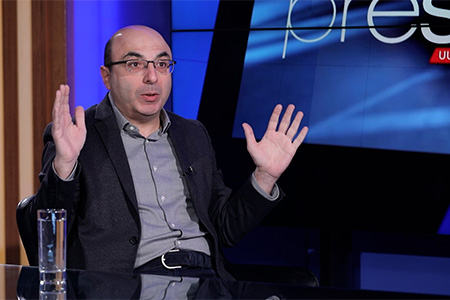 Political scientist: The Armenian public is simply obliged to significantly change the entire content of public discourse and struggle
 Cross tattoos are being removed from the skin of Christian prisoners in Azerbaijan by fire, according to a human rights activist.
 Zakharova: Armenia`s likely introduction of visas with Russia will be a step against Yerevan itself
 Putin: Armenia`s recognition of Karabakh as part of Azerbaijan in Prague has given Russia`s position on this issue an ambivalent character
 Putin: Armenia`s adoption of the law on EU accession means an announcement of its withdrawal from the Eurasian Economic Union
 Medvedev: Yerevan will never become an EU member, but it will permanently damage relations with the Eurasian Economic Union, including with Moscow.
 Aram Vardevanyan: Public demands solutions, not apology scandals in Parliament
 Arrested Armenian oligarch on economy and new jobs
  "In Baku, we gave a worthy rebuff to the false claims regarding the past and present of our people" – Former Artsakh Parliament Speaker from Baku captivity
  NA Vice Speaker candidate believes his wife`s salary as director of HayPost is the lowest in the company`s history
 RF Permanent Representative: There is no CSTO-Armenia conflict
 Moscow: NATO seeking to "Pull" Armenia away from CSTO Allies
  Political analyst: Russia intends to determine which "Camp" Armenia will choose through a referendum
 Narek Karapetyan will give up his parliamentary salary in favor of charitable contributions.