

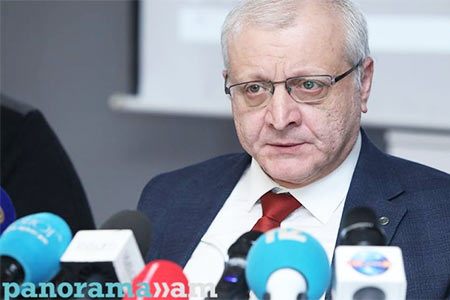
ArmInfo. Armenia's main problem is not the threat of external interference, but a crisis of domestic political legitimacy. This opinion was expressed on Facebook by political scientist Suren Surenyants, leader of the Democratic Alternative party, in response to reports that Armenia has requested a hybrid rapid response team from the EU "to counter Russia ahead of the parliamentary elections in Armenia scheduled for June 7, 2026."
As Surenyants noted, a substantive analysis shows that this is a case of electoral manipulation. He asserted that Armenian Foreign Minister Ararat Mirzoyan's official request to the European Union to send a "hybrid rapid response team" to Yerevan already alters the logic of the electoral process. "Essentially, an external entity is invited to participate in shaping and monitoring the electoral environment at the direct request of the current government. The key problem with this approach is the politicization of the concept of 'disinformation.' In practice, it becomes a tool for restricting narratives politically undesirable to the government, rather than a means of combating false information. When the government and a foreign partner jointly decide which statements are considered dangerous, elections cease to be a competition of free ideas and become a controlled information environment," the party leader explained.
The political scientist recalled that a similar model has already been used in Moldova and Brussels, noting that it is a model in which the content of elections is pre-managed. "That is, the government identifies itself with 'democracy,' while the opposition or alternative political rhetoric is automatically presented as the result of external influence. Voters cease to be seen as independent political actors and are perceived as a threat from which they themselves must be protected. It is no coincidence that this approach has been criticized within the West itself," the political scientist noted.
Sureniants recalled that even US Vice President J.D. Vance noted at the Munich Security Conference last year that control of the media and technocratic management of the electoral process in the name of democracy lead not to the protection of democracy, but to its destruction. "In Armenia's case, the problem is not the threat of external interference, but a crisis of domestic political legitimacy. This crisis is not resolved by external 'rapid response teams.' On the contrary, such interventions deepen public mistrust and present election results as the result of foreign political patronage. If constant external intervention is necessary to organize elections, can they still be considered free elections in a sovereign state?" the political scientist concluded.
Recall that Radio Liberty previously reported that it had obtained a letter from Armenian Foreign Minister Ararat Mirzoyan to Brussels, in which he "requested that a rapid response team be sent to Yerevan to counter Kremlin disinformation and Russian interference in the parliamentary elections in Armenia, and then, perhaps, a more permanent civilian mission." In this regard, it was recalled that the EU sent a similar team of approximately 20 people to Chisinau during last year's parliamentary elections "to help the Moldovan authorities identify and counter disinformation emanating from Russia on social media." It should be added that the EU's top diplomat, Kaja Kallas, had previously announced the allocation of EUR 15mln to Armenia to "counter Russian propaganda."







 Expert: Economic pressure on Armenia may be virtually painless for other EAEU members, but not for Armenia itself
 Expert on protests in France: Civilizations fade when society loses a vision of the future
 Turkologist: Azerbaijan is not all-powerful—its vulnerabilities should become part of Armenia’s security strategy
 Opinion: The development of the Amulsar mine near the resort town of Jermuk is the beginning of an environmental disaster in Armenia
 Expert: The arrest of opposition figures in Armenia for social media posts is a systematic attempt to intimidate the public and suppress dissent.
 The Armenian Foreign Minister commented on the country`s return to work within the CSTO.
 The Artsakh Public Council expressed outrage at the UN Secretary-General`s behavior
 Lukashenko called for Armenia to assume the CIS presidency in 2029
 Dmitry Medvedev predicted a Ukrainian-like fate for Armenia amid the country`s shift in foreign policy
 Russian Security Council: In Armenia, they want to force Russian asset owners to dispose of their assets
 Zakharova: Russia ready to discuss with Armenia the prospects for expanding military cooperation as part of a review of bilateral ties
 Tevanyan: Armenia, like Ukraine and Moldova, is being drawn into the EU’s global war
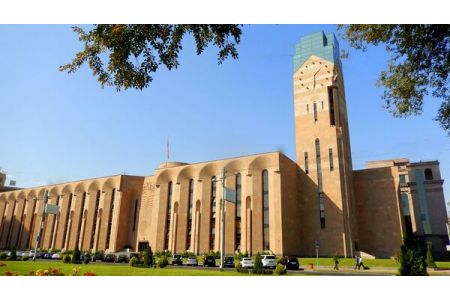 Yerevan City Hall is considering introducing a valet parking system in the city
 Expert: The circus surrounding the “Albanization” of Armenian culture in the presence of foreign ambassadors in occupied Artsakh is genocide
 Political scientist: If Russian-Armenian relations are destroyed, Turkey will take Russia`s place
 Political scientist: The Armenian public is simply obliged to significantly change the entire content of public discourse and struggle
 Cross tattoos are being removed from the skin of Christian prisoners in Azerbaijan by fire, according to a human rights activist.
 Zakharova: Armenia`s likely introduction of visas with Russia will be a step against Yerevan itself
 Putin: Armenia`s recognition of Karabakh as part of Azerbaijan in Prague has given Russia`s position on this issue an ambivalent character
 Putin: Armenia`s adoption of the law on EU accession means an announcement of its withdrawal from the Eurasian Economic Union