

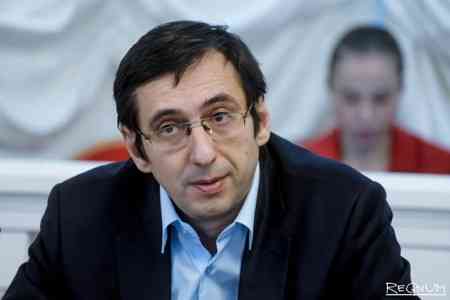
ArmInfo.Political and geopolitical contradictions surrounding the "Trump Route for International Peace and Prosperity" (TRIPP) not only remain unresolved but continue to escalate, as stated by Andrey Areshev, a political observer and expert at the Strategic Culture Foundation, during a Moscow-Yerevan video conference, while discussing developments unfolding in the South Caucasus.
First and foremost, the expert noted that signals are coming from Iran, which, as Areshev recalled, is in a difficult situation, given the growing threat of an American strike and tense negotiations with the United States. "Nevertheless, Iran remains a serious player, and it's no coincidence that immediately after US Vice President J.D. Vance's visit, it was announced that Armenia and Iran could sign some kind of strategic agreement this year," the political scientist noted.
At the same time, Areshev continued, the Russian side is undergoing a rather complex process of preparing for negotiations. He recalled that Russia, represented by Deputy Prime Minister Alexei Overchuk, has repeatedly confirmed its interest in negotiations regarding the country's possible participation in communications projects in Armenia. "And we see various extra-regional forces also clearly expressing their interests in unblocking or, conversely, continuing to block certain transport routes. For example, there is increasing talk of using the 'Trump Route' for the export and transit of rare earth metals and other minerals. In other words, this route is being considered as part of the so-called Middle Corridor, designed to connect Turkey and Central Asia. At the same time, it is clear that this project could become the site of further US-Chinese, US-Iranian, or other conflicts, which would negatively impact its operation, especially considering that work is only in the initial stages," the expert noted, recalling that the President of Azerbaijan mentioned 2028 as a possible launch date for the route. Areshev pointed out that it concerns the construction of roads that will be used for various purposes, and not always for commercial gain. "Transportation is not always commercial in nature; in some cases, even frequently, it has a geopolitical component," the expert believes.
For example, he says, the Meghri section is being considered as the so-called Middle Corridor, which is envisioned as a route bypassing Russia, connecting Central Asia and the Caspian shores through the Caucasus with Turkey and Europe. "It's no coincidence that both Europeans and Americans are showing considerable interest in this route. However, given the growing disagreements between the European Union and the United States, I'm far from certain that Washington and Brussels will act in concert on Caucasus issues. This, incidentally, creates further division and could have unpredictable consequences," the political scientist noted. According to him, various interest groups are present in Armenia's Syunik-ranging from the European monitoring mission to Russian border guards-and Azerbaijan is nearby. Turkey has a significant presence in Nakhichevan, and Iran is on the opposite bank of the Araks River. "Listing these countries provides an objective picture of what's happening in the region-the involved forces and their interests. This could all play out in completely different ways, and various scenarios are not excluded in the coming years. For example, we must understand that where logistics are involved, there could also be a military presence, which is of interest to Turkey and other players," Areshev concluded.
























 Politician: The Moldovan scenario in Armenia will lead to revolution
 American agenda in South Caucasus has two priorities: TRIPP project and increasing pressure on Iran - expert
 Hungary to stop issuing worker visas to citizens of the Philippines, Georgia, and Armenia
 Russia is counting on holding the next "3+3" meeting in Baku or Yerevan
 Robert Kocharyan: Peace treaty with Azerbaijan will include guarantees for peace
 Edmon Marukyan: 1.7mln people must go to polls, and this government will be crushed
 Armenian authorities have turned country into center of a geopolitical struggle - Samvel Karapetyan
  Expert: Pashinyan is finished if most voters go to polls
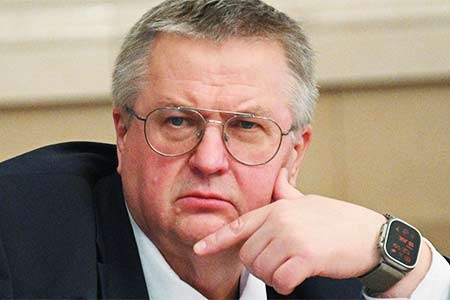 It is up to Armenia to decide what kind of jam it will make - RF vice-premier
  Russia again warns Armenia against following Ukraine`s path
 Kocharyan: We go to elections with proven experience and lessons learned
 Europe stands in solidarity with Armenia in the face of the economic coercion by Russia- European Commissioner