


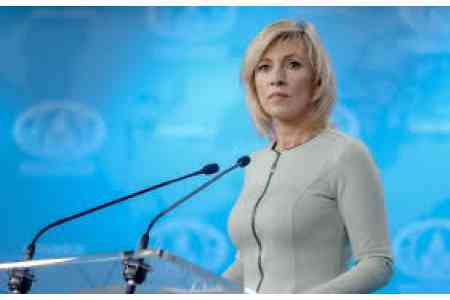
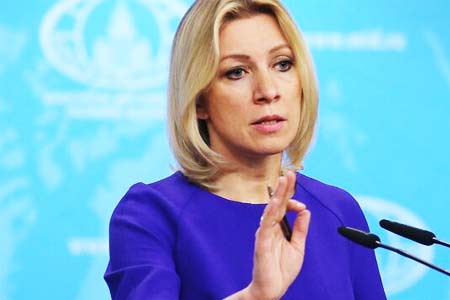
ArmInfo. No precise details were provided regarding the announced $9 billion project to build American small modular reactors in Armenia. This was stated by Russian Foreign Ministry spokesperson Maria Zakharova during a weekly briefing on February 12, in response to a request for comment.
In this regard, she stated that after these decisions, out of personal curiosity, she decided to inquire about these reactors.
At the same time, Zakharova noted that a number of Armenian media outlets rushed to present this news as "unprecedented Washington investments" in the republic's economy. "I just want to say that the most important thing is to use the unprecedented in the sense that nothing like this has ever happened before, and never will. Because in reality, it turns out that it's not the Americans who are being asked to pay for all this, but Yerevan. Moreover, as was stated, the funds will be channeled through the yet-to-be-created TRIPP fund, which is supposedly being conceived for other infrastructure projects. So, it's all very murky," she noted.
Zakharova also discussed energy issues and energy matters in detail, drawing attention to materials on the construction of a nuclear power plant, which the Russian side regularly discussed with Yerevan at various levels. She noted that the Russian state corporation Rosatom also regularly comments on this topic, and that Russian Deputy Foreign Minister Mikhail Galuzin previously commented on the parameters of Moscow's possible participation in the TRIPP (Trump Route for International Peace and Prosperity) project.
"Of course, Armenia is free to work with any partners it deems necessary. However, the choice of American technology raises questions. The small nuclear power plants proposed and proposed by Washington do not exist, let alone in the United States. They don't exist at all. They exist only on paper," she noted, adding that she tried to find places to "see these energy wonders" but couldn't find any. The Russian diplomat also noted that, according to experts, the final cost of such a plant for clients could be significantly higher than the estimated cost featured in advertising brochures. According to Zakharova, it's a well-known fact that the project to build small modular reactors in the United States was shelved in 2024 after costs jumped from an initial $5 billion to $10 billion.
"There are some estimates that Armenia will essentially be used, at its own expense, as a testing ground for American technologies that are essentially unproven." Experts immediately asked another question: "What will happen to the waste?" "Where will they be buried? On Armenian territory, in the Armenian Highlands?" the Russian diplomat noted.
Zakharova then proposed returning to Russia and energy cooperation with Armenia. "We have been Yerevan's reliable partner in the nuclear industry for decades. I'll even remind you of the facts: in 1995, Russia helped restore and restart the Armenian Nuclear Power Plant. Throughout these years, our country has supported its operation-with maintenance and fuel supplies. With our assistance, a project to extend its service life until 2026 was implemented, thanks to which the Armenian Nuclear Power Plant is operating today. We are currently working together on another project, another extension of the plant's life until 2036. And I would like to note that Russia is the only country that already operates a small-capacity nuclear power plant," the official representative of the Russian Foreign Ministry noted.
She also emphasized that the Russian side has repeatedly offered its partners proven Russian solutions across all plant capacity ranges: small, medium, and large. According to her, the Russian side has demonstrated options whereby nuclear energy retains a significant role in the republic's energy balance, thereby contributing to energy sovereignty. "The competitive advantages of domestic technologies have been presented to the Armenian side on numerous occasions. The most recent instance, for example, was on February 6 during a meeting between Rosatom head Alexey Likhachev and Armenian Parliament Speaker Alen Simonyan during his official visit to the Russian Federation. We have discussed this issue repeatedly during meetings of the bilateral intergovernmental commission on economic cooperation, and given the nature of bilateral relations between our countries, we are ready to explore preferential financial models. We have repeatedly spoken to the Armenian side about this. These proposals remain on the table," Zakharova emphasized.
As a reminder, the possibility of constructing several small modular nuclear reactors with a capacity of 50- 60 MW was previously discussed in Armenia. Moreover, their construction in several regions of the country was even considered. However, one of the most significant challenges in this area is the lack of reactor management skills among Armenian nuclear scientists. Previously, Gera Sevikyan, Advisor to the Director General of the Armenian Nuclear Power Plant, told ArmInfo that a fundamental decision had been made to build a new unit in the country using the Russian TOI reactor with a capacity of 1,200 MW. However, as Gnel Sanosyan, Minister of Territorial Administration and Infrastructure of the Republic of Armenia, subsequently noted, constructing a unit of such capacity is fraught with problems, since the capacity of Armenia's entire energy system remains the same: 1,200 MW. Later, Armenian Prime Minister Nikol Pashinyan announced that the country had made a fundamental decision to build a modular nuclear reactor. Moreover, according to Armenian authorities, the country of production for the modular nuclear power plant will be determined in 2026-2027.


























 Lawyer: according to preliminary results, Pashinyan`s party lacks 2/3 majority necessary to amend Armenia`s Constitution
 Politician: With high voter turnout, current government to no chance
 Political analyst: Relatively high turnout indicates that Armenian citizens are actively and consciously shaping the country`s future
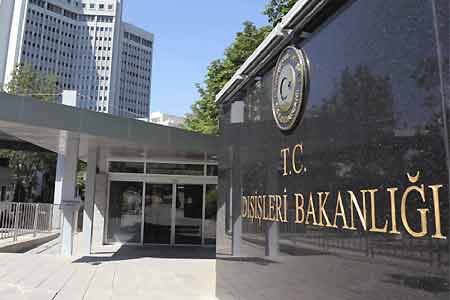 Turkish MFA comments on results of Armenian elections
  Zakharova: International observers cannot ignore `flagrant violations` in Armenian elections
 Strong Armenia to issue statement after vote count completed - Narek Karapetyan
 Russian Senator: Opposition complaints regarding election violations by ruling party remain unanswered
 RA premier receiving congratulations on his victory in parliamentary elections
 Head of IPA CIS Council Secretariat: Extremely difficult atmosphere during parliamentary elections campaign in Armenia accompanied by mass arrests
 Pashinyan`s party leads with 51.13% based on vote counts from 533 polling stations
 Voting in parliamentary elections in Armenia ends
  Strong Armenia: Administrative Court not providing judicial decisions to citizens wishing to vote in parliamentary elections