
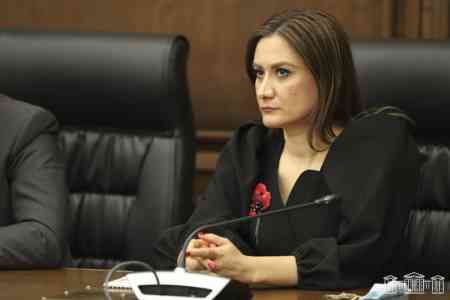
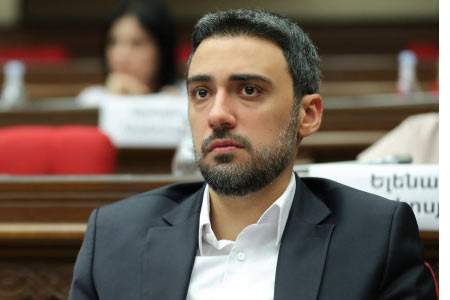
ArmInfo. An extraordinary session of the National Assembly of the Republic of Armenia has begun in Armenia, with only one item on its agenda: amendments to the Electoral Code. The amendments were sponsored by MPs from the ruling Civil Contract faction, Arusyak Dzhulakyan, Vladimir Vardanyan, and Lilit Minasyan. The document is planned to be considered in two readings.
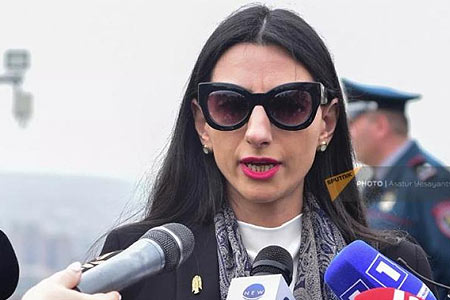
Introducing the legislative initiative, Arusyak Dzhulakyan noted that the amendments are aimed at regulating issues related to election observation missions. Election observation missions, Dzhulakyan noted, participate in the electoral process as public oversight bodies, whose main task is to provide an independent, objective, and impartial assessment of the electoral process in order to help ensure the legitimacy and credibility of elections. This goal can only be achieved if missions and observers act politically neutrally and impartially. This mission can only be fulfilled if observers maintain political neutrality and refrain from any actions or statements that could be perceived as supporting or opposing any political force, candidate, or political position. The political neutrality of observers is fundamental to ensuring the credibility, transparency, and legitimacy of elections. According to the OSCE/ODIHR guidelines, observation missions are obligated to act independently and impartially, refrain from making political judgments during the electoral process, and not interfere in the organization of elections or political competition.
However, as Dzhulakyan noted, the legal regulation of the electoral process in the Republic of Armenia is not fully settled. This process is based on the principles of free, fair, transparent, and competitive elections. Observer missions participate in it as independent and non-political entities, whose goal is to exercise public oversight of the electoral process. According to Article 30 of the Electoral Code of the Republic of Armenia, the right to conduct an observation mission is granted to those organizations in the Republic of Armenia that, among other things, do not support candidates or parties participating in the elections. Part 2 of Article 32 of the Electoral Code of the Republic of Armenia stipulates that, when exercising their rights, observers are obligated to be impartial, neutral, not publicly express a biased position, and not display a biased attitude toward any issue related to the government or the opposition, candidates or parties participating in the elections. The obligation of political neutrality directly follows from this legal status of the observer. Article 23 of the Electoral Code of the Republic of Armenia prohibits organizations and observers accredited to conduct observation missions from engaging in election campaigning. Public expression of a political position by an observer may be considered covert or indirect propaganda, contrary to electoral law. An analysis of international standards and the aforementioned provisions of Armenian legislation clearly demonstrates that the political neutrality of observation missions is a legal obligation, political bias is incompatible with observer status, and violation of neutrality may be considered indirect interference in the electoral process.
However, the legislation of the Republic of Armenia does not establish sufficient mechanisms to ensure the fulfillment of the obligation of political neutrality and impartiality by observation missions. The presented draft aims to ensure compliance with this requirement of legislation and international standards. Specifically, it clarifies the criteria that a non-governmental organization registered in the Republic of Armenia must meet in order to conduct an observation mission during elections held in the Republic of Armenia. The draft also emphasizes the need for transparency in the activities of non-governmental organizations and foundations conducting observation missions, including financial transparency, based on the premise that organizations striving to ensure election transparency must also be transparent and accountable to the public. The draft also clarifies the procedure for submitting an application for accreditation to the Central Electoral Commission.
The document differentiates the statutory accreditation periods for observers who are citizens of the Republic of Armenia and for observers who are not citizens of the Republic of Armenia and who are accredited by non-governmental organizations registered in the Republic of Armenia. Specifically, it stipulates that applications for accreditation by observers who are not citizens of the Republic of Armenia may be submitted no later than 15 days before election day. This provision is necessary for national security reasons. The draft also clarifies the grounds for rejecting an application for accreditation of an observation mission, as well as for revoking an observation mission's accreditation.
Vahagn Aleksanyan, a member of parliament from the ruling Civil Contract faction, noted that political passivity has been observed on the part of the parliamentary opposition, which can be interpreted as the latter's acceptance of the low probability of its entry into the new parliament. "The developments show that you have been advised to leave politics, since your statements are lowering the opposition's ratings, and another party, led by a Russian oligarch, will now take over politics in your place. If this is true, then say so; if not, also say so," the ruling party member stated.
In response, Artsvik Minasyan, secretary of the opposition Armenia faction, noted that Aleksanyan's speech indicates panic within the ruling political force. "It is more than obvious to everyone that the ruling majority is guided by these orders and decrees, and is guided by the orders of one person who is striving for dictatorship. The draft presented today is clear evidence of this," Minasyan said. He added that the opposition had proposed in-depth discussions on the Electoral Code, but the pro-government forces refused, intending to adopt this crucial document in just one hour. "We consider such behavior unacceptable. The proposed bill is aimed at the authorities' attempt to completely take control of the electoral process and legitimize the falsification of the upcoming elections. We reject all of this, draw the attention of international organizations to this issue, and declare that we will not participate in discussions on the proposed document, which is yet another manifestation of the Armenian authorities' anti-state and anti-people policies," the opposition leader noted.














 Opinion: Following Berlin talks, Baku gains expanded influence within EU and strengthens cooperation ties with main European powerhouse
 Armenian Analyst: One of the Key Tasks of the United Opposition is to Form Effective Mechanisms to Contain the Armenian Authorities
 Armenian expert: Could modern Azerbaijan even exist without Russian and Soviet modernization?
 South Caucasus is entering a new phase of turbulence - ex-official
  Zatulin: Pashinyan was eager to get back to Russia because he actually lost the elections
 Human rights activist Ruben Melikyan dismissed from YSU
 Pashinyan removed from INNOPROM guest list
 Zakharova: Armenia`s pro-EU pivot poses economic security risks to EAEU member states
 It`s time for South Caucasus countries to think of South Caucasus as single, unified region - RA premier
  Pashinyan: Armenia and Azerbaijan should leave each other alone
 Moscow sees situation with Armenia as attempt to attack Russia-involving integration associations - Russian presidential aid
 Zakharova: Armenia views relations with Russia as tool for financially securing reorientation toward EU
 The Armenian Minister of Justice and the EU Ambassador discussed visa liberalization issues for Yerevan.
 Azerbaijan`s aggressive plans against Armenia became possible in wake of Pashinyan`s decisions on Artsakh - expert
  Zakharova: Russia sent a note of protest to Armenia over the act of vandalism at the "Mother Armenia" memorial in Gyumri
 Samvel Karapetyan proposes creating a post-election opposition coalition
 Artsakh`s Cultural Heritage Ombudsman called on Moscow to respond to destruction of WWII monuments by Azerbaijan in occupied NKR