

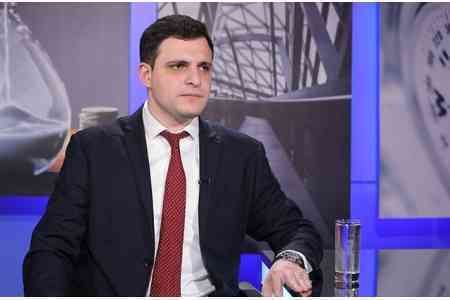
ArmInfo. Although the likelihood of the Iranian regime remaining stable amid the protests that have erupted in Iran remains quite high, Armenia should remain an active observer and prepare for the worst, as noted by orientalist Sergey Melkonyan in an interview with an ArmInfo correspondent, speaking about the protests that erupted in Iran on December 28 following the collapse of the Iranian rial and soaring food prices. In response to the situation, the Ministry of Foreign Affairs of the Islamic Republic of Iran, in a statement on December 8, condemned "hypocritical statements by American officials" regarding domestic events in Iran, calling "the US position of maximum pressure, threats, and interference in Iran's internal affairs aimed at inciting violence and terrorism, as well as creating unrest and instability in the country."
Reacting to the situation, Melkonyan pointed out that the Iranian leadership has a history of successfully resisting large-scale external interventions. He mentioned that previous similar interventions in Iran's affairs had actually backfired. "Instead of achieving goals related to regime change or its collapse, as they are formulated in Israel or the United States, Israeli strikes, supported by American and other allies, led to the consolidation of society around the regime in the face of external threat," the orientalist recalled.
Therefore, according to the expert, the consequences could vary significantly. For example, as Melkonyan noted, the protests could continue to spiral, and then an external attack would be directed not at the security system, but, for example, at the locations of the political leadership. The orientalist noted that the protests in Iran initially had a socio-economic basis and only gradually transformed into politically oriented ones, with demands for regime change in some regions of the country.
According to Melkonyan, there are two main scenarios for how the situation would unfold. "First, the regime remains intact, and the leadership maintains its position. In this case, two sub-scenarios are possible: either the regime tightens internal regulations, or it begins to implement further reforms, as was the case, for example, with the hijabs or the resignation of the head of the Central Bank. If external intervention occurs, the scenarios could vary: consolidation around the leadership is possible amid a general external threat, as well as negative consequences, such as targeted political assassinations or a threat to the current leadership," the expert believes. However, as the orientalist pointed out, although the protests have a broad geographic reach, they are primarily occurring not in large cities, but among rural populations. "There is a protest movement in the capital, but it is small and primarily related to economic issues. This is precisely what complicates the leadership's response, as the protests are erupting in sparsely populated regions where security forces are limited. However, given the experience and flexibility of the current Iranian leadership, they will likely be able to quell the protests and reach a new social contract," Melkonyan noted.
The expert also noted that Armenia will need to be prepared for other developments. He noted this includes a possible refugee flow and the spillover of conflicts from one area to another, the so-called "spillover effect." "One of the most radical scenarios in this case is an attempt to exploit the ethnic card. In this context, the most pressing option could be the use of the Azerbaijani population for separatist purposes, accompanied by a nationalist discourse and aimed, among other things, at Armenia," the expert clarified.
Furthermore, Melkonyan noted that Armenia borders Azerbaijani provinces in Iran, which, he said, creates additional risks. He also noted the risk of economic issues, given that approximately 30% of Armenia's exports pass through Iranian territory. "This is one of two transport arteries for Armenia, and in this context, any internal unrest in Iran could lead to serious economic consequences. In this case, Armenia will need to develop strategies to overcome them in advance," Melkonyan concluded.
As ArmInfo previously reported, Western media reports indicate that protests have already spread to more than 90 towns and cities in Iran, with over 1,000 protesters detained and 36 people killed.












 Opinion: The development of the Amulsar mine near the resort town of Jermuk is the beginning of an environmental disaster in Armenia
 Expert: The arrest of opposition figures in Armenia for social media posts is a systematic attempt to intimidate the public and suppress dissent.
 Azerbaijani Studies Expert: While Azerbaijan Prepares Its Generation for War, Aliyev’s Aide Calls on Armenia to Prepare Armenian Society for “Peace”
 Turkologist: Azerbaijan will never, under any circumstances, stop pressuring the Armenian people
 Political scientist: We need to move away from the question of "when" and replace it with more important questions
 Lukashenko called for Armenia to assume the CIS presidency in 2029
 Dmitry Medvedev predicted a Ukrainian-like fate for Armenia amid the country`s shift in foreign policy
 Russian Security Council: In Armenia, they want to force Russian asset owners to dispose of their assets
 Zakharova: Russia ready to discuss with Armenia the prospects for expanding military cooperation as part of a review of bilateral ties
 Tevanyan: Armenia, like Ukraine and Moldova, is being drawn into the EU’s global war
 Yerevan City Hall is considering introducing a valet parking system in the city
 Expert: The circus surrounding the “Albanization” of Armenian culture in the presence of foreign ambassadors in occupied Artsakh is genocide
 Political scientist: If Russian-Armenian relations are destroyed, Turkey will take Russia`s place
 Political scientist: The Armenian public is simply obliged to significantly change the entire content of public discourse and struggle
 Cross tattoos are being removed from the skin of Christian prisoners in Azerbaijan by fire, according to a human rights activist.
 Zakharova: Armenia`s likely introduction of visas with Russia will be a step against Yerevan itself
 Putin: Armenia`s recognition of Karabakh as part of Azerbaijan in Prague has given Russia`s position on this issue an ambivalent character
 Putin: Armenia`s adoption of the law on EU accession means an announcement of its withdrawal from the Eurasian Economic Union
 Aram Vardevanyan: Public demands solutions, not apology scandals in Parliament