

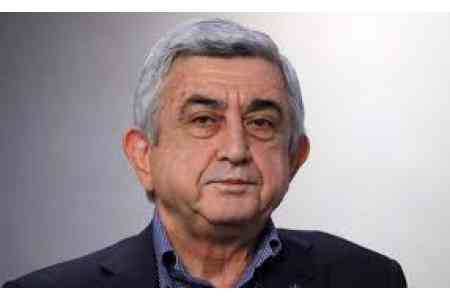
ArmInfo. Third President of the Republic of Armenia Serzh Sargsyan commented on the release of documents by the RA government regarding the negotiation process on the Nagorno-Karabakh conflict.
According to the former president, the package of documents presented by the RA government is nothing more than a simplified and simultaneously futile attempt to shift responsibility for the catastrophic consequences of the current authorities' failed policy regarding the Nagorno-Karabakh conflict since May 2018. "A very simple question arises: if, according to the current Armenian authorities, the negotiation process and the co-chairs' proposals benefited only Baku, then why did the Azerbaijani side reject all of these proposals, criticize the co-chairs, and even call for the group's dissolution, at least from 2008 to 2018? Azerbaijan, unlike Armenia, refused to accept as a basis the five statements of the presidents of the co-chair countries-Russia, the United States, and France-on Nagorno-Karabakh. Azerbaijan, unlike Armenia, rejected the statements adopted by the OSCE foreign ministers within the OSCE Ministerial Council in 2008-2017 and the statement adopted at the OSCE summit in Astana in 2010, or subsequently abandoned the original agreement. Azerbaijan, unlike Armenia, rejected the agreements reached at the summits in St. Petersburg (June 17, 2010), Astrakhan (October 27, 2010), Sochi (March 3, 2011), Kazan (June 24, 2011), Sochi (January 23, 2012), Vienna (May 16, 2016), St. Petersburg (June 20, 2016), and Geneva (October 16, 2017). Having reached an impasse in the negotiation process, Azerbaijan repeatedly threatened to withdraw from it by 2018, but did not take this step, fearing open confrontation with the co-chair countries with an international mandate to mediate the conflict settlement - the three permanent members of the UN Security Council - Russia, the United States, and France - and, accordingly, fearing an open clash with the entire international community.
At the same time, Baku, by repeatedly violating the ceasefire and torpedoing the negotiation process, constantly provoked Yerevan to refuse negotiations in order to blame Armenia for the failure of the peace process. However, the Azerbaijani side was unsuccessful. Moreover, the positions of Armenia and the OSCE Minsk Group Co-Chairs became virtually identical, as has been publicly stated on numerous occasions. By rejecting almost all proposals and initiatives from the Co-Chair countries or constantly retreating from existing agreements, Azerbaijan was effectively opposing not only Armenia but also the international community in its approaches to conflict resolution," the former president noted.
He emphasized that after the change of power in Armenia in the spring of 2018, the need and importance of continuing efforts aimed at preserving, strengthening, and further improving everything achieved over the years of peace negotiations became clear. It also became clear that any deviation from this could have unpredictable consequences. The OSCE Minsk Group Co-Chairs also shared this opinion. However, after May 2018, the new Armenian authorities announced their decision to begin negotiations from "their own position," effectively abandoning the results of the previous years' negotiating work, without even explaining to the co-chairs what exactly this "position" was. While they had previously been repeatedly assured that Armenia's position was in line with the approaches of the OSCE Minsk Group co-chairs, Yerevan was seen by the international community as an unconstructive party in the negotiation process. "And after the new Armenian ruler, "putting himself in the shoes of a madman," began to express doubts about the possibility of resolving the conflict through negotiations, Baku got what it had been unable to do for years: accusations of Armenia's refusal to negotiate as a pretext for war.
Could the war have been stopped? Probably yes, if they had been prepared for an adequate counteroffensive and had there been support and understanding from their allies and the international community, which would have taken decisive measures to immediately end the fighting. We witnessed this development in April 2016, when, having failed diplomatically, Azerbaijan unleashed aggressive actions against Nagorno-Karabakh, attempting to force its approach into the negotiation process. However, due to the obvious diplomatic, political, and military mistakes of Pashinyan and his team, Armenia found itself in an extremely dire situation in 2020, leading to a crushing military defeat with thousands of casualties and the loss of Artsakh. Allegations that during the negotiation process, Russia and other co-chair countries, in order to resolve the conflict, allegedly offered Azerbaijan the return of seven districts under Armenian control around Nagorno-Karabakh, without offering anything in return in terms of status, security guarantees, or other characteristics, are not only untrue but also do not stand up to scrutiny. The Minsk Group co-chair countries have repeatedly stated this, and documents published by the current Armenian authorities on December 2 clearly confirm this.
From December 2008 until the summit of the presidents of Russia, Armenia, and Azerbaijan in Kazan on June 24, 2011, the parties held negotiations on an agreement on the "Basic Principles" with the mediation of Russia and the OSCE Minsk Group co-chairs. Twelve bilateral (Armenia and Azerbaijan) and trilateral (Russia, Armenia, and Azerbaijan) presidential summits were held, as well as three dozen meetings of foreign ministers. Azerbaijan has consistently shied away from the agreements reached. This culminated in the Kazan Summit, when, contrary to the expectations of the co-chair countries, Azerbaijan effectively abandoned the agreed-upon text, proposing more than 10 amendments. Following Kazan, from 2011 to 2018, the co-chairs continued their efforts to find ways to resolve the conflict. Following the draft "Basic Principles" discussed at the Kazan Summit (the last working document to be submitted to the OSCE Secretariat along with all working documents agreed upon prior to 2011), not a single working document has been the subject of negotiations between the parties.
It is no coincidence that Sergey Lavrov has repeatedly stated that "no documents exist other than those submitted to the OSCE." All proposals developed from 2011 to 2018 were presented to the parties in a "non-paper" format and differed from the document discussed in Kazan in June 2011 only in form, not in content. The latest versions of these "non-papers" were formulated as three interconnected documents, forming a single whole, which together retained almost all the elements of the Kazan document and represented a solid framework for enshrining a comprehensive approach to the settlement of the Nagorno- Karabakh conflict. The "non-paper" presented to the parties in Krakow on January 18, 2018, consisted of just three points on a single page, which the co-chairs proposed could be included in a possible future joint statement between Armenia and Azerbaijan. Baku also rejected this proposal. Only in June 2019, a year after Pashinyan came to power, was the first official (not "non-paper") document signed by the co-chairs since the Kazan summit presented to the parties. This document contained the same proposals as those presented in April 2019, but without the co-chairs' signatures. What provisions have been developed jointly with the Co-Chairs on the Karabakh settlement since 2008?
Interim status. Until a final decision on status was made, Nagorno-Karabakh received a temporary status with a detailed description of its mechanisms, namely: the formation and functioning of legislative, executive, and local authorities, courts, self-defense forces, and law enforcement agencies; observer status in the OSCE; the right to join international organizations, where Nagorno-Karabakh's temporary status will not be viewed as an obstacle; the implementation of external relations in the areas specified by the agreement; foreign direct investment; assistance from international donor organizations and foreign states; and access to international markets. In practice, all of this, as the Co-Chairs themselves noted, meant "status quo plus," and not the abolition of Karabakh's existing status.
Final legal status. It was assumed that the final legal status of Nagorno-Karabakh would be determined by a popular vote, which would enshrine the free expression of the will of the population of Nagorno-Karabakh (the co-chairs insisted on this in all their proposals, despite Baku's demand for a referendum on the status of Nagorno-Karabakh to be held throughout the territory of Azerbaijan), and would be legally binding.
It was emphasized that the wording of the question or questions put to the vote would not be limited in any way, implying a choice of any status. The population participating in the vote in Nagorno-Karabakh was understood to include persons of any nationality in the same proportions as in Nagorno-Karabakh in 1988, according to the results of the last population census conducted before the conflict (according to the census, the Armenian population of Nagorno-Karabakh at that time constituted 76%).
Security guarantees. The temporary status provided for multi-layered security guarantees: a commitment by Azerbaijan not to use force against Nagorno-Karabakh, international peacekeeping operations with the deployment of peacekeeping forces, recognition of Armenia's role as a guarantor of Nagorno-Karabakh's security, security provision by the Nagorno-Karabakh self-defense forces, security guarantees from the co- chair countries, as well as a corresponding resolution adopted by the UN Security Council for this purpose. A corridor connecting Nagorno-Karabakh with Armenia. Until the final status was determined, the Nagorno-Karabakh authorities were to ensure and resolve all issues related to the security of the corridor through the Lachin region, within the status quo that existed at the time the peace agreement entered into force. The final status and width of this corridor were to be determined in the context of the final determination of Nagorno-Karabakh's status.
Return of territories. As part of the package agreement, which covered such details as the final status, the corridor, and other elements, following the implementation of international and other clear guarantees and security measures, including those of the UN Security Council, after the peace agreement entered into force, the return of five regions-Aghdam, Fizuli, Jabrail, Zangilan, and Kubatly-was envisaged. These regions would be demilitarized, and peacekeeping forces would be deployed directly on the line of contact, not in Karabakh. The return of the non-corridor portion of Lachin and the Kelbajar region was envisaged in connection with the agreement on organizational matters for holding a national referendum to determine the final status of Nagorno-Karabakh.
Opening communication channels. As part of the implementation of the conflict settlement agreement, the Kazan document, as well as its subsequent developments, proposed removing all reservations and dissenting opinions from relevant international agreements restricting freedom of communication routes, lifting blockades, ensuring unimpeded transport and other communications, and opening all borders and communication routes passing through the territories of the parties (these restrictions were imposed by Azerbaijan itself). Again, the discussion was about opening communication routes throughout the region, and there was no emphasis on any specific region or regions. All the co-chairs' proposals envisaged a package solution to the Nagorno-Karabakh problem with a phased implementation of the interconnectedness of all components of the settlement," said the third President of the Republic of Armenia.
He added that it is very strange, if not disgusting, to see, in a small, selective list of dozens of existing documents on Nagorno-Karabakh published by Armenia's current rulers, references to statements by the OSCE Chairman-in-Office at the 1994 Budapest Summit and the 1996 Lisbon Summit. No less paradoxical is the publication and references to resolutions adopted by the UN Security Council in 1993 on the Karabakh issue. None of these documents, with the exception of the Azerbaijani one, have been mentioned or referenced by anyone-the UN, the OSCE, or the co-chair countries-for at least ten years after 2008.
"Pashinyan and his team have effectively become supporters of the Azerbaijani leadership. Furthermore, the current authorities ignore, as Baku has done for many years, the statements on Nagorno-Karabakh adopted at the OSCE Summit and the Council of Foreign Ministers in 2008-2017, not to mention the crucial statements on the Karabakh settlement by the presidents of the co-chair countries - Russia, the United States, and France - issued in 2009-2013 in L'Aquila, Muskoka, Deauville, Los Cabos, and Enniskillen. Just as the equally significant statements adopted at the meeting of presidents and foreign ministers in Vienna on May 16, 2016, and at the summit in St. Petersburg on June 20, 2016, are ignored, numerous joint statements by the presidents of Russia, Armenia, and Azerbaijan are also being forgotten.
By publishing a series of documents with a link to the website of former Russian Co-Chair of the OSCE Minsk Group, V.N. Kazimirov, the Armenian government pretended to ignore the key trilateral, permanent ceasefire agreements between Azerbaijan, Nagorno-Karabakh, and Armenia in 1994-1995, achieved largely thanks to Ambassador Kazimirov. The list goes on. This is precisely the legacy the Armenian government inherited regarding the Karabakh settlement, which the Pashinyan government handled so incompetently and with such tragic consequences. It would be logical to suggest that the current Armenian authorities publish documents on Nagorno-Karabakh adopted after 2018. Let's hope that copying them won't take too long. And this publication will serve as clear evidence of the legacy Pashinyan will leave for future Armenian leaders. After all, upon coming to power, Pashinyan promised to "inform the people about everything"-who "gave him the mandate." However, this promise was transformed into videos posted on Facebook of bike rides around the world, selfies, eating pies, and so on. And finally, as a culmination, came the utterance: "No matter what it takes, we will negotiate." And what was remembered about Pashinyan's policy toward Nagorno-Karabakh? Only two theses remained in the public consciousness: the first, "Artsakh is Armenia, that's it," and the second, "Nagorno-Karabakh is Azerbaijan."
The publication of documents on Nagorno-Karabakh on December 2, 2018, conceived by Pashinyan and his team, was intended not only to discredit the previous authorities, led by three presidents, by manipulating public opinion and attempting to blame them for the failure of their defeatist policies, presented as peacekeeping. It was also aimed at distracting people from the heavy burden of the tragic consequences of the current authorities' incompetent policies. However, this attempt completely failed and effectively resulted in the self-exclusion of Pashinyan's team and the admission of its full responsibility for what had happened," the third president of Armenia stated.

























 Azerbaijani studies expert : Ruben Vardanyan’s wife threatened with arrest if she visits Baku
 Political scientist: The model of allied relations between Russia and Armenia has collapsed
 Expert: The defeated authorities` position on normalizing relations with the enemy should not affect the rights of Artsakh refugees
 Political scientist: If Russian-Armenian relations are destroyed, Turkey will take Russia`s place
 Political scientist: The Armenian public is simply obliged to significantly change the entire content of public discourse and struggle
 Cross tattoos are being removed from the skin of Christian prisoners in Azerbaijan by fire, according to a human rights activist.
 Zakharova: Armenia`s likely introduction of visas with Russia will be a step against Yerevan itself
 Putin: Armenia`s recognition of Karabakh as part of Azerbaijan in Prague has given Russia`s position on this issue an ambivalent character
 Putin: Armenia`s adoption of the law on EU accession means an announcement of its withdrawal from the Eurasian Economic Union
 Medvedev: Yerevan will never become an EU member, but it will permanently damage relations with the Eurasian Economic Union, including with Moscow.
 Aram Vardevanyan: Public demands solutions, not apology scandals in Parliament
 Arrested Armenian oligarch on economy and new jobs
  "In Baku, we gave a worthy rebuff to the false claims regarding the past and present of our people" – Former Artsakh Parliament Speaker from Baku captivity
  NA Vice Speaker candidate believes his wife`s salary as director of HayPost is the lowest in the company`s history
 RF Permanent Representative: There is no CSTO-Armenia conflict
 Moscow: NATO seeking to "Pull" Armenia away from CSTO Allies
  Political analyst: Russia intends to determine which "Camp" Armenia will choose through a referendum
 Narek Karapetyan will give up his parliamentary salary in favor of charitable contributions.
