


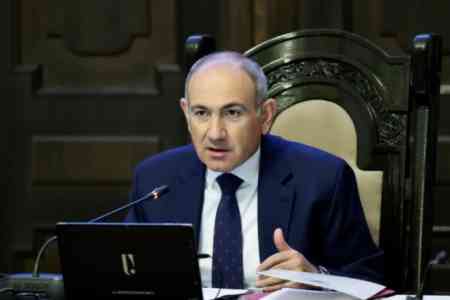
ArmInfo. On November 13, the Armenian government adopted a written resolution "On approving and recognizing as urgent the draft law "On Universal Health Insurance" and related laws." Prime Minister Nikol Pashinyan announced this at a regular Cabinet meeting on November 14.
According to Pashinyan, there were proposals to launch health insurance not on January 1, 2026, but a little later. However, experience shows that all reforms encounter difficulties at the initial stage, and one should not expect everything to go smoothly from the very beginning. "We have repeatedly postponed the implementation of the Universal Health Insurance system," he noted.
Health Minister Anahit Avanesyan, in turn, noted that the document had undergone lengthy three-year discussions with members of parliament from the ruling Civil Contract faction.
Thus, the first stage will begin in January 2026. The system will automatically screen people and enroll them as beneficiaries. They will then receive an invitation to become beneficiaries of the system through the Armed eHealth e-health system (or through their primary care physician).
The system will be implemented over three years. By 2028, the entire population of Armenia should be covered by this system. The state-provided system will gradually transition to compulsory health insurance. Until then, those who used the state-provided system will continue to do so.
In the first stage, the compulsory health insurance system will include children under 18, individuals aged 65 and older (even if they are employed), individuals with disabilities aged 18 to 65, and members of socially vulnerable families. The state will fully cover the health insurance policies of these categories of citizens. Citizens with a monthly income of over 200,000 drams will pay for their own insurance. Overall, the first phase plans to reach 1.6 million beneficiaries (RA citizens residing in the RA for more than 183 days).
The base cost of an insurance policy in 2026 will be 129,600 drams (10,800 drams per month). However, since the payment amount to the Zinap Fund will change, beneficiaries will not have to make the additional 10,800 drams monthly.
Specifically, individuals with salaries between 200,000 and 500,000 drams will be able to reduce their monthly Zinap contribution from 5,500 to 1,000 drams. The 4,500 drams saved can be used to pay for health insurance. Additionally, when filing their income tax return in 2026, they will be able to receive an additional 6,000 drams per month (as a tax deduction). For citizens with salaries between 500,000 and 1 million drams, the Zinapa contribution will also be reduced to 1,000 drams (from 7,500), allowing them to redirect 6,500 drams toward insurance. When filing their income tax return in 2027, they will be able to receive a 4,000 drams per month refund.
Individuals earning over 1 million drams will be able to receive a refund of 4,000 drams per month by filing an income tax return in 2027.
The insurance payment will be made by a tax agent, meaning it will be withheld from wages in the same way as income tax, social security payments, and other payments.
In 2026, the insurance will cover the most in-demand services, including outpatient services, clinic visits, family doctor visits, specialist consultations, and laboratory tests (a certain number per year). The list of services will be expanded and refined to include certain surgical procedures, particularly ophthalmological (cataracts), cardiovascular, and other procedures. An annual medical examination will be mandatory under the system.
The 2026 budget allocates 127 billion drams for the implementation of the health insurance system.
As a reminder, on February 2, 2023, the Armenian Cabinet approved the Concept for the Implementation of the IUD, proposed by the Ministry of Health. According to this concept, the system's implementation was planned for the next four years. 2023 was considered a "preparatory" year, while 2024-2026 were designated as the "testing phase," with full implementation of the IUD in 2027. According to the plan, the system's implementation phase should begin in July 2024. Despite the fact that in early July 2024, the World Bank announced its readiness to provide Armenia with a $110 million loan to support the "Achieving Universal Health Coverage" program, the IUD's implementation was postponed until January 2025. However, on November 1, 2024, in parliament, Armenian Finance Minister Vahe Hovhannisyan made it clear that the introduction of the IUD would be postponed once again, this time indefinitely, stating that the draft budget for next year did not include a corresponding expenditure line. "We will be guided by our capabilities," the RA chief financial officer stated at the time.












































 Armenia`s ex-minister of justice calls on opposition to honestly answer questions troubling Armenian citizens
 Lawyer: according to preliminary results, Pashinyan`s party lacks 2/3 majority necessary to amend Armenia`s Constitution
 Politician: With high voter turnout, current government to no chance
 Antonio Costa: EU to deepen its partnership with Armenia, expanding cooperation in energy, trade, and digitalization
 Israeli MFA congratulates Pashinyan
 Turkish MFA comments on results of Armenian elections
  Zakharova: International observers cannot ignore `flagrant violations` in Armenian elections
 Strong Armenia to issue statement after vote count completed - Narek Karapetyan
 Russian Senator: Opposition complaints regarding election violations by ruling party remain unanswered
 RA premier receiving congratulations on his victory in parliamentary elections
 Head of IPA CIS Council Secretariat: Extremely difficult atmosphere during parliamentary elections campaign in Armenia accompanied by mass arrests
 Pashinyan`s party leads with 51.13% based on vote counts from 533 polling stations
 Voting in parliamentary elections in Armenia ends
  Strong Armenia: Administrative Court not providing judicial decisions to citizens wishing to vote in parliamentary elections
