

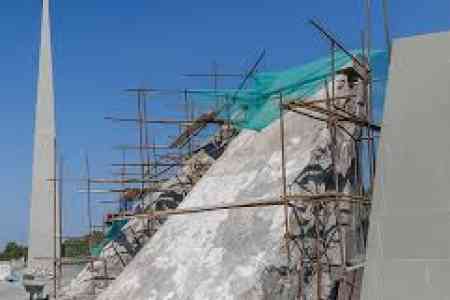
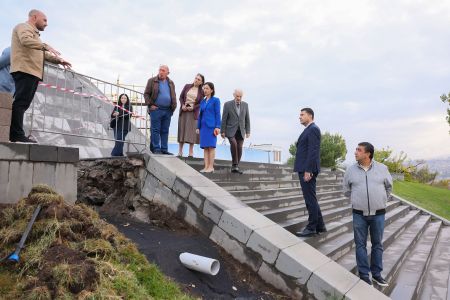
ArmInfo. Instead of completely demolishing the Tsitsernakaberd Armenian Genocide Memorial Complex, it's necessary to simply reconsider the approach to its reconstruction. Architect Anahit Tarkhanyan stated this at a press conference in Yerevan during a discussion of the reconstruction of the Armenian Genocide Memorial Complex.
In this regard, the architect noted that the design work being used for its reconstruction is unprofessional and contains numerous errors. This, she noted, could lead to serious consequences. Specifically, the methodology currently being used for the memorial's reconstruction will ultimately lead to more serious problems with its hydrophobicity, which they are currently ostensibly trying to solve.
In this regard, she touched on the main problem that will arise with the onset of the rainy season. "The upper part of the memorial remains open, which will allow rainwater to penetrate the memorial's foundation. This, in turn, will lead to increased humidity and further damage," Tarkhanyan explained.
Meanwhile, the architect noted that there are certain approaches to this type of work. In this regard, she expressed outrage that this reconstruction is currently being carried out by people lacking the necessary experience and understanding. "During the reconstruction, it was necessary to at least use hydrophobic materials that repel water. It's noteworthy that the complex already had water drainage mechanisms, which were designed by its architects. These are all principles that were established long ago and were intended specifically to protect monuments and structures of national significance," the architect explained.
She then touched on the financial costs. Tarkhanyan noted that the funds allocated for the work were five times greater than those required for a reconstruction of this type.
"The government allocated significant resources for the memorial's reconstruction. But the question arises as to whether such expenditures were necessary. The reality is that the reconstruction of the Memorial Complex could have been carried out with less labor, in less time, and at a lower cost. And with the right approach, all work on its grounds could have been completed by summer," the expert noted.
Speaking about the actions that need to be taken to preserve the memorial complex, she emphasized that, first and foremost, everything must be done to temporarily suspend work on its grounds. Then, Tarkhanyan continued, it is necessary to analyze the work already completed and understand the complex's current condition.
"Furthermore, it is necessary to develop a separate approach specifically for the reconstruction of the basalt pylons (12 slabs installed around the complex - ed.), which are currently in a terrible state. Specifically, we need to understand how to restore the damaged pylons and what approach to use for transforming the intact slabs," Tarkhanyan explained.
In summary, the architect reiterated that the excesses allowed by the architects were senseless and constituted nothing more than a waste of public funds. In this regard, she announced her intention to hold meetings in the near future with the Minister of Education, Science, Culture, and Sports (MECS) Zhanna Andreasyan and the designers to understand what is actually happening on the grounds of the Armenian Genocide Memorial Complex and how it can be corrected.
As a reminder, the state has allocated 800 million drams for the reconstruction of the Armenian Genocide Institute Museum and the Tsitsernakaberd Memorial Complex. The work is scheduled for completion within 300 days, that is, by the end of 2026.
However, many experts are inclined to believe that the so-called reconstruction of the Tsitsernakaberd memorial complex to the victims of the Armenian Genocide, which "coincidentally" coincided with the signing of the Washington Declaration of Peace, sends a message about Yerevan's willingness to make concessions. Furthermore, the issue of artificially extended reconstruction deadlines and numerous mistakes, which are resulting in more damage than restoration, has been repeatedly raised.









 Expert: Economic pressure on Armenia may be virtually painless for other EAEU members, but not for Armenia itself
 Expert on protests in France: Civilizations fade when society loses a vision of the future
 Turkologist: Azerbaijan is not all-powerful—its vulnerabilities should become part of Armenia’s security strategy
 Opinion: The development of the Amulsar mine near the resort town of Jermuk is the beginning of an environmental disaster in Armenia
 Expert: The arrest of opposition figures in Armenia for social media posts is a systematic attempt to intimidate the public and suppress dissent.
 The Artsakh Public Council expressed outrage at the UN Secretary-General`s behavior
 Lukashenko called for Armenia to assume the CIS presidency in 2029
 Dmitry Medvedev predicted a Ukrainian-like fate for Armenia amid the country`s shift in foreign policy
 Russian Security Council: In Armenia, they want to force Russian asset owners to dispose of their assets
 Zakharova: Russia ready to discuss with Armenia the prospects for expanding military cooperation as part of a review of bilateral ties
 Tevanyan: Armenia, like Ukraine and Moldova, is being drawn into the EU’s global war
 Yerevan City Hall is considering introducing a valet parking system in the city
 Expert: The circus surrounding the “Albanization” of Armenian culture in the presence of foreign ambassadors in occupied Artsakh is genocide
 Political scientist: If Russian-Armenian relations are destroyed, Turkey will take Russia`s place
 Political scientist: The Armenian public is simply obliged to significantly change the entire content of public discourse and struggle
 Cross tattoos are being removed from the skin of Christian prisoners in Azerbaijan by fire, according to a human rights activist.
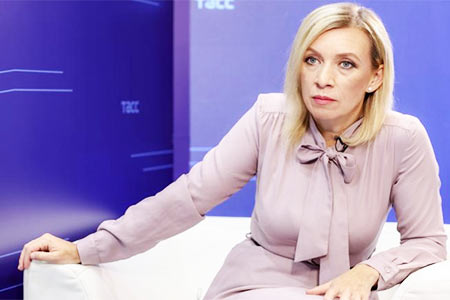 Zakharova: Armenia`s likely introduction of visas with Russia will be a step against Yerevan itself
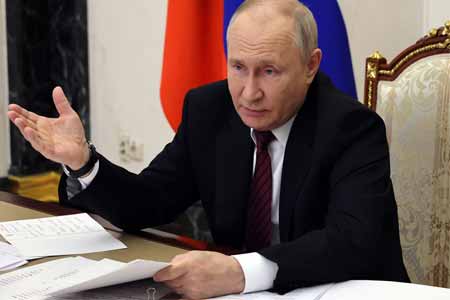 Putin: Armenia`s recognition of Karabakh as part of Azerbaijan in Prague has given Russia`s position on this issue an ambivalent character
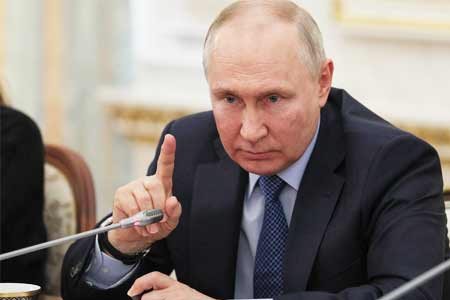 Putin: Armenia`s adoption of the law on EU accession means an announcement of its withdrawal from the Eurasian Economic Union