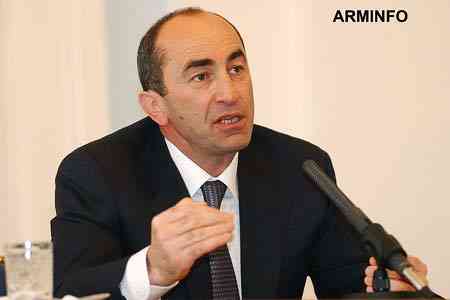
ArmInfo.As a result of the documents signed in Washington on August 8, all parties except Armenia itself received advantages. This was stated by the second President of the Republic of Armenia, Robert Kocharyan, at a press conference on October 7.
It should be noted that on August 8, Armenia and Azerbaijan initialed a draft peace treaty in Washington, D.C., with US mediation. Following this, Yerevan and Baku submitted a joint statement abolishing the OSCE Minsk Group, mandated to resolve the Nagorno-Karabakh conflict. Independent Armenian experts criticized this document, calling it an act of capitulation and evidence of further concessions by the Armenian authorities, including on the issue of providing a corridor through southern Armenia.
Without going into detail about these documents, about which much has already been said, the second President of the Republic of Armenia indicated that the United States would gain control over the future corridor, which would pass through Armenia. Robert Kocharyan believes that Washington will thereby gain control of Armenia's borders with Iran. Another aspect of these documents is directly related to US President Donald Trump's nomination for the Nobel Peace Prize.
In turn, Azerbaijan received the right to construct a corridor through Armenian territory, dismantle the OSCE Minsk Group, and suspend Section 907 of the Freedom Support Act.
"As for Armenia, I tried to find some specifics in these documents, but in my opinion, the result was zero, other than the emergence of new problems," the second president of Armenia noted, pointing to what Prime Minister Nikol Pashinyan received from the aforementioned documents. "He received a single photograph signed by President Trump and a null and void document that will allow him to deceive the Armenian people once again," Robert Kocharyan emphasized.
He added that Nikol Pashinyan acted as a backdrop in the White House, against a backdrop of a table, chairs, and paintings hanging on the walls.
Touching upon the initialed draft peace treaty between Armenia and Azerbaijan, the second President of Armenia pointed out that the document is largely technical in nature. "I personally don't understand what the initialing of the treaty means, especially in the presence of heads of state," the second President of Armenia said.
He also raised the issue of signing the so-called "Trump Route" in the United States, which the Armenian authorities are trying hard to link with the "Crossroads of the World" project. Meanwhile, according to Kocharyan, the transit potential of each state consists of three components: the country's geographic location, its terrain, and the state of its transportation networks. Moreover, the first two components are mandatory conditions. If they are present, the third component is simply a matter of investment.
Robert Kocharyan presented a map of Armenia, skeptically assessing the country's transit potential. Specifically, Turkey and Georgia have every opportunity to bypass Armenia and conduct mutual transportation, the same can be said for Turkey and Russia. The Georgia-Azerbaijan route is the main corridor between the Caspian and Black Seas. Azerbaijan and Iran also have ample opportunity to develop transportation routes. All these countries conduct mutual trade without entering Armenia. Therefore, Armenia is of no transit interest to the bordering states. The only exception is the connection between Turkey and Azerbaijan, for which the corridor is truly significant, and it is indeed of great importance to Ankara and Baku. This significance is consistent with the Turan project.
The second president of the Republic of Armenia reiterated the Armenian side's intention to transfer a portion of the country's territory for the management of this corridor for an extended period. Moreover, the transferred territory is of geopolitical significance and has transit potential.









 Armenian expert: Could modern Azerbaijan even exist without Russian and Soviet modernization?
 South Caucasus is entering a new phase of turbulence - ex-official
  Expert: Azerbaijan`s political leadership states `occupation of Armenia is their new national goal`
  Human rights activist Ruben Melikyan dismissed from YSU
 Zakharova: Armenia`s pro-EU pivot poses economic security risks to EAEU member states
 It`s time for South Caucasus countries to think of South Caucasus as single, unified region - RA premier
  Pashinyan: Armenia and Azerbaijan should leave each other alone
 Moscow sees situation with Armenia as attempt to attack Russia-involving integration associations - Russian presidential aid
 Zakharova: Armenia views relations with Russia as tool for financially securing reorientation toward EU
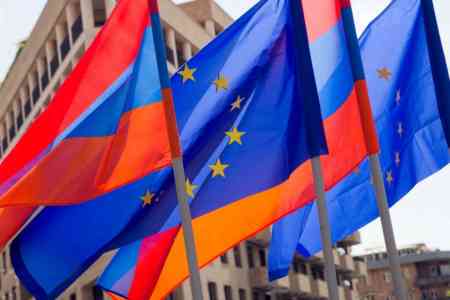 The Armenian Minister of Justice and the EU Ambassador discussed visa liberalization issues for Yerevan.
 Azerbaijan`s aggressive plans against Armenia became possible in wake of Pashinyan`s decisions on Artsakh - expert
  Zakharova: Russia sent a note of protest to Armenia over the act of vandalism at the "Mother Armenia" memorial in Gyumri
 Samvel Karapetyan proposes creating a post-election opposition coalition
 Artsakh`s Cultural Heritage Ombudsman called on Moscow to respond to destruction of WWII monuments by Azerbaijan in occupied NKR
 Prosecutor General`s Office petitions Central Electoral Commission for criminal prosecution of Robert Kocharyan
 Dutch Prime Minister expresses his support for Armenia`s democratic reform and economic diversification agenda