
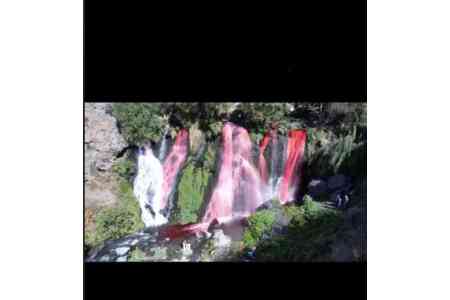
ArmInfo. Shaki Waterfall, a hydrogeological natural monument of Armenia and under state protection, has turned blood-red. This is due to the increasing frequency of "gender parties" (a shamanic event during which expectant parents, their friends, and family discover the sex of their unborn child - Ed.), which originated in the United States in the 2000s and has become widespread in Armenia in recent years.
The press service of the Ministry of Environment responded to footage circulated after the "gender party," which clearly shows the waterfall turning pink. However, from a distance, it appears as if red water, reminiscent of blood, is trickling from the top of the waterfall-as if nature is bleeding and reminding us that it, too, is vulnerable. The ministry noted in response to the situation that such actions violate the Armenian Law "On Specially Protected Natural Areas," which prohibits any activity within the territory of a natural monument that threatens its preservation. "Furthermore, the order of the Ministry of Nature Protection of March 21, 2018, which prohibits any activity that damages the appearance of a natural monument, was also violated," the ministry added.
The Ministry of Environment reported that information about the waterfall's pollution was forwarded to the Inspectorate for Environmental Protection and Mineral Resources for appropriate action. "We urge citizens to comply with legal requirements for environmental protection and refrain from any actions that could damage the country's natural heritage," the ministry concluded.
Demographers believe that such activities are certainly harmful to nature, but do not have the same negative impact as selective abortions. They believe the main thing is for the Gender Party not to increase the statistics of selective abortions. Sex-selective abortion, or sex-selective abortion, remains a serious demographic problem in Armenia due to deeply ingrained stereotypes about son preference. Although a 2016 law prohibits sex- selective abortions after the 12th week of pregnancy, the problem has not been fully addressed, leading to the use of unsafe methods and a gender imbalance in newborns.
As previously reported by the Ministry of Health, approximately 80,000 girls have not been born in Armenia over the past 30 years due to the widespread practice of sex- selective abortion.







 Expert: Economic pressure on Armenia may be virtually painless for other EAEU members, but not for Armenia itself
 Expert on protests in France: Civilizations fade when society loses a vision of the future
 Turkologist: Azerbaijan is not all-powerful—its vulnerabilities should become part of Armenia’s security strategy
 Opinion: The development of the Amulsar mine near the resort town of Jermuk is the beginning of an environmental disaster in Armenia
 Expert: The arrest of opposition figures in Armenia for social media posts is a systematic attempt to intimidate the public and suppress dissent.
 The Artsakh Public Council expressed outrage at the UN Secretary-General`s behavior
 Lukashenko called for Armenia to assume the CIS presidency in 2029
 Dmitry Medvedev predicted a Ukrainian-like fate for Armenia amid the country`s shift in foreign policy
 Russian Security Council: In Armenia, they want to force Russian asset owners to dispose of their assets
 Zakharova: Russia ready to discuss with Armenia the prospects for expanding military cooperation as part of a review of bilateral ties
 Tevanyan: Armenia, like Ukraine and Moldova, is being drawn into the EU’s global war
 Yerevan City Hall is considering introducing a valet parking system in the city
 Expert: The circus surrounding the “Albanization” of Armenian culture in the presence of foreign ambassadors in occupied Artsakh is genocide
 Political scientist: If Russian-Armenian relations are destroyed, Turkey will take Russia`s place
 Political scientist: The Armenian public is simply obliged to significantly change the entire content of public discourse and struggle
 Cross tattoos are being removed from the skin of Christian prisoners in Azerbaijan by fire, according to a human rights activist.
 Zakharova: Armenia`s likely introduction of visas with Russia will be a step against Yerevan itself
 Putin: Armenia`s recognition of Karabakh as part of Azerbaijan in Prague has given Russia`s position on this issue an ambivalent character
 Putin: Armenia`s adoption of the law on EU accession means an announcement of its withdrawal from the Eurasian Economic Union