
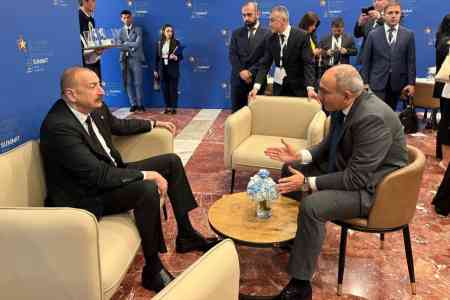
ArmInfo. The Prime Minister of the Republic of Armenia Nikol Pashinyan and the President of the Republic of Azerbaijan Ilham Aliyev met in Copenhagen, Denmark on 2 October 2025, on the margins of 7th Summit of the European Political Community.
Both sides highlighted the significance of agreements reached during Washington Peace Summit initiated by the US President Donald J. Trump. They reaffirmed readiness to work for further strengthening of peace between Armenia and Azerbaijan.
President of Azerbaijan and the Prime Minister of Armenia underscored the benefits of transport communications in the region, discussed current progress of infrastructural development in the territory of Azerbaijan and TRIPP project in the territory of Armenia, exchanging views about the implementation of Washington Declaration.
In this regard, the sides welcomed the decision adopted unanimously on the closure of the OSCE Minsk Process and its related structures. Both sides highlighted the importance of further implementing Confidence-Building Measures and agreed to continue their contacts.
A meeting between Armenian Prime Minister Nikol Pashinyan and Azerbaijani President Ilham Aliyev took place in Copenhagen. This was announced on the Prime Minister's Facebook page, which also published a 20-second video without sound.
As a reminder, on August 8, Armenian Prime Minister Nikol Pashinyan and Azerbaijani President Ilham Aliyev signed a joint "Declaration of Peace" in Washington. It includes a joint appeal to the Organization for Security and Cooperation in Europe (OSCE) to terminate the OSCE Minsk Process and related structures, as well as the creation of a transport corridor through Armenian territory that will connect Azerbaijan with its Nakhchivan exclave. The TRIPP (Trump Route for International Peace and Prosperity) project, a 42-kilometer road in southern Armenia, whose management will be entrusted to the United States for a period of 99 years, is believed by experts to have the potential to significantly change the geopolitical situation in the South Caucasus.
On September 1, 2025, the OSCE announced the official dissolution of the OSCE Minsk Group, mandated to resolve the Nagorno-Karabakh conflict. Based on a joint statement by Yerevan and Baku, the structure will be completely dissolved by December 1, 2025.
Regarding TRIPP, Pashinyan stated on September 29 in a conversation with Armenian journalists in Strasbourg that discussions around the "Trump Route for International Peace and Prosperity" project have already begun. An American delegation recently visited Armenia and held a series of meetings with government representatives and relevant agencies. However, he stated that no specific agreements have been reached at this time. Pashinyan believes this is due to the fact that the Trump administration clearly has a very broad global agenda. Nevertheless, he added, discussions on the specific content and the project have already begun. "Specifically, we are currently working on who should design the project, how we should design it, and who should finance it, because a railway needs to be designed, right?" Pashinyan asked. As Pashinyan indicated, the TRIPP infrastructure project will operate in the Republic of Armenia, and its business model will be agreed upon bilaterally between the United States and Armenia. TRIPP, consisting of several dozen kilometers of various infrastructure facilities, will have both regional and global significance and impact.
Nevertheless, President Aliyev continues to promote the opening of the so-called "Zangezur Corridor" at various international forums. He most recently spoke about it at the UN. This sometimes even surprises Pashinyan, as he did recently at PACE, when he called on all those repeating Aliyev's words to at least familiarize themselves with the Washington documents, which make no mention of it.
However, already on October 1, from the podium of the Armenian parliament, Pashinyan suggested that by "Zangezur Corridor," the Azerbaijani leadership meant a road on its territory, specifically between the cities of Horadiz and Zangelan. "Therefore, when they say 'Zangezur Corridor,' you should know that they are not talking about Armenia; they are talking about their own country. Therefore, let's consider this topic closed. ... They use the term 'Zangezur Corridor.'" Let them call it whatever they want, we have no problems," Pashinyan said.



















 Expert: Current process is not about peace, but implementing Azerbaijan`s wishlist
 Expert: Real peace unattainable until Armenia-Azerbaijan agreement is signed and ratified
 TRIPP`s proximity to Iranian border could slow its implementation - expert
  Who and why is sacrificing RA National Security Service`s reputation? - expert
  Tehran creating security environment in which sustainable shipping in Strait of Hormuz difficult to imagine without its direct participation - expert
  Arrested Armenian oligarch on economy and new jobs
  NA Vice Speaker candidate believes his wife`s salary as director of HayPost is the lowest in the company`s history
 RF Permanent Representative: There is no CSTO-Armenia conflict
 Moscow: NATO seeking to "Pull" Armenia away from CSTO Allies
  Political analyst: Russia intends to determine which "Camp" Armenia will choose through a referendum
 Narek Karapetyan will give up his parliamentary salary in favor of charitable contributions.
 Armenian analyst: Developing relations with Europe and the U.S. must not jeopardize relations with regional powers
 Armenia and France discuss further development of strategic partnership and EU cooperation
  To overcome risks Armenia must reduce domestic escalation - expert
  Zatulin: Pashinyan was eager to get back to Russia because he actually lost the elections
 Human rights activist Ruben Melikyan dismissed from YSU
 Pashinyan removed from INNOPROM guest list
 Zakharova: Armenia`s pro-EU pivot poses economic security risks to EAEU member states
 It`s time for South Caucasus countries to think of South Caucasus as single, unified region - RA premier
  Pashinyan: Armenia and Azerbaijan should leave each other alone