


ArmInfo. Armenia's path to progress lies not in blind submission, but in reconsidering the rules of regional interaction. In this sense, the idea that lasting peace can be achieved at any cost through reconciliation is not only naive but also self-destructive.
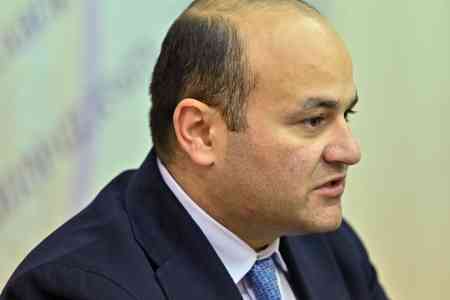
This opinion, as reported by the press service of the Alternative Projects group, was expressed by former Armenian Foreign Minister Ara Ayvazyan.
He outlined the country's post-war recovery paths and the steps that, on the contrary, constitute an obstacle to achieving this goal. According to him, post-war state reconstruction lies not in slogans or wishes, but in new ideas, bold plans, and the ability to correctly understand global developments. In this vein, he emphasized that the alternative to constant concessions is not endless confrontation and war, but strategic deterrence.
"In Armenia's polarized political landscape, there is a widespread belief that non-government forces have 'no alternative' to the current path chosen by the current authorities. However, Armenia's options, finding itself in a geopolitical impasse, are gradually shrinking, while external pressure is growing, and this kind of political fatalism is not only mistaken but also dangerous," the former Foreign Minister noted.
In this vein, Ayvazyan noted that Armenia does not need a different set of solutions, but a fundamentally new strategic approach, as well as a rethinking of what it means to establish peace, achieve security, and ensure sovereignty in a hostile and unstable geopolitical environment. In this vein, he outlined the problems that must be addressed to avoid irreversible consequences.
Ayvazyan noted that external players and unfolding geopolitical rifts are increasingly shaping Armenia's domestic agenda. "Turkey and Azerbaijan aren't just neighbors; they set the agenda for Armenia's political life, using manipulation and pressure to control any negotiations, ceasefires, or unblocking of communication channels in order to manage Yerevan's behavior both domestically and internationally," the former Foreign Minister explained.
In such circumstances, Ayvazyan noted, the most pressing task for any Armenian government is not to define a vision of prosperity or democracy divorced from regional reality, but, above all, to determine how to resist and contain pressure. Meanwhile, he noted that in practice, the country is faced with unilateral concessions and the abandonment of previously formed state and national positions. "However, the more Armenia concedes, the more Ankara and Baku tighten their demands. The current settlement process has not yielded any guarantees or security agreements," Ayvazyan emphasized.
As the former Foreign Minister noted, an effective foreign policy requires not only military but also institutional, economic, psychological, and informational development. In this vein, Ayvazyan stated that to neutralize external threats, the mobilization of internal capabilities should become a key principle of Armenia's strategic doctrine. This should include, according to Ayvazyan, defense reforms and national cohesion by overcoming the discourse of defeat and strengthening unity around sovereignty, not partisanship. Furthermore, as the former foreign minister noted, this implies engaging the diaspora. "But not only for charity or lobbying, but also as a strategic expansion of Armenia's influence in the diplomatic, defense, economic, technological, and academic spheres," Ayvazyan explained.
Furthermore, he emphasized the need for economic resilience and stability by reducing dependence on Turkish and Azerbaijani routes and diversifying other communication options.
The former foreign minister also touched on Russia's diminishing role in Armenia's security architecture. He drew attention to the danger of ignoring Russia as a strategic ally, noting that the country will remain an important player for the foreseeable future, both with a military and diplomatic presence, and in shaping regional balance. "Yerevan must initiate a coordinated, transactional partnership with Moscow, based on genuine strategic dialogue and military-industrial cooperation. In this case, the choice is not between complete dependence or a complete break, but between changing the relationship and creating a mutually beneficial strategic alliance," the former Foreign Minister believes.
Ayvazyan then touched on the "Trump route" and the agreement signed in Washington. The former Foreign Minister believes that, in this context, one of the most dangerous threats to Armenia's sovereignty is Azerbaijan and Turkey's aggressive pursuit of the idea of opening a route through Meghri, which they present as the so-called "Zangezur Corridor." In this vein, he urged that the declaration signed in Washington be viewed as part of a complex diplomatic process that will require strict monitoring and oversight by Armenia, the continuous strengthening of its internal defense and institutional mechanisms.
"Furthermore, this will require an active search for alternative allies and formats for international cooperation, a clear definition of 'red lines,' and the development of strategies that will minimize the risks of dependence on one party. Otherwise, blind faith in such documents without real guarantees could lead to a loss of control over critical strategic positions and the undermining of sovereignty," Ayvazyan emphasized.
Summarizing the above, the former Foreign Minister noted that to address all of the above-mentioned problems and avoid further setbacks, it is necessary to assess the risks, rethink the country's foreign policy, and build public awareness and strategic resistance.
"In a region where Turkey and Azerbaijan are pursuing expansionist power politics, establishing a new balance is a prerequisite for lasting stability. Pursuing clear national interests, establishing strong internal resistance, and forming effective alliances must become the cornerstones of Armenia's foreign and security policy. A true alternative begins with rethinking strategic thinking and understanding that the foundation of peace is stability, balance, and sovereignty, not adaptability and subordination," Ayvazyan emphasized.
Therefore, according to him, the country must first decide what kind of state it wants to be and then choose the right tools and partners to secure its place in an increasingly unstable world order. "Stability isn't given, it's created. And peace doesn't emerge from weakness; it must be earned through strength, strategy, and the will to survive," Ayvazyan concluded.
























 Political Scientist: As long as the opposition remains silent, Pashinyan can use Plan B and secure a constitutional majority
 US-Iranian memorandum more beneficial for Iran from political and economic perspective - expert
  Political analyst: While Pashinyan pledges peace with Azerbaijan, Baku continues promoting the "Western Azerbaijan" project
 Political analyst: In light of new realities, Yerevan may propose advancing peace process with Baku without constitutional referendum
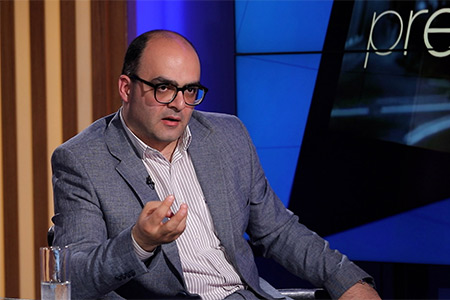 Present-day geopolitical competition shifts from territorial control to infrastructure flows
 Artsakh`s Cultural Heritage Ombudsman called on Moscow to respond to destruction of WWII monuments by Azerbaijan in occupied NKR
 Prosecutor General`s Office petitions Central Electoral Commission for criminal prosecution of Robert Kocharyan
 Dutch Prime Minister expresses his support for Armenia`s democratic reform and economic diversification agenda
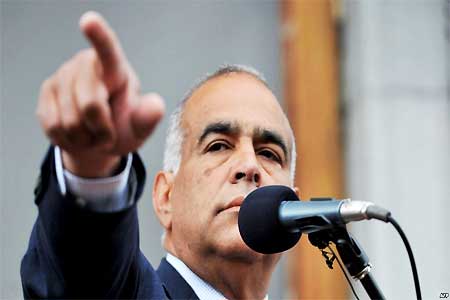 Heritage: It`s time for Armenia`s opposition to present people with legitimate alternative to power
 RA Security Council Sec, Assistant to President of Azerbaijan hold negotiations in Dilijan
 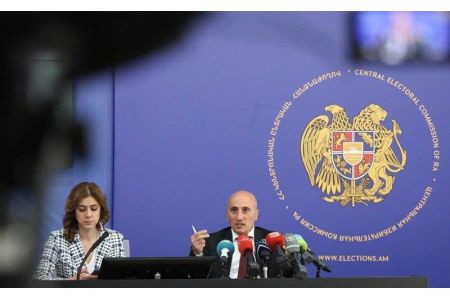 CEC Neutralizes PAP: Three Political Forces to Enter Armenian Parliament Following Election Vote
 Elections in Armenia were accompanied by unprecedented pressure on opposition, RF MFA spokesperson claims
  Expert: Even OSCE observers recorded numerous violations during elections in Armenia
  Moscow to await official results of Armenian elections - Peskov
 Antonio Costa: EU to deepen its partnership with Armenia, expanding cooperation in energy, trade, and digitalization
 Israeli MFA congratulates Pashinyan
 Turkish MFA comments on results of Armenian elections
  Zakharova: International observers cannot ignore `flagrant violations` in Armenian elections