
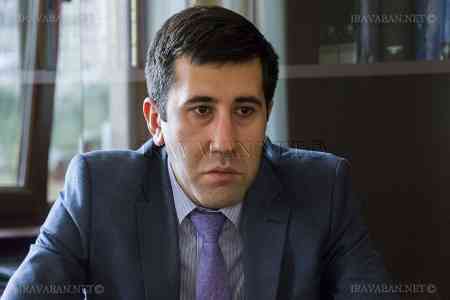
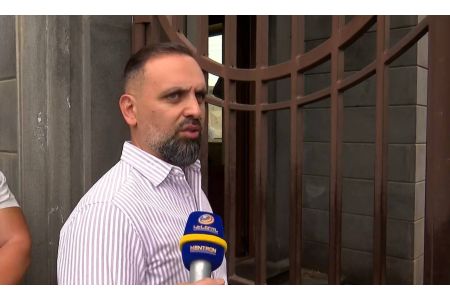
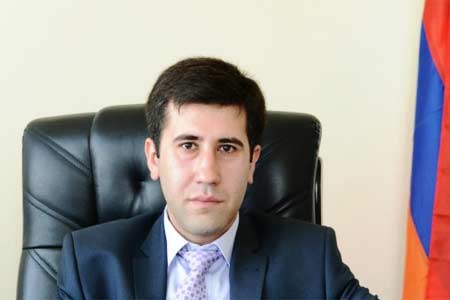
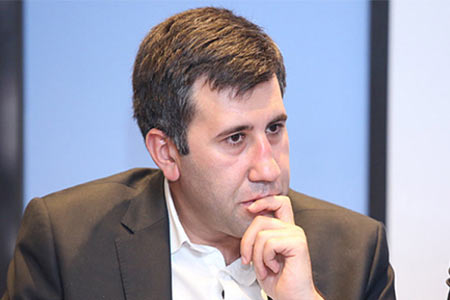
ArmInfo.The decision of the Constitutional Court of Armenia, which declared the previously adopted list of illnesses barring judicial appointments to be contrary to and invalid under Articles 49 and 75 of the RA Constitution, could hinder the effective administration of justice. Lawyer Ruben Melikyan stated this in an interview with an ArmInfo correspondent, referring to the Constitutional Court's previously published ruling in response to a statement by the Ombudsman of Armenia, Anahit Manasyan.
Specifically, the ruling applied to individuals with permanent total deafness in both ears or blindness in both eyes. Melikyan noted that he is currently only familiar with the final part of the ruling. However, commenting on the overall controversy surrounding this issue, he emphasized that the ability of judges to objectively evaluate video recordings presented by both the defense and the prosecution is becoming especially important today. In this vein, Melikyan shared a case from his own practice.
"In one such case, the prosecutor insisted that the video footage presented showed my client kicking a car, but I didn't see it. And essentially, the outcome of the case depended on what the judge saw," the human rights activist said.
In this regard, he wondered what to do if a similar case were heard by a judge who was blind in both eyes. In other words, as Melikyan emphasized, it's difficult to imagine how anyone could effectively administer justice in such a situation. "For example, from a criminal justice perspective, the judge's direct perception of the evidence presented is important. And there are cases where this perception cannot be achieved by any other means than vision. Of course, we cannot ignore the fact that today, in the age of technological advancement, such people have greater opportunities. But from this perspective, tomorrow we can fight for the rights of blind drivers and also present it as a fight against discrimination," the lawyer lamented.
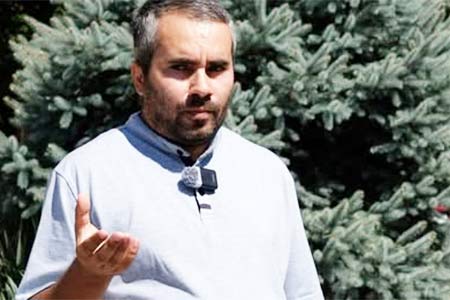
Melikyan, however, agreed that exceptions are possible in some cases, recalling that when he was Artsakh Ombudsman, his deputy at the time was Artak Beglaryan (now the head of the Artsakh Union NGO, who is blind in both eyes - ed.). Furthermore, he said that as a student, he had two students who were blind in both eyes but who demonstrated good results. However, he emphasized that in this case, there are certain criteria, and not everyone can become a judge. "If we're talking about deafness in both ears, then we must also understand that a judge must not only understand the essence of the case but also pay attention to intonation, which is very important for developing correct perception. Text can be read, but if we're dealing with live speech, the inability to perceive a person's intonation can lead to many problems in the administration of justice," Melikyan explained.
In light of the above, touching on the possible motives behind such a decision, the lawyer noted that its timing during the pre-election period is no coincidence. "It's important to understand that the Armenian Ombudsman is widely associated with the ruling Civil Contract party, and perhaps they are simply trying to reap additional benefits from the segment of the population that suffers from certain hearing or vision impairments," the human rights activist concluded.
As a reminder, several articles of the Constitution regarding the complete ban on appointing individuals with complete deafness or blindness as judges were declared invalid. The Constitutional Court decided to consider the case based on a petition filed by Armenian Ombudsman Anahit Manasyan, in which she challenged restrictions related to physical disabilities and illnesses that prevent appointment to judicial office. In particular, the discussion focused on the list of physical defects and illnesses adopted by the Armenian government on May 30, 2019, which make it impossible for people who are deaf in both ears or blind in both eyes to be appointed to the position of judge.













 Armenian expert: Could modern Azerbaijan even exist without Russian and Soviet modernization?
 South Caucasus is entering a new phase of turbulence - ex-official
  Expert: Azerbaijan`s political leadership states `occupation of Armenia is their new national goal`
  Human rights activist Ruben Melikyan dismissed from YSU
 Zakharova: Armenia`s pro-EU pivot poses economic security risks to EAEU member states
 It`s time for South Caucasus countries to think of South Caucasus as single, unified region - RA premier
  Pashinyan: Armenia and Azerbaijan should leave each other alone
 Moscow sees situation with Armenia as attempt to attack Russia-involving integration associations - Russian presidential aid
 Zakharova: Armenia views relations with Russia as tool for financially securing reorientation toward EU
 The Armenian Minister of Justice and the EU Ambassador discussed visa liberalization issues for Yerevan.
 Azerbaijan`s aggressive plans against Armenia became possible in wake of Pashinyan`s decisions on Artsakh - expert
  Zakharova: Russia sent a note of protest to Armenia over the act of vandalism at the "Mother Armenia" memorial in Gyumri
 Samvel Karapetyan proposes creating a post-election opposition coalition
 Artsakh`s Cultural Heritage Ombudsman called on Moscow to respond to destruction of WWII monuments by Azerbaijan in occupied NKR
 Prosecutor General`s Office petitions Central Electoral Commission for criminal prosecution of Robert Kocharyan
 Dutch Prime Minister expresses his support for Armenia`s democratic reform and economic diversification agenda