
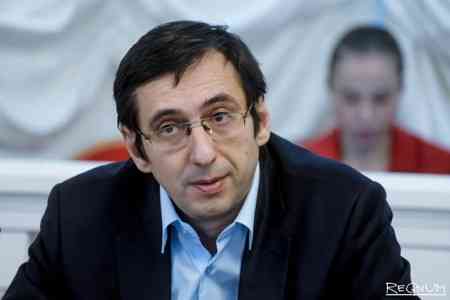
ArmInfo.Armenia, under the guise of "multi-vectorism," is pursuing a course of European integration. Russian political scientist and expert at the Strategic Culture Foundation, Andrei Areshev, shares this opinion.
The expert recalled that on September 20, Armenian Prime Minister Nikol Pashinyan stated at a congress of the ruling Civil Contract party that if his political party wins the upcoming parliamentary elections in June 2026, integration into the European Union will become a foreign policy priority for Armenia, while relations with Russia are undergoing a "constructive transformation."
"Disagreeing with statements about Russia's alleged "hybrid war" against Armenia, he said that during "all discussions, including with international partners," he consistently emphasizes the importance of dialogue with the Russian President and Prime Minister.
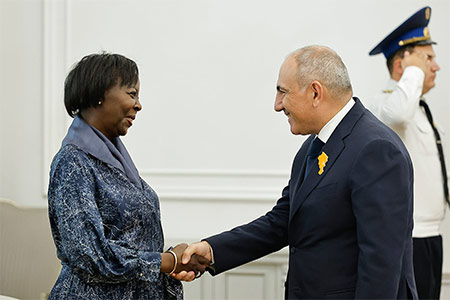
Earlier, on September 19, Armenian Deputy Prime Minister Mher Grigoryan discussed regional developments and unblocking communications with Elisabeth Falchetti, Managing Director for Turkey and the Caucasus at the European Bank for Reconstruction and Development (EBRD). During the meeting with another Deputy Prime Minister, Tigran Khachatryan, the construction of the Sisian-Kajaran road section, as well as prospects for cooperation in various areas, were discussed. The EBRD is a major institutional investor in Armenia, with its main priorities being enhancing the competitiveness of companies and supporting intermediation in the financial sector through risk-sharing products. According to ARKA, since the start of its operations in Armenia, the EBRD has allocated ?2.4 billion to implement 220 programs in various sectors. "Including energy, infrastructure, telecommunications, and finance," Areshev wrote in his article for the Strategic Culture Foundation.
He noted that on July 14, following Pashinyan's working visit to Brussels, European Commission President Ursula von der Leyen noted that ties between the European Union and Armenia are stronger than ever. "Brussels will allocate over ?200 million to Armenia as part of the second phase of the Resilience and Growth Program," said EU Enlargement Commissioner Marta Kos, who recently visited Baku and Yerevan. According to her, Brussels is ready to support Armenia in projects in transport, digitalization, trade, energy, and infrastructure as part of the Crossroads of the World project. Earlier, it was announced that the White House intended to allocate $145 million to Yerevan for the implementation of the Trump Road to International Peace and Prosperity (TRIPP) initiative. The first tranche will be used to support investments in trade, infrastructure, supply chains for critical mineral resources, and cross-border security," the expert noted.
Areshev also noted Armenian Economy Minister Gevorg Papoyan's statement that the largest economic impact will come not from the resumption of railway operations, but from a major American company investing in Armenia.
The expert also noted that earlier reports indicated the possible construction of railways and highways, oil and gas pipelines, and the development of communications infrastructure as part of the "Zangezur Corridor," which links the mainland of Azerbaijan with the Nakhchivan Autonomous Region and further on to Turkey.
"The presence of oil and gas pipelines in this package, and even the name 'Trump Road,' point to a likely revival of American and Western European projects from the 1990s and early 2000s to create additional transit corridors in the South Caucasus.
The process of normalizing Armenian-Turkish relations has also intensified. On September 12, the special representatives of Turkey and Armenia for the normalization process, Serdar K?l?c and Ruben Rubinyan, "...reaffirmed their commitment to continuing the normalization of relations without preconditions and reached an agreement to accelerate the process to implement the 2022 border crossing agreement between the two countries," once again deciding "on the necessary technical work to be carried out by the relevant authorities of the two countries on the restoration and commissioning of the Kars-Gyumri railway line and the electric interconnector," the Russian political scientist continued.
According to him, all of this is accompanied by a significant decline in Armenian-Russian trade, as previously reported on the sidelines of the Eastern Economic Forum by Russian Deputy Prime Minister Alexei Overchuk: "As for trade between Russia and Armenia, it has already declined significantly, and we expect that by the end of the year it will have fallen by half compared to last year. That is, if last year it was 12.4 billion, then this year it will probably be around 6 billion, maybe a little more." Experts also point to the decline in re-exports between Armenia and Russia, which since 2022 accounted for about a third of total bilateral trade, which is also negatively impacting its volume.
"This is also confirmed by Gevorg Papoyan: while the share of finished goods in Armenian exports to Europe is allegedly growing, re-export brings very little economic benefit, and therefore its reduction does not have any particular negative consequences. According to the minister, more than $3.7 billion of the total trade reduction of $4.2 billion comes from jewelry and unprocessed gold, $185 million from platinum, $175 million from silver,
In this vein, he recalled that in 2024-25, the Pashinyan government and the ruling Civil Contract party launched the process of making a decision on the country's accession to the European Union, adopting a separate law on the matter. "Both Moscow and Yerevan have repeatedly spoken about the impossibility of Armenia's simultaneous membership in two integration associations, and Pashinyan has acknowledged that sooner or later a choice will have to be made (something suggests it has already been made). At the beginning of this year, A. Overchuk pointed out the negative impact of Armenia's decision to join the EU on economic relations with the Russian Federation. According to him, Russian businesses "began gradually reducing their operations in the Armenian market back in 2024." Furthermore, as part of Yerevan's "pro- European" policy, in January 2024 they abandoned the Black Sea ferry route between the Russian port of Kavkaz and the Georgian port of Poti, which had operated intermittently since 2007. Freight through this route accounted for approximately 20% of Armenian-Russian trade turnover, under the pretext of its alleged unprofitability," the Russian political scientist stated.
Areshev also noted President Vahagn Khachatryan's remarks in an interview with RTVI on September 11 that "our relations with Russia are now completely different-partnership-like. Russia's attitude toward Armenia is not that of an older brother to a younger brother, but simply a partnership, which is what we've been striving for over the past four years." At the same time, Yerevan "wants its Russian colleagues to take into account the independent decisions of our country's authorities." The Armenian government "must decide for itself with whom, how, to trade, work, and have diplomatic relations." Pashinyan expresses a similar opinion: "...Armenia has been an independent state for 34 years, and it's important to understand that partnership is not a 'marriage,' but friendship, and if you have many friends, then you're a normal person. International relations exist so that a state can have as many partners as possible."
"Clearly pursuing the 'European choice,' which is closely tied to integration into Azerbaijani-Turkish projects in the Caucasus and carries serious risks for the economy and ordinary citizens, the current Armenian authorities are attempting to put on a less-than-convincing show for their Russian partners in an effort to continue receiving preferences from EAEU membership, which clearly won't hinder their progress toward the West," Areshev concluded.








 Expert: The arrest of opposition figures in Armenia for social media posts is a systematic attempt to intimidate the public and suppress dissent.
 Azerbaijani Studies Expert: While Azerbaijan Prepares Its Generation for War, Aliyev’s Aide Calls on Armenia to Prepare Armenian Society for “Peace”
 Turkologist: Azerbaijan will never, under any circumstances, stop pressuring the Armenian people
 Political scientist: We need to move away from the question of "when" and replace it with more important questions
 Lukashenko called for Armenia to assume the CIS presidency in 2029
 Dmitry Medvedev predicted a Ukrainian-like fate for Armenia amid the country`s shift in foreign policy
 Russian Security Council: In Armenia, they want to force Russian asset owners to dispose of their assets
 Zakharova: Russia ready to discuss with Armenia the prospects for expanding military cooperation as part of a review of bilateral ties
 Tevanyan: Armenia, like Ukraine and Moldova, is being drawn into the EU’s global war
 Yerevan City Hall is considering introducing a valet parking system in the city
 Expert: The circus surrounding the “Albanization” of Armenian culture in the presence of foreign ambassadors in occupied Artsakh is genocide
 Political scientist: If Russian-Armenian relations are destroyed, Turkey will take Russia`s place
 Political scientist: The Armenian public is simply obliged to significantly change the entire content of public discourse and struggle
 Cross tattoos are being removed from the skin of Christian prisoners in Azerbaijan by fire, according to a human rights activist.
 Zakharova: Armenia`s likely introduction of visas with Russia will be a step against Yerevan itself
 Putin: Armenia`s recognition of Karabakh as part of Azerbaijan in Prague has given Russia`s position on this issue an ambivalent character
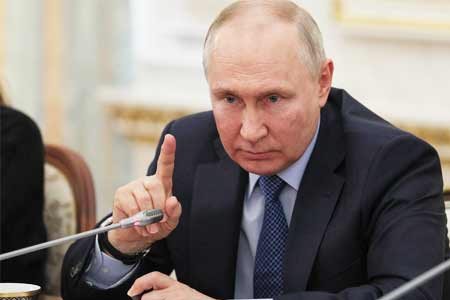 Putin: Armenia`s adoption of the law on EU accession means an announcement of its withdrawal from the Eurasian Economic Union