



ArmInfo. The Armenian communities of Syria, Lebanon, Iraq, and the Middle East as a whole, which became centers of active survival after the Genocide, are now facing an existential threat, according to Vera Yakupyan of the Azdag publication.
According to her, the collapse of state structures, demographic decline, and Turkey's growing influence have created an unstable environment in which the Armenian presence is becoming increasingly vulnerable. "Turkey's indirect control over Aleppo has changed the political and military-economic balance in the region, and Lebanon's economic collapse has accelerated emigration. The question is no longer about sounding the alarm, but about developing a new strategy," she noted, as quoted by the Armenian Revolutionary Federation (ARF).
Yakupian is confident that the future of Armenian communities remains closely tied to the ability of traditional diaspora parties, especially the ARFF, to choose new political and organizational paths. "The 35th Congress of the ARF already emphasized that the party's goal should be 'building a competitive national state of new quality and preserving Armenian identity.' This position should pave the way from ideological confrontation to practical stabilization and modernization.
But even so, this transformation cannot be limited to a vision. How can Armenian communities in the Middle East transform their historical resilience into institutional stability in the face of modern geopolitical threats? This flexibility will only be realized through the modernization of structures, the formation of new alliances, and initiatives that directly serve the survival of the communities," Yakupian asserts.
She recalled that historically, the ARF has been a defender of Armenian identity and the interests of the diaspora, but today it needs to transform its powerful infrastructure-schools, youth organizations, media, and community structures-into flexible centers. According to her, these structures can provide legal and psychological support during times of crisis and simultaneously serve as platforms for representing Turkey's regional aspirations in the international community.
"A new generation must be trained as political advocates for the diaspora, capable of establishing contacts with international organizations, Western governments, and think tanks. This means a shift for the ARF from a classic, purely ideological (and oppositional in Armenia) position to a redistribution of alliances. Forming alliances not only with Armenia's domestic political structures but also with multinational minorities in the Middle East (Assyrians, Kurds, Maronites) can ensure a common defense," Yakupyan believes. She believes the ARF needs to shift its approach from confrontation to cooperation, building it, including with international NGOs and UN agencies, not from a partisan standpoint, but as a representative of the region's endangered communities.
"Armenia's new political course, aimed at normalizing relations with Turkey and Azerbaijan, has exacerbated the mistrust between the diaspora and its homeland. Much of the diaspora views this process as a violation of historical justice, while the Armenian authorities present it as a realistic step toward stability and survival. This opposition could hinder the protection of Armenian communities in the Middle East. But the crisis also creates new opportunities," Yakupyan continued.
She is confident that relations between Armenia and the diaspora must be restructured not on an emotional or ideological basis, but on the basis of strategic realism.
"Armenia must recognize that diaspora communities face immediate threats, and their protection is inseparable from pan-Armenian responsibility. An effective approach requires Armenia to regularly raise minority protection issues at international forums (UN, UNESCO), framing them as cultural and human rights issues. The fate of Armenian communities in the Middle East can no longer depend on historical memory. A clear strategy, structural restructuring, and pan-Armenian maturity are needed. The ARF, thanks to its historical legitimacy and organizational capabilities, is uniquely positioned for leadership and restoration," she added.
Yakupyan believes that Armenia, having normalized its foreign relations, must act not only as a state but also as a force bearing pan-Armenian responsibility. The diaspora must transform itself into a social organization that brings together diverse experiences and capabilities.
"If Armenian political and social forces pool their capabilities, reconsider their approach, and act in solidarity, then the Armenian presence in the Middle East can not only be preserved but also become an example of a new vision based on flexibility, cooperation, and strategic wisdom," she concluded.


























 Present-day geopolitical competition shifts from territorial control to infrastructure flows
 Expert: Public participation in decision-making essential for sustainable urban development
  Politician: Statement by Armenia`s third president may deprive opposition of only political basis for ousting Pashinyan
 RA Security Council Sec, Assistant to President of Azerbaijan hold negotiations in Dilijan
 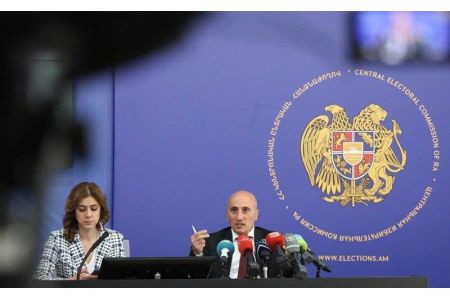 CEC Neutralizes PAP: Three Political Forces to Enter Armenian Parliament Following Election Vote
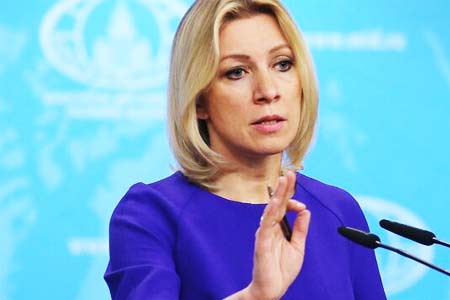 Elections in Armenia were accompanied by unprecedented pressure on opposition, RF MFA spokesperson claims
  Expert: Even OSCE observers recorded numerous violations during elections in Armenia
  Moscow to await official results of Armenian elections - Peskov
 Antonio Costa: EU to deepen its partnership with Armenia, expanding cooperation in energy, trade, and digitalization
 Israeli MFA congratulates Pashinyan
 Turkish MFA comments on results of Armenian elections
  Zakharova: International observers cannot ignore `flagrant violations` in Armenian elections
 Strong Armenia to issue statement after vote count completed - Narek Karapetyan
 Russian Senator: Opposition complaints regarding election violations by ruling party remain unanswered
 RA premier receiving congratulations on his victory in parliamentary elections