
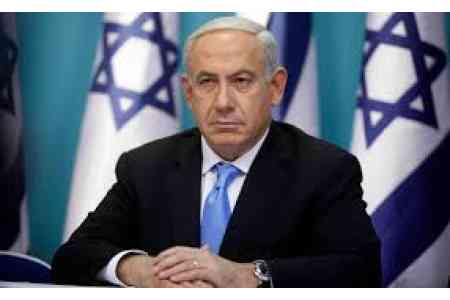
ArmInfo. Israeli Prime Minister Benjamin Netanyahu stated for the first time that he recognizes the Genocide carried out by the Ottoman Empire against Armenians, Assyrians and Greeks in the early 20th century, The Times of Israel reports.
Asked by Patrick Bet-David on his podcast why Israel does not recognize the Armenian genocide, Netanyahu said, "I think we have. I think the Knesset passed a resolution to that effect," though no such legislation has been passed into law. Pressed on why no Israeli prime minister has recognized the genocide, Netanyahu responds, "I just did. Here you go."
The Times of Israel recalls that Armenians have long sought international recognition of the killings by the Ottoman Empire, which reportedly left some 1.5 million of their people dead, as a genocide. Turkey - the Ottoman Empire's successor state - strongly rejects the allegation that the massacres, imprisonment and forced deportation of Armenians amounted to genocide.
In 2001, when relations with Turkey were at an apex, then-foreign minister Shimon Peres outright denied "Armenian allegations," denouncing them as an effort to create a parallel with the Holocaust. "Nothing similar to the Holocaust occurred. What the Armenians went through is a tragedy, but not genocide," he said.
Yet there have also been attempts by prominent politicians to move Israeli policy. In 2000, then-education minister Yossi Sarid of the left-wing Meretz party announced plans to place the Armenian genocide on Israel's history curricula. "Genocide is a crime against humanity and there is nothing more horrible and odious than genocide. One of the objectives of our education - our main objective - is to instill sensitivity to the harm to the innocent based on nationality alone," he said on the 85th anniversary of the massacre. "We Jews, as principal victims of murderous hatred, are doubly obligated to be sensitive, to identify with other victims."
More than a decade later, in June 2011, it was MK Arye Eldad of the far-right National Union party who introduced a bill to declare every April 24 Armenian Genocide Remembrance Day. A few weeks earlier, the Knesset had held its first discussion on recognizing the genocide. A majority seemed to support recognition, but the issue was never put to a vote.
Even Israel's previous president, Reuven Rivlin, was an outspoken advocate for the recognition of the Armenian genocide. "It's unthinkable for the Knesset to ignore this tragedy," Rivlin said when he was the Knesset speaker for the Likud party, before becoming president. "We demand that people don't deny the Holocaust, and we can't ignore the tragedy of another nation."
But as president, his priorities shifted dramatically. During a 2015 UN address, Rivlin spoke at length about the massacre of Armenians a century before. But he tiptoed around recognition. Speaking in Hebrew, Rivlin referred to the retzah bnei ha'am ha' armeni, which means "the murder of the members of the Armenian nation," which hints at the Hebrew term for genocide, retsa am, but falls shorts of using the term itself.
He also decided as president not to renew his signature on an annual petition calling on Israel to recognize the genocide. A 2018 Knesset vote on recognizing the genocide was cancelled to a lack of coalition support.















 Expert: Gagik Tsarukyan embodies post-Soviet model of big business-state relations; this model is used in many other post-Soviet countries
 Expert: Azerbaijan promoting aggressive plans against Armenia at state level
 Iranologist: Baku`s propaganda of might masks the country`s inability to provide water to its own population
 Moscow: NATO seeking to "Pull" Armenia away from CSTO Allies
  Political analyst: Russia intends to determine which "Camp" Armenia will choose through a referendum
 Narek Karapetyan will give up his parliamentary salary in favor of charitable contributions.
 Armenia and France discuss further development of strategic partnership and EU cooperation
  To overcome risks Armenia must reduce domestic escalation - expert
  Zatulin: Pashinyan was eager to get back to Russia because he actually lost the elections
 Human rights activist Ruben Melikyan dismissed from YSU
 Zakharova: Armenia`s pro-EU pivot poses economic security risks to EAEU member states
 It`s time for South Caucasus countries to think of South Caucasus as single, unified region - RA premier
  Pashinyan: Armenia and Azerbaijan should leave each other alone
 Moscow sees situation with Armenia as attempt to attack Russia-involving integration associations - Russian presidential aid