
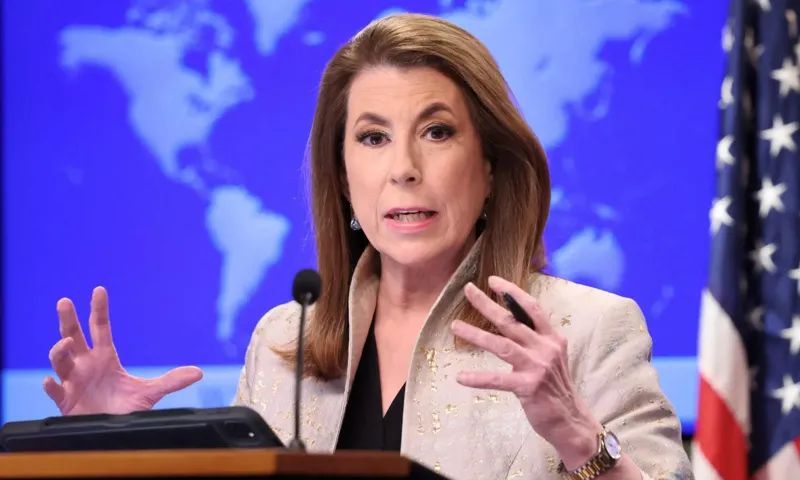
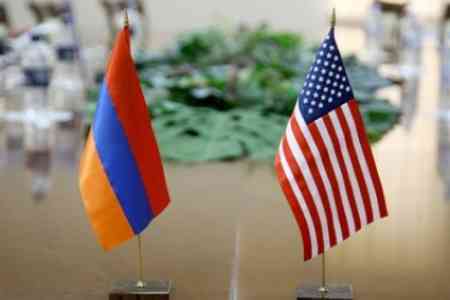
ArmInfo. The declaration of peace between Armenia and Azerbaijan has reaffirmed that President Trump is indeed the president of peace. Last week, he hosted the leaders of Armenia and Azerbaijan at the White House, where they signed a historic joint declaration for peace after decades of bitter conflict and too many lives lost - a landmark achievement for international diplomacy and an end to violence that only President Trump could deliver. The two leaders also signed bilateral economic agreements with the United States, unlocking the great potential of the South Caucasus region in trade, transit, energy, infrastructure, and technology; and creating new opportunities for the American people and American businesses, Tammy Bruce, Spokesperson for the U.S. Department of State, told a briefing.
In response to a question as to what United States will do if Russia or Iran try to block or sabotage this new peace route, she said:
"The world knows to take President Trump seriously. This arrangement, this deal, is important to him. They were at the White House. This matters to this administration. It matters to the world. I can say that as some people may not even know because it doesn't get coverage, these two neighbors have been in conflict for decades. I think it's over 35 years now, with countless lives lost and generations scarred.
"While many have tried - we have to say the Europeans, the French, and Putin and even Biden - only President Trump was able to successfully bring this to - these two countries together to agree to this historic peace. So I think what the world knows is that he is committed to longstanding, durable peace between countries regardless of how long the conflicts have lasted or the hostility has lasted. And that commitment, as we've also seen - he's a realist, it's based in diplomacy, but he'll do what he needs to do to make the most of being the President of the United States and stopping the wars."
On August 8, Armenian Prime Minister Nikol Pashinyan and Azerbaijani President Ilham Aliyev signed a joint "peace declaration" in Washington. It provides for a joint appeal to the Organization for Security and Cooperation in Europe (OSCE) to terminate the OSCE Minsk process and related structures, as well as the creation of a transport corridor through Armenian territory that will connect Azerbaijan with its Nakhchivan exclave. The TRIPP (Trump Route for International Peace and Prosperity) project, a 42-km road in southern Armenia that will hand over control of the road to the United States for 99 years, according to experts, is capable of significantly changing the geopolitical situation in the South Caucasus. On the same day, the Foreign Ministers of Armenia and Azerbaijan initialed a peace agreement, which consists of 17 articles. The preamble of the document states that the Republic of Armenia and the Republic of Azerbaijan, recognizing the urgent need to establish a just, comprehensive and lasting peace in the region, striving to promote the achievement of this goal through the establishment of interstate relations, guided by the Charter of the United Nations, the Declaration on Principles of International Law concerning Friendly Relations and Cooperation among States in accordance with the Charter of the United Nations (1970), the Final Act of the Helsinki Conference on Security and Cooperation in Europe (1975) and the Almaty Declaration of December 21, 1991, and striving to develop relations based on the norms and principles enshrined in the said documents, expressing mutual will to establish good-neighborly relations among themselves, agreed to establish peace and interstate relations.
Yerevan. August 13. ArmInfo. Alexander Avanesov. The declaration of peace between Armenia and Azerbaijan has reaffirmed that President Trump is indeed the president of peace. Last week, he hosted the leaders of Armenia and Azerbaijan at the White House, where they signed a historic joint declaration for peace after decades of bitter conflict and too many lives lost - a landmark achievement for international diplomacy and an end to violence that only President Trump could deliver. The two leaders also signed bilateral economic agreements with the United States, unlocking the great potential of the South Caucasus region in trade, transit, energy, infrastructure, and technology; and creating new opportunities for the American people and American businesses, Tammy Bruce, Spokesperson for the U.S. Department of State, told a briefing.
In response to a question as to what United States will do if Russia or Iran try to block or sabotage this new peace route, she said:
"The world knows to take President Trump seriously. This arrangement, this deal, is important to him. They were at the White House. This matters to this administration. It matters to the world. I can say that as some people may not even know because it doesn't get coverage, these two neighbors have been in conflict for decades. I think it's over 35 years now, with countless lives lost and generations scarred.
"While many have tried - we have to say the Europeans, the French, and Putin and even Biden - only President Trump was able to successfully bring this to - these two countries together to agree to this historic peace. So I think what the world knows is that he is committed to longstanding, durable peace between countries regardless of how long the conflicts have lasted or the hostility has lasted. And that commitment, as we've also seen - he's a realist, it's based in diplomacy, but he'll do what he needs to do to make the most of being the President of the United States and stopping the wars."
On August 8, Armenian Prime Minister Nikol Pashinyan and Azerbaijani President Ilham Aliyev signed a joint "peace declaration" in Washington. It provides for a joint appeal to the Organization for Security and Cooperation in Europe (OSCE) to terminate the OSCE Minsk process and related structures, as well as the creation of a transport corridor through Armenian territory that will connect Azerbaijan with its Nakhchivan exclave. The TRIPP (Trump Route for International Peace and Prosperity) project, a 42-km road in southern Armenia that will hand over control of the road to the United States for 99 years, according to experts, is capable of significantly changing the geopolitical situation in the South Caucasus. On the same day, the Foreign Ministers of Armenia and Azerbaijan initialed a peace agreement, which consists of 17 articles. The preamble of the document states that the Republic of Armenia and the Republic of Azerbaijan, recognizing the urgent need to establish a just, comprehensive and lasting peace in the region, striving to promote the achievement of this goal through the establishment of interstate relations, guided by the Charter of the United Nations, the Declaration on Principles of International Law concerning Friendly Relations and Cooperation among States in accordance with the Charter of the United Nations (1970), the Final Act of the Helsinki Conference on Security and Cooperation in Europe (1975) and the Almaty Declaration of December 21, 1991, and striving to develop relations based on the norms and principles enshrined in the said documents, expressing mutual will to establish good-neighborly relations among themselves, agreed to establish peace and interstate relations.

























 Iranologist: Baku`s propaganda of might masks the country`s inability to provide water to its own population
 Analyst: Continued tensions between Yerevan and Moscow could entail new restrictive measures from Russia
 Political analyst: Russia intends to determine which "Camp" Armenia will choose through a referendum
 Armenia and France discuss further development of strategic partnership and EU cooperation
  To overcome risks Armenia must reduce domestic escalation - expert
  Zatulin: Pashinyan was eager to get back to Russia because he actually lost the elections
 Human rights activist Ruben Melikyan dismissed from YSU
 Pashinyan removed from INNOPROM guest list
 Zakharova: Armenia`s pro-EU pivot poses economic security risks to EAEU member states
 It`s time for South Caucasus countries to think of South Caucasus as single, unified region - RA premier
  Pashinyan: Armenia and Azerbaijan should leave each other alone
 Moscow sees situation with Armenia as attempt to attack Russia-involving integration associations - Russian presidential aid
 Zakharova: Armenia views relations with Russia as tool for financially securing reorientation toward EU
 The Armenian Minister of Justice and the EU Ambassador discussed visa liberalization issues for Yerevan.
 Azerbaijan`s aggressive plans against Armenia became possible in wake of Pashinyan`s decisions on Artsakh - expert
  Zakharova: Russia sent a note of protest to Armenia over the act of vandalism at the "Mother Armenia" memorial in Gyumri