
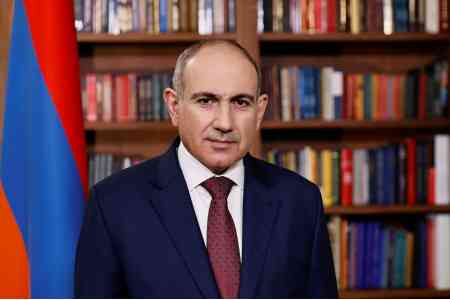
ArmInfo. The political survival of Nikol Pashinyan's government now relies less on popularity and more on the deep and comprehensive vacuum of trust in Armenia's political system, as highlighted in a study conducted by Vache Tamrazyan, Deputy Chairman of the Center for Law and Freedom NGO.
The study provides a comprehensive analysis of public approval and trust ratings for the Prime Minister of the Republic of Armenia Nikol Pashinyan and his government - from the Velvet Revolution of 2018 to mid-2025.
According to the expert, this creates a fragile and unstable political balance on the way to the important parliamentary elections in 2026. This study divides Pashinyan's tenure into three stages. The first stage (2018-mid-2020) is the era of the revolutionary mandate, characterized by approval ratings above 80%. This period is marked by the hope and promise of a new Armenia, free from the corruption and stagnation of the past.
The second stage covers the end of 2020 and 2021, the period of the 44-day war, which led to an irreversible decline in public trust. The military defeat and the subsequent tripartite ceasefire agreement (of November 9, 2020 - ed.), perceived by the general public as a national humiliation, caused a catastrophic and irreversible collapse of public trust. Pashinyan's approval ratings, which exceeded 84% before the war, fell sharply and have consistently remained in the low double digits in the following years. "This gap between the leader and society turned out to be fundamental and irreparable," the study says. Despite this collapse, Pashinyan's Civil Contract party won a convincing victory in the 2021 snap parliamentary elections. However, this paradoxical result did not indicate the restoration of the people's mandate, but only emphasized the deep vacuum of trust in Armenian politics. "The convincing victory of Pashinyan's party, which restored his mandate, was not due to popular approval, but against the backdrop of deep public rejection of the alternative," Tamrazyan noted.
The third and current phase of Pashinyan's rule (2022-2025) is characterized by a low level of approval from the population (11-17%) and has been marked by a series of challenging events: the military invasion by Azerbaijan, the prolonged blockade of the Lachin corridor, and, ultimately, the military takeover in September 2023 and ethnic cleansing of Nagorno-Karabakh. However, it was during this period that a new, clear popular mandate emerged - strong support for the government's historic foreign policy course towards diversification from Russia and towards the West.
This strategic shift -moving away from traditional dependence on Russia and increasing engagement with the West - is not simply a project promoted by the ruling elite. It is based on a parallel and dramatic shift in Armenian public opinion, shaped by the war and a sense of abandonment by a long-standing ally. Despite the challenges that Pashinyan's government faces in gaining domestic legitimacy on many fronts, there is a clear and growing popular mandate for this historic shift in geopolitical course>, the study says. According to Tamrazyan, this pro-Western sentiment has crystallized around the issue of European integration. The support for joining the EU has gone beyond narrow professional circles and is now the viewpoint of the majority. This has provided Pashinyan's government with a popular mandate for it's declared policy of deeper integration with the EU, including taking formal steps to launch the accession process. , the expert noted.
The study also touched on Pashinyan's course to achieve peace with Azerbaijan and normalize relations. In the current reality, as the expert notes, there is public ambivalence towards Azerbaijan and Turkey. While the Armenian government is actively promoting a peace agenda, including the "Crossroads of Peace" project aimed at regulating relations and opening borders with neighbors, society remains skeptical and divided, as evidenced by all the polls conducted during this period. About 80% of the Armenian population does not support making any concessions to Azerbaijan in exchange for peace. This, according to Tamrazyan, is a serious obstacle to negotiations, especially regarding Baku's demand to amend the Constitution of Armenia.
"The government has found itself in a difficult situation: it is promoting a peace agenda that society theoretically wants, but ultimately rejects, considering the perceived high cost of peace, and lack of trust in negotiators. This internal contradiction creates a permanent political vulnerability, that the opposition systematically exploits, presenting any possible concessions as betrayal or web of contradictions: it holds a strong mandate in foreign policy, but lacks support for domestic issues.










 Opinion: The development of the Amulsar mine near the resort town of Jermuk is the beginning of an environmental disaster in Armenia
 Expert: The arrest of opposition figures in Armenia for social media posts is a systematic attempt to intimidate the public and suppress dissent.
 Azerbaijani Studies Expert: While Azerbaijan Prepares Its Generation for War, Aliyev’s Aide Calls on Armenia to Prepare Armenian Society for “Peace”
 Turkologist: Azerbaijan will never, under any circumstances, stop pressuring the Armenian people
 Political scientist: We need to move away from the question of "when" and replace it with more important questions
 Lukashenko called for Armenia to assume the CIS presidency in 2029
 Dmitry Medvedev predicted a Ukrainian-like fate for Armenia amid the country`s shift in foreign policy
 Russian Security Council: In Armenia, they want to force Russian asset owners to dispose of their assets
 Zakharova: Russia ready to discuss with Armenia the prospects for expanding military cooperation as part of a review of bilateral ties
 Tevanyan: Armenia, like Ukraine and Moldova, is being drawn into the EU’s global war
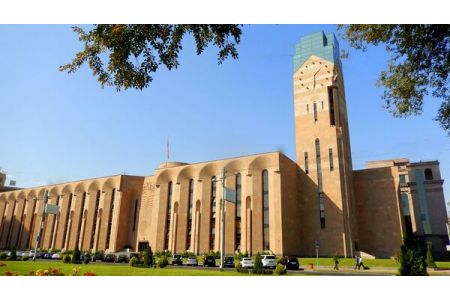 Yerevan City Hall is considering introducing a valet parking system in the city
 Expert: The circus surrounding the “Albanization” of Armenian culture in the presence of foreign ambassadors in occupied Artsakh is genocide
 Political scientist: If Russian-Armenian relations are destroyed, Turkey will take Russia`s place
 Political scientist: The Armenian public is simply obliged to significantly change the entire content of public discourse and struggle
 Cross tattoos are being removed from the skin of Christian prisoners in Azerbaijan by fire, according to a human rights activist.
 Zakharova: Armenia`s likely introduction of visas with Russia will be a step against Yerevan itself
 Putin: Armenia`s recognition of Karabakh as part of Azerbaijan in Prague has given Russia`s position on this issue an ambivalent character
 Putin: Armenia`s adoption of the law on EU accession means an announcement of its withdrawal from the Eurasian Economic Union
 Aram Vardevanyan: Public demands solutions, not apology scandals in Parliament