


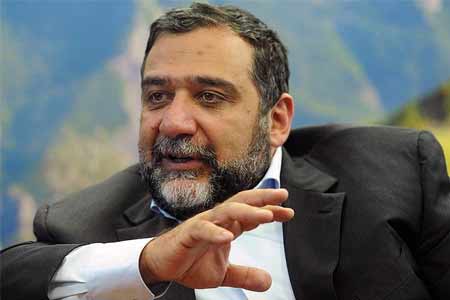
ArmInfo.Former state minister of Artsakh Ruben Vardanyan does not think Armenia and Azerbaijan are drawing closer to peace. In his interview with a Russian TV channel he commented on the US-brokered negotiations between the Armenian and Azerbaijani FMs and their work on a "road map for peace."
According to him, Azerbaijan's setting up a checkpoint on the Lachin corridor was an anti-Russian step.
"They are sparing no effort to neutralize the Agreement of November 9, 2020, which was signed with Russia's participation. In this respect, the basis for a peace agreement is very week, as peace in the South Caucasus is difficult to establish without Russia. Also, I can hardly imagine a peace agreement 'at gun point,' when people cannot move freely. It is not a way peace agreements work," Mr Vardanyan said. Never has such a thing happened in history nor will ever happen. It is a big game, including by Azerbaijan, to squeeze Russia out of the South Caucasus.
As to Azerbaijan referring to previously signed documents in pursuing its policy of establishing full control over the Lachin corridor, Mr Vardanyan said that the Trilateral Agreement provides for free communication between Nagorno-Karabakh and Armenia through the Lachin corridor, with Azerbaijani armed forces to be located at a distance of at least 5 km from the Lachin corridor. The corridor had been under the Russian peacekeepers' control for 2 years and a half, and the ones that set up the checkpoint are themselves unable to explain its status. Thus, Baku has caused a serious problem not only to the Artsakh population and Russian peacekeeping troops, but also to itself, by creating an explosive situation. And this is playing into the hands of the forces sparing no effort to have Russia leave the region.
As to the Azerbaijan foreign office's explanations that the checkpoint is designed to prevent the transportation of military personnel and arms supplies to Nagorno-Karabakh, whereas the road is free for civilians and cargoes, Mr Vardanyan stressed that it is the Russian peacekeepers' function - and they had performed it before. In case of any questions to the peacekeepers, scanners should have been installed to show nothing like that was taking place. But the Trilateral Agreement does not provide for the presence of Azerbaijani servicemen, and any interpretations are just a play on words. The Trilateral Agreement is quite clear.
Moreover, if Azerbaijan has a "peace agenda", it is not the way of this agenda into practice. "Progress toward peace can hardly be imagined with stress being caused to people," Mr Vardanyan said.
As to the fact that the U.S.-brokered negotiation process has left the Russia-brokered one behind, Mr Vardanyan said that his knowledge of history, including the history of the 20th century, enables him to realize that "all the papers have no sense" without solid grounds.
"We well remember the British premier who returned with a peace paper from Munich, but World War II broke out, however. Any talks rove a success only with solid grounds - people seeking an agreement. Second, no peace can be established in the region at gunpoint, by means of intimidation, ethnic cleansing threats, statements like 'those disagreeing will not live here'. A whole generation has grown up in Nagorno- Karabakh who do not at all know what Azerbaijan is because they have never had any contacts with Azerbaijanis. And I hardly see an image Azerbaijan is creating for itself in Artsakh, with its rhetoric and steps, instead of a peace agenda," Mr Vardanyan said. In this context, he calls for strict commitment to the Trilateral Agreement, under which the Lachin corridor is under the Russian peacekeepers' control.










 Political scientist: Real recount will deprive Pashinyan of any constitutional majority
 Expert: Even OSCE observers recorded numerous violations during elections in Armenia
  Armenia`s ex-minister of justice calls on opposition to honestly answer questions troubling Armenian citizens
 Elections in Armenia were accompanied by unprecedented pressure on opposition, RF MFA spokesperson claims
  Moscow to await official results of Armenian elections - Peskov
 Antonio Costa: EU to deepen its partnership with Armenia, expanding cooperation in energy, trade, and digitalization
 Israeli MFA congratulates Pashinyan
 Turkish MFA comments on results of Armenian elections
  Zakharova: International observers cannot ignore `flagrant violations` in Armenian elections
 Strong Armenia to issue statement after vote count completed - Narek Karapetyan
 Russian Senator: Opposition complaints regarding election violations by ruling party remain unanswered
 RA premier receiving congratulations on his victory in parliamentary elections
 Head of IPA CIS Council Secretariat: Extremely difficult atmosphere during parliamentary elections campaign in Armenia accompanied by mass arrests
 Pashinyan`s party leads with 51.13% based on vote counts from 533 polling stations
 Voting in parliamentary elections in Armenia ends
  Strong Armenia: Administrative Court not providing judicial decisions to citizens wishing to vote in parliamentary elections
