
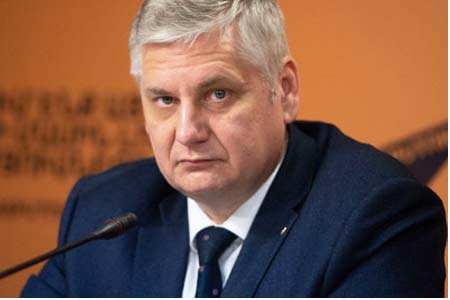
ArmInfo.Sergey Markedonov, the leading researcher at the Euro-Atlantic Security Center of the MGIMO Institute for International Studies, analyzed the policies of the Eurasian Triangle countries - Azerbaijan-Israel-Iran.
Thus, the expert stated that on the last Wednesday of March, the head of the Azerbaijani Foreign Ministry, Jeyhun Bayramov, visited Israel. He drew attention to the fact that at the joint press conference the minister thanked the Jewish state for the consistent support of Azerbaijan and its territorial integrity. In turn, Bayramov's Israeli counterpart Eli Cohen (by the way, the full namesake of the famous intelligence officer) considered official Baku's decision to open an embassy in Tel Aviv as "historic".
"Iran reacted as expected to the meeting of the two ministers. On March 31, Spokesman of the Ministry of Foreign Affairs of the Islamic Republic Nasser Kanaani spoke out against the machinations of the "Zionist regime" and the inadmissibility of turning Azerbaijan into an unfriendly state. Azerbaijan is presented as an object of a "Zionist conspiracy" (with particular emphasis on the long-standing historical and cultural ties between Iranians and Azerbaijanis), and Georgia as a country that has fallen under the bad influence of the United States and the West as a whole," Markedonov noted.
At the same time, the expert drew attention to the fact that relations between Iran and Azerbaijan are not going through the best times today. "Emotions and passions have not yet subsided after the attack on the Azerbaijani embassy in Tehran on January 27, 2023. As a result, a lot of assumptions and "scenarios" were spread in the media and social networks that new "geopolitical axes" were being formed in the Caucasus and the Middle East, and that Baku and Tel Aviv would be on the same boat against Tehran," the political scientist believes.
He drew attention to the fact that several years ago, the well-known SIPRI think tank published its calculations, according to which in 2015-2019, Azerbaijan purchased 60% of its strike and defense systems from Israel from all military imports.
At the same time, he wondered if this data is enough to clearly place the figures on the Eurasian geopolitical board?
According to Markedonov, there is no doubt that the opening of the Azerbaijani embassy in the Jewish state, as well as the presentation of credentials to the first ambassador, Mukhtar Mammadov, are developments of great symbolic significance.
"However, one should not overestimate their "historicity", nevertheless, it follows logically from the whole dynamics of relations between Baku and Tel Aviv in the post-Soviet period.
However, it should be kept in mind that along with its pro-Israeli line, Azerbaijan maintains a high level of relations with Palestine. The opening of the embassy in Tel Aviv and Bayramov's meeting with Cohen came under the focus of media attention. At the same time, the news about the opening of a representative office of Azerbaijan in Ramallah and the meeting of the country's Foreign Minister with Mahmoud Abbas remained in the shadows. Meanwhile, Baku has previously maintained close contacts with the Palestinian Authority, voted in the UN for granting it the status of an observer state. And the public mindset inside Azerbaijan has always been taken into account by the authorities of this country. And no matter what difficulties arose earlier in the Iranian direction (and there were many), they tried not to cross the "red lines," the Russian political scientist added.
According to him, in general, the foreign policy of post-Soviet Azerbaijan is built not on the basis of joining certain alliances, but through selective partnership.
"This is not a choice between the West and Russia, Iran and Israel, but diplomatic diversification. However, Baku's partners are acting in a similar way. And the Azerbaijani authorities certainly do not like to be used in their geopolitical combinations. The West is not the first time turns its eyes to Baku, having views on Iran, and now on Russia. But the Azerbaijani authorities, even after the "second Karabakh" did not accept the recognition of the Turkish Republic of Northern Cyprus.
It's the big powers that love to indulge in shades of black and white. Medium and small ones prefer halftones and nuances. It's this way easier to survive in this "crazy world"," he summed up.



















 Azerbaijani studies expert : Ruben Vardanyan’s wife threatened with arrest if she visits Baku
 Political scientist: The model of allied relations between Russia and Armenia has collapsed
 Expert: The defeated authorities` position on normalizing relations with the enemy should not affect the rights of Artsakh refugees
 Political scientist: If Russian-Armenian relations are destroyed, Turkey will take Russia`s place
 Political scientist: The Armenian public is simply obliged to significantly change the entire content of public discourse and struggle
 Cross tattoos are being removed from the skin of Christian prisoners in Azerbaijan by fire, according to a human rights activist.
 Zakharova: Armenia`s likely introduction of visas with Russia will be a step against Yerevan itself
 Putin: Armenia`s recognition of Karabakh as part of Azerbaijan in Prague has given Russia`s position on this issue an ambivalent character
 Putin: Armenia`s adoption of the law on EU accession means an announcement of its withdrawal from the Eurasian Economic Union
 Medvedev: Yerevan will never become an EU member, but it will permanently damage relations with the Eurasian Economic Union, including with Moscow.
 Aram Vardevanyan: Public demands solutions, not apology scandals in Parliament
 Arrested Armenian oligarch on economy and new jobs
  "In Baku, we gave a worthy rebuff to the false claims regarding the past and present of our people" – Former Artsakh Parliament Speaker from Baku captivity
  NA Vice Speaker candidate believes his wife`s salary as director of HayPost is the lowest in the company`s history
 RF Permanent Representative: There is no CSTO-Armenia conflict
 Moscow: NATO seeking to "Pull" Armenia away from CSTO Allies
  Political analyst: Russia intends to determine which "Camp" Armenia will choose through a referendum
 Narek Karapetyan will give up his parliamentary salary in favor of charitable contributions.