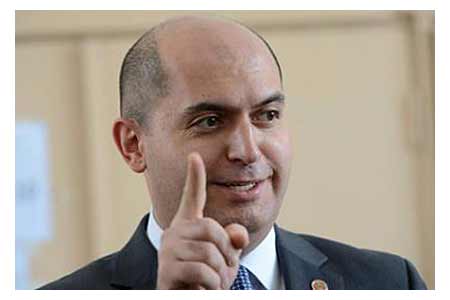
ArmInfo. Another anti-Armenian, anti-state deal between Armenia and Azerbaijan is being concluded behind the back of the Armenian people. Deputy Chairman of the Republican Party of Armenia Armen Ashotyan stated this on May 7 during a live broadcast on his Facebook page, reacting to the statements of Secretary of the Security Council of the Republic of Armenia Armen Grigoryan on the negotiation process on the Nagorno-Karabakh settlement.
Thus, responding to Grigoryan's statements that not only Azerbaijan put forward 5 proposals for the normalization of Armenian-Azerbaijani relations, but Armenia also proposed six proposals in response, which were accepted by the Azerbaijani side, Ashotyan noted that the key circumstance is the fact that the Security Council Secretary did not publish Yerevan's proposals.
"It is necessary to record a very important circumstance, this "flock" on behalf of the Republic of Armenia made six proposals to resolve the Karabakh conflict and normalize Armenian-Azerbaijani relations, which the Armenian society does not know about. These proposals are hidden from Nikol (RA Prime Minister Nikol Pashinyan - ed. note), the Ministry of Foreign Affairs, the Security Council of the Republic of Armenia," Ashotyan noted, adding that another anti-Armenian, anti-state deal is being concluded behind the back of the Armenian people.
At the same time, the politician added, if this is not the case, why are they hiding it from the Armenian people?
"Moreover, Grigoryan assured that these proposals were accepted by Azerbaijan and the international community. This is also a lie, since not a single international organization, not a single foreign person has confirmed that they received such proposals and they are acceptable to the international community. The same applies to Azerbaijan. Both the international community and Azerbaijan refer exclusively to Azerbaijani proposals," RPA deputy chairman noted.
Referring to Grigoryan's statements that the opposition in Armenia is so incompetent that it is still discussing what kind of negotiations on the settlement of the Karabakh conflict were conducted by the third President of Armenia Serzh Sargsyan - substantive or package, Ashotyan recalled that the previous authorities had a consensus on the issue of a package settlement of the problem with the international community. In this vein, he recalled that it was Nikol Pashinyan who returned discussions on a package or phased settlement of the Karabakh conflict to the domestic political field.
At the same time, the Deputy Chairman of the RPA stressed that Serzh Sargsyan has all the documents regarding the negotiation process in his hands, and he can prove every word with concrete facts. He also called on the authorities to publish these documents if they want to prove who is right and who is wrong, as well as who and what legacy left.
" Serzh Sargsyan's government was negotiating over a negotiation package, where the people of Artsakh had the right to self-determination. Moreover, the essence of this self-determination was revealed in the documents, that is, the people of Artsakh were not bound by the referendum, and its result was legally binding," he said.
Ashotyan recalled that the transfer of regions to Azerbaijan on the basis of the 5 + 2 principle gave Artsakh the opportunity for self-determination, which Pashinyan personally stated in Kapan in the winter of 2020. This was also touched upon by the OSCE Minsk Group Co-Chairs and the President of Azerbaijan Ilham Aliyev.
Ashotyan also accused the Armenian authorities of lowering the bar for resolving the Karabakh conflict in the international arena and surrendering Artsakh.
Earlier, in an interview with Factor TV, Secretary of the Security Council Armen Grigoryan, referring to proposals for the normalization of Armenian-Azerbaijani relations, noted that the five points proposed by Azerbaijan do not affect the issue of Nagorno-Karabakh, the security and protection of the rights of our compatriots living there.
"The main part of our response was about this, we voiced our proposals, proposed to combine the package of proposals of Azerbaijan and Armenia as a whole, to start peace negotiations. As I mentioned yesterday, both the international community and Baku are aware that our two packages must be combined in order to start peace talks," he said.
When asked whether the proposals of Armenia include the issue of self-determination of Artsakh, Armen Grigoryan answered that there is an issue of security, an issue of status in terms of self-determination. " To solve this problem, we should provide an opportunity. But we also note that it is rights and security that will determine the status. And in this regard, we expect more intensive discussions to understand both the protection of institutional rights and security," he said.
When asked whether the version when in case of providing security guarantees and the rights of the people of Artsakh, the latter will become part of Azerbaijan is acceptable for the Armenian authorities, Armen Grigoryan replied that in the case of such guarantees, they should discuss how they will act and receive assurances that these guarantees ensure the security and rights of the Armenians living in Artsakh.
"We recognized the territorial integrity of Azerbaijan back in 1992. We have repeatedly said publicly that Armenia has no territorial claims against Azerbaijan. Armenia is concerned that the security and rights of the Armenians living in Nagorno-Karabakh are not protected. And by and large the process that has been going on for the last thirty years was to get such guarantees. It is difficult to answer questions completely now, but we need to see these guarantees to be sure, because security is a matter where clear guarantees are needed. This security must be ensured not only verbally or technically, but also at the institutional level. When we receive these guarantees, we will discuss all the other issues. The priority is a mechanism, if we have clear ideas and discussions on this mechanism, then we will be able to discuss other issues," he said.
Answering the question whether it is possible that the signing of a peace agreement by Armenia and Azerbaijan will bring the Artsakh issue beyond the borders of these two states and transfer it to another platform, in particular, he said: "I think that by and large there should be no problems here. As for moving forward, we have always been in touch with Stepanakert and will keep in touch. Stepanakert has always been informed, and will continue to be informed, and moving forward we will always take into account the Stepanakert's opinion. When the Armenian authorities inform the authorities of Artsakh about the content of the negotiations with Azerbaijan, they are deeply convinced that what they are doing is in the interests of our compatriots in Artsakh. By sharing this information with Artsakh, we are trying to create unity so that we can move forward".
To the question, what would the Armenian authorities do if there were any disagreements with Artsakh, Armen Grigoryan replied that while everything was agreed with Artsakh, effective work had been done. "There is no talk about the withdrawal of peacekeepers from Artsakh". Secretary of the Security Council Armen Grigoryan in an interview with Factor TV said.
To the remark that in the tripartite statement with the President of the European Council of Europe there was no mention of peacekeepers, and whether the solution of the Artsakh problem implies the withdrawal of peacekeepers, Grigoryan noted: "Why such a question should arise. At the moment it is not clear in which direction we will resolve the issue. When we talk about the international presence in terms of security, we mean the presence of peacekeepers there, which will create guarantees."
To the question whether the West is setting the task for the Russian peacekeepers to leave Artsakh, Armen Grigoryan replied: "We have not discussed such an issue."
When asked why Sargsyan does not publish information about the negotiation process, Grigoryan noted that the third president of the Republic of Armenia has the entire package of negotiations. "Maybe he will publish it to show whether he really negotiated the independence of Nagorno-Karabakh in 2016. There is no such thing in the documents," said Grigoryan.














 RA Government guarantees high salaries for CC justices, Syunik families deprived of family benefits - politician
  Armenian experts, leading Turkish think tanks discuss prospects for expanding cooperation
  Political Scientist: As long as the opposition remains silent, Pashinyan can use Plan B and secure a constitutional majority
 US-Iranian memorandum more beneficial for Iran from political and economic perspective - expert
  Zakharova: Armenia`s pro-EU pivot poses economic security risks to EAEU member states
 It`s time for South Caucasus countries to think of South Caucasus as single, unified region - RA premier
  Pashinyan: Armenia and Azerbaijan should leave each other alone
 Moscow sees situation with Armenia as attempt to attack Russia-involving integration associations - Russian presidential aid
 Zakharova: Armenia views relations with Russia as tool for financially securing reorientation toward EU
 The Armenian Minister of Justice and the EU Ambassador discussed visa liberalization issues for Yerevan.
 Azerbaijan`s aggressive plans against Armenia became possible in wake of Pashinyan`s decisions on Artsakh - expert
  Zakharova: Russia sent a note of protest to Armenia over the act of vandalism at the "Mother Armenia" memorial in Gyumri
 Samvel Karapetyan proposes creating a post-election opposition coalition
 Artsakh`s Cultural Heritage Ombudsman called on Moscow to respond to destruction of WWII monuments by Azerbaijan in occupied NKR
 Prosecutor General`s Office petitions Central Electoral Commission for criminal prosecution of Robert Kocharyan
 Dutch Prime Minister expresses his support for Armenia`s democratic reform and economic diversification agenda
 Heritage: It`s time for Armenia`s opposition to present people with legitimate alternative to power
 RA Security Council Sec, Assistant to President of Azerbaijan hold negotiations in Dilijan
  CEC Neutralizes PAP: Three Political Forces to Enter Armenian Parliament Following Election Vote