
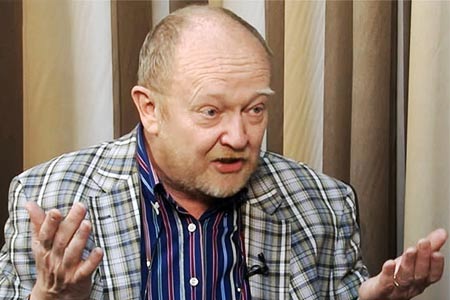
ArmInfo. As of today it is unambiguously premature to assert about the prospect of Afghan instability going beyond the borders of the country and its spread in neighboring states. A similar opinion was expressed to ArmInfo by chief researcher at the Dialogue of Civilizations Research Institute, orientalist Aleksey Malashenko.
"Yes, after 20 years of presence, the Americans practically left Afghanistan. And it must be acknowledged that being a great country, the United States lost to the traditional Islamic society reigning in Afghanistan. The United States have gotten involved in the others affairs with its own charter. And today their departure from Afghanistan is a consequence of their usual behavior in this style, "he stressed.
According to the orientalist, it was clear from the outset that it was unattainable to implement plans to achieve peace in Afghanistan in the form in which it was presented by the Americans and their allies in the NATO coalition. First of all, due to the fact that over the past decades traditionalist Afghanistan with its very energetic radical Islam has been fighting against senseless foreign attempts to impose socialism or some kind of liberal economic model on it.
And all this uncompromising struggle, according to the expert, began with the emergence of the Soviet Union with its socialist model of development in a fairly calm, Shah Afghanistan, which subsequently led to the emergence of the Taliban movement, after which the country became a den of Islamic extremism. After the terrorist attacks of September 11, 2001, the United States came to Afghanistan, for some reason deciding that they could succeed there, without having previously achieved anything worthwhile in Vietnam.
In general, Malashenko believes that, by and large, the withdrawal of the United States, the activation of the Taliban and its activity on the borders of the CSTO zone of responsibility is of rather little importance for Russia. He is convinced that Moscow, like all other players, especially neighboring countries, perfectly recognize the power that is being formed in Afghanistan, even in the face of the Taliban, especially the pragmatic Taliban. Especially after these pragmatic Taliban will have done away with the remnants of the old regime and begin to build a nation-state and foreign policy relations.
Nevertheless, according to Malashenko's estimates, the current instability in Afghanistan and on the borders with neighboring countries is creating another zone of destabilization, in which Russia and Turkey receive another conditional negotiating table. Especially considering that Ankara has quite serious asset in this region. At the same time, the orientalist does not see any special connection between the "Afghan table" and the rest of the negotiating tables, in particular, with the Karabakh negotiation track.
"Of course, there is also the CSTO - an interesting enough office to maintain the military-patriotic influence of Russia against external enemies. But you need to understand that this office makes some maneuvers, exercises, spends money, makes symbolic statements, but it will never fight. For some reason, the Kirghiz asked for help, then Armenia, now Tajikistan has for some reason declared its hope for support of the CSTO. Moscow loves to talk about it and can, but the situation, as a rule, is settled even without the CSTO. I think this will be the case in Afghanistan as well, especially considering that all this does not cause much alarm in Moscow," the orientalist summed up.









 Analyst: The primary issue with Armenia`s new Parliament Speaker`s speech lies is its one-sided interpretation of the causes of the political crisis
 Expert: Gagik Tsarukyan embodies post-Soviet model of big business-state relations; this model is used in many other post-Soviet countries
 Expert: Azerbaijan promoting aggressive plans against Armenia at state level
 NA Vice Speaker candidate believes his wife`s salary as director of HayPost is the lowest in the company`s history
 RF Permanent Representative: There is no CSTO-Armenia conflict
 Moscow: NATO seeking to "Pull" Armenia away from CSTO Allies
  Political analyst: Russia intends to determine which "Camp" Armenia will choose through a referendum
 Narek Karapetyan will give up his parliamentary salary in favor of charitable contributions.
 Armenia and France discuss further development of strategic partnership and EU cooperation
  To overcome risks Armenia must reduce domestic escalation - expert
  Zatulin: Pashinyan was eager to get back to Russia because he actually lost the elections
 Human rights activist Ruben Melikyan dismissed from YSU
 Zakharova: Armenia`s pro-EU pivot poses economic security risks to EAEU member states
 It`s time for South Caucasus countries to think of South Caucasus as single, unified region - RA premier
  Pashinyan: Armenia and Azerbaijan should leave each other alone
 Moscow sees situation with Armenia as attempt to attack Russia-involving integration associations - Russian presidential aid