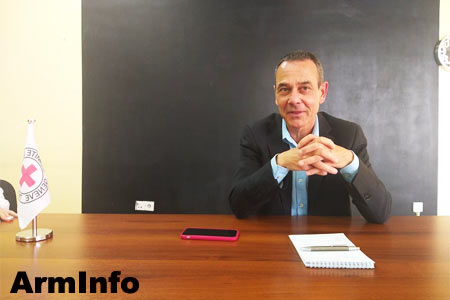
ArmInfo.The head of the Yerevan office of the International Committee of the Red Cross, Thierry Ribo, in an interview with ArmInfo, spoke about the organization's current activities in the region, new projects, work on prisoners of war, interaction with Russian peacekeepers and much more.
Mr. Ribaux, you have headed the ICRC office in Yerevan during very difficult times - the new type of coronavirus pandemic and the fighting in the Nagorno-Karabakh conflict zone have increased the volume of work. Could you tell us what projects are currently being implemented by your organization and whether it is planned to attract new projects, if so, in which areas?
First of all, I would like to remind you that our presence in the region of the Nagorno-Karabakh conflict dates back to 1992. Then we launched our activities through our offices in Yerevan and Baku, as well as the mission in Nagorno-Karabakh. Since then, our stay in the region has been uninterrupted. We carry out humanitarian activities aimed at eliminating or reducing the consequences of the Nagorno-Karabakh conflict for civilians.
However, it is natural that the recent escalation of the armed conflict has led to an increase, including in our work in the region. I would like to note that our main activity at the initial stage of the escalation was related to the support of people who are directly in the escalation zone and affected by it. For example, in Nagorno-Karabakh, on the one hand, we were engaged in supporting the relevant health care structures, on the other hand, through local structures, we provided food and hygiene kits for the people who remained there. In Armenia, we, together with our partner, the Armenian Red Cross Society, have focused on supporting displaced persons who have come to Armenia in search of safety. We also supported structures such as educational institutions and health systems that needed to provide relevant services without delay.
Since the stage of the state of emergency and our corresponding response is now over, we are focusing more on the situation in the regions of Armenia, assessing the needs of the civilian population and considering possible projects that can be implemented there. In particular, we are talking about the need to support the communities that are located in the immediate vicinity of the Armenian-Azerbaijani border. If for a long time our programs in this regard were aimed at the Tavush region, now we have paid attention to other regions, in particular, Syunik, Vayots Dzor, Gegharkunik. And now we are working with the local population and communities to understand the needs of the residents of these regions, in order to provide targeted support.
One of the main elements of our work is also to pay attention to the families that have sheltered displaced persons as a result of the escalation. In cooperation with the Armenian Red Cross Society, we are helping these families to cope with the costs they have faced because they have nobly opened their doors to families from Nagorno-Karabakh. Today, there is already a specific program of assistance in this area, which we are implementing in cooperation with the Ministry of Social Labor of the Republic of Armenia and the Armenian Red Cross Society. In the future, we also plan to cooperate with the Armenian Red Cross Society to resolve a number of issues that may be faced by families of displaced persons in Armenia. One of the most important areas of our activity is related to people who are considered missing. And in this situation, I note that since mid-November 2020, the ICRC, along with Russian peacekeepers, has participated on a daily basis in operations to search for missing persons and remove the remains of the deceased, including providing the necessary technical support and providing advice on the identification of the remains. We believe it is incredibly important that families have the opportunity to receive answers about the whereabouts of their loved ones as a result of the fighting, as well as to be able to bury the dead with dignity. But at the same time, we understand that the process has not yet been completed and, based on this, the issue of the parties ' obligations on the issue of missing persons becomes relevant. We are ready to help improve the legislation in this regard in favor of families who will face the problem of missing relatives.
As you know, the ICRC has quite a lot of experience in helping to identify the remains of missing persons. We know that the ICRC has created a data bank to facilitate the identification of the remains of the missing from the first Karabakh War. Taking into account the above, and taking into account the fact that the Minister of Health of the Republic of Armenia reported that more than two hundred remains will most likely not be able to be identified due to their serious damage, can we expect that the ICRC will assist the Armenian side in this matter?
You are absolutely right that in this region, the ICRC has been dealing with the issue since the 90s of the last century, and there is a certain process and dialogue with the authorities of the parties involved in order to draw attention to this issue. Unfortunately, we have to state that there is no serious progress in this direction. But, nevertheless, we try to keep our finger on the pulse in order to continue to remind the authorities of the parties involved of their obligations in relation to missing persons, including since the 90s.
As for this situation, the identification process is certainly extremely complex in itself. It begins with the collection of remains in places where there were recent fighting. We, along with Russian peacekeepers, participate in the search and evacuation operations conducted by Armenian and Azerbaijani teams. In this process, as a rule, there are also ICRC forensic experts who, as the remains are discovered and evacuated, advise the teams on how to collect them, because the correct, attentive attitude to the process at this stage leads to an increase in the chances of identification already in the morgue or the relevant forensic institutions. Naturally, the first and most important step is the proper and decent treatment of the remains at the collection sites.
The second stage is already a question of the capabilities and competence of the centers of forensic expertise. And in this situation, the ICRC also provides material and technical support. We are in constant contact with the medical examination center in Yerevan. Discussions are underway on the procedures that the center uses to identify the bodies of the victims. We have provided a number of recommendations to improve the chances of achieving maximum identification accuracy. Of course, we know that there are a certain number of remains that are difficult to identify, and perhaps some of them will not be able to be identified, for example, if we are talking about burned remains. However, the process is still ongoing. I would also like to point out the rather decent opportunities of the Armenian centers. At the same time, I would also like to draw your attention to the fact that the ICRC does not have its own laboratories on the ground, and our specialists who specialize in this field provide advice and support. But there are such specialized institutions in other countries, and we are discussing the possibilities of cooperation with the Armenian authorities both in this area and in terms of the prospects for strengthening and developing professional skills in this area within the country. We do not want to replace Armenian specialists, but, on the contrary, to improve their skills, so that Armenia will have its own experts who will be fully prepared for the identification of remains, including those who went missing during the fighting in the 90s, when such an opportunity arises.
What does the ICRC think about Azerbaijan's purposeful delaying of the search for the bodies of the dead, which in turn complicates the identification process?
Yes, indeed, the longer the process takes, the more difficult the identification is. But here it is necessary to consider the context of the conditions for conducting operations to search for and retrieve the bodies of the victims. As you know, the search began almost immediately after the signing of the ceasefire declaration. There were situations when the process stopped for a while. However, the conditions under which search groups operate are quite complex. The entire area is literally filled with unexploded ordnance. ICRC mine clearance specialists are also involved in the search, advising the parties on how to safely evacuate the remains. You also need to understand that this is a considerable territory and the process takes time. Naturally, in the first weeks it was easier to carry out operations, and they were more effective. Now it is more difficult to do this for obvious reasons. Teams have to return to the same places several times, perform operations over and over again, and sometimes, after working all day, they come back empty-handed.
We also attach great importance to the ongoing cooperation and interaction between the parties, with the participation of our specialists and Russian peacekeepers. This question is also in the constant field of our attention. We understand that all this may seem like an easy process from the outside. We also understand what it is like, unfortunately, for the families of the missing, who have been in the dark for so long. However, the process is really complicated and . often, in addition to everything, the weather conditions also create interference.
Given the role of the ICRC as a neutral intermediary, would you like to know whether the organization currently has access to persons under the jurisdiction of Azerbaijan, especially those who are classified by the Azerbaijani authorities as "mercenaries" and "terrorists"? What information do the ICRC receive through its channels from Azerbaijan in terms of the condition of our prisoners and their conditions of detention?
As for those detained in connection with the Nagorno-Karabakh conflict, I would like to note that the ICRC has been visiting them for more than two decades. And at this stage, we also continue to visit the detained persons in Azerbaijan. I will not comment publicly on issues related to the treatment of detainees, as this is part of our confidential dialogue with the authorities responsible for the detention of these people. However, I would like to point out the need for the exchange of family-related information. This is also an important part of our work within the ICRC's mandate. We consider it very important to maintain communication between the detainees and their families. Naturally, a lot of information is exaggerated on the topic of the number of persons held in Azerbaijan, but the ICRC is not entitled to disclose data on the number, since this is also part of our confidential dialogue with the authorities. We receive information about the persons who are being held mainly from their families, who contact us in connection with the alleged information, as well as from the authorities, who can inform us about the presence of a person on the other side - military or civilian. We systematize the data obtained and do everything possible to make sure that the detained persons are in the party, to be able to monitor the conditions of their detention, treatment, and health status. All these issues are in the center of our attention, we are in a fairly active dialogue with the relevant party on this issue, although the rinformation about the results is closed and not subject to disclosure.
As for the activities of other organizations in the field, they have their own mandate of activity. In their own way, they try to provide information to the extent that they can provide it. This is their right and responsibility. From this point of view, the ICRC is certainly not the most open organization for the media regarding issues related to prisoners of war and detainees, since the lion's share of the activities carried out is not public and is within the framework of a strictly confidential dialogue.
Do I understand correctly that the detainees are now deprived of the opportunity to communicate with their families, as it was in the old days?
No, of course, we can help people keep in touch with each other. This continues even now, as we visit people in Azerbaijan and there is an opportunity to provide them with communication with their relatives - this can be letters, calls or oral messages through the ICRC. But, most importantly, this opportunity is provided to them now.
People in general may underestimate the value of family news. For the family, it is just a matter of getting news from their relatives and loved ones who are unknown to them somewhere-it is worth a lot. Just to get word that he's alive and well, that everything is in order, is of great importance to a family in the dark.
What would you say about the labels that the Azerbaijani side puts on the Armenian prisoners and prisoners of war, calling them "terrorists", how correct and acceptable is this in your opinion, especially from the point of view of international law?
As for the terminology regarding the status of detainees, this is always the prerogative of the relevant authorities. And the actual assignment of this or that status is part of their responsibility. On the other hand, it is also the prerogative of the authorities who have detained people in connection with the conflict to try them for possible crimes. In principle, this is provided for by international humanitarian law and is not a violation of it. We, the ICRC, of course, do not go into discussions in the public space, but issues related to the status are discussed without fail, remaining within the framework of a confidential dialogue with the relevant authorities. Of course, the issue of status is extremely important rand we do not neglect it in any way, but all considerations on this issue are confidential - this is part of the huge work that we carry out as part of our mission.
I would also like to say a few words about the process of returning prisoners of war and detained civilians. A certain number of them have been returned to Armenia and Azerbaijan recently. The ICRC was not involved in this process, with a few exceptions, when, as part of our work and the involvement of the Russian side, a female civilian was returned to Lebanon.
As for the interpretation of international humanitarian law, it is absolutely normal that in addition to the ICRC, a third party can be involved in the process, as in this situation, Russia. From our side, we usually visit people until the decision is made to transfer them to their homeland. Then our employees visit them and on their return-to provide support if necessary.
During his visit to Moscow last year, the head of the ICRC, Peter Maurer, announced his intention to expand the organization's activities in the region, taking into account the aggravation of the conflict over Nagorno-Karabakh. What stage is this process at?
We have certainly and quite seriously increased our regional presence, not only in terms of the capabilities of our staff, but also in terms of the types of competence. In addition, we have also increased the financial capacity of the ICRC delegations in Yerevan and Baku and the mission in Nagorno-Karabakh. And if before the latest escalation, our total budget for the region did not exceed about 15 million Swiss francs, now about 47 million francs are included in the budget for 2021. This, in turn, gives us the opportunity to respond adequately and fulfill the tasks that we set for ourselves as a humanitarian organization. It is also important to note that working with the population to eliminate and reduce the humanitarian consequences of the conflict is primarily the prerogative and responsibility of the parties concerned. And we, as an international organization, can support these efforts, especially in those areas where we can benefit - this is the issue of prisoners of war and detainees, and the problem of missing persons, and so on. I would also like to point out that we have also increased the number of our offices in Armenia - now, in addition to the Yerevan delegation, we have opened sub-offices in Goris and Ijevan.
Since you have repeatedly mentioned the Russian peacekeepers. I would like to know how the ICRC's interaction with the peacekeepers is developing, are there any difficulties or obstacles in establishing contacts?
Here we are working in a new environment with the presence of Russian peacekeepers and in new realities that require increased coordination and coherence in the direction, for example, related to operations to search and recover the remains of the dead. The ICRC was engaged by the Armenian and Azerbaijani sides as an impartial and neutral humanitarian organization to facilitate this process, and since Russian peacekeepers are also involved, it turns out that four elements are involved in this important mission. And in this regard, as I have already noted, we are in daily contact. In addition, our dialogue with the Russian peacekeepers takes place within the framework of programs to provide humanitarian assistance to the population in Nagorno-Karabakh. As you know, the Russian side, through the peacekeeping contingent, provides considerable assistance to the local population. And we are in close contact, including in order to complement the work, making support more targeted and effective.
Thank you, Mr. Ribaux, for this interesting conversation!




 Who and why is sacrificing RA National Security Service`s reputation? - expert
  Tehran creating security environment in which sustainable shipping in Strait of Hormuz difficult to imagine without its direct participation - expert
  Arrested Armenian oligarch on economy and new jobs
  NA Vice Speaker candidate believes his wife`s salary as director of HayPost is the lowest in the company`s history
 RF Permanent Representative: There is no CSTO-Armenia conflict
 Moscow: NATO seeking to "Pull" Armenia away from CSTO Allies
  Political analyst: Russia intends to determine which "Camp" Armenia will choose through a referendum
 Narek Karapetyan will give up his parliamentary salary in favor of charitable contributions.
 Armenian analyst: Developing relations with Europe and the U.S. must not jeopardize relations with regional powers
 Armenia and France discuss further development of strategic partnership and EU cooperation
  To overcome risks Armenia must reduce domestic escalation - expert
  Zatulin: Pashinyan was eager to get back to Russia because he actually lost the elections
 Human rights activist Ruben Melikyan dismissed from YSU
 Pashinyan removed from INNOPROM guest list
 Zakharova: Armenia`s pro-EU pivot poses economic security risks to EAEU member states
 It`s time for South Caucasus countries to think of South Caucasus as single, unified region - RA premier
  Pashinyan: Armenia and Azerbaijan should leave each other alone