

ArmInfo.The document of November 10 is an excellent and graphic illustration of Russia's foreign policy and foreign policy course in the South Caucasus region. A similar opinion was expressed to ArmInfo by Sergei Markedonov, a leading researcher at the Institute of International Studies at MGIMO of the Russian Foreign Ministry, editor-in-chief of the journal "International Analytics".
"What happened, of course, has a global level and subtext. Which is a separate topic for a separate study. But returning to the regional level, we can state that Russia has no desire for a final choice between Armenia and Azerbaijan. Yerevan. And, of course, the awareness of the danger of Azerbaijan's transformation into a second Georgia. Taking into account its economic and military potential, proximity to Turkey, the risks from such a development of events for the Russian presence in the Caucasus will be enormous. Hence the neat balance, which does not imply emotions and unequivocal assessments, " - he stressed.
On November 10, the leaders of Russia, Armenia and Azerbaijan, Vladimir Putin, Nikol Pashinyan and Ilham Aliyev, adopted a joint ceasefire statement, which entered into force on November 10. Within the framework of this agreement, Armenia is making a number of territorial concessions. Yerevan undertook to transfer the Kelbajar region to Baku by November 15, the Agdam region by November 20, and the Lachin region by December 1. All the territories occupied during the war remain with Azerbaijan. Lachin corridor - 5 km wide, will provide communication between Artsakh and Armenia under the control of Russian peacekeepers, who will also be deployed along the line of contact in Artsakh. According to the analyst, Armenia cannot count on joining NATO as long as Turkey is there. And the collective West is not ready to make more favorable offers to Yerevan than even the latest offers from Moscow. Especially considering the fact that the territory of Armenia itself in recent decades has not become an arena of armed confrontation with neighboring countries, not least thanks to Russia. It is with these realities that the analyst determines Moscow's restraint in relation to the conflict that has flared up since September 27. At the same time, according to his estimates, on November 10 it was Russia that was the main initiator of the ceasefire agreement. After that, the shooting really stopped, and the Russian peacekeepers ended up in Karabakh. However, in his opinion, there is still no talk of a full-fledged peace, and the further development of Karabakh, taking into account its importance, the entire Caucasus, is only being drawn.
"The emotions and arguments of Armenia, of course, can be understood. However, the new agreement does not at all mean Moscow's consent to the full military triumph of Baku. The peacekeeping forces are being introduced not into Azerbaijan, but into the territory of the unrecognized NKR, at a point that is formally recognized as part of Azerbaijan," but where there is no real control of it. And it is not assumed in full, at least in the next 5 years. All this speaks about the special allocation of this territory. And, despite the fact that the document does not mention the status of the NKR, by default it implies at least a deferred nature So, there is no talk of repeating the scenario of the Serbian Krajina. There are, of course, many questions for the agreement. However, it cannot be called a game with only one goal, "the analyst concluded.














 Expert: Economic pressure on Armenia may be virtually painless for other EAEU members, but not for Armenia itself
 Expert on protests in France: Civilizations fade when society loses a vision of the future
 Turkologist: Azerbaijan is not all-powerful—its vulnerabilities should become part of Armenia’s security strategy
 Opinion: The development of the Amulsar mine near the resort town of Jermuk is the beginning of an environmental disaster in Armenia
 Expert: The arrest of opposition figures in Armenia for social media posts is a systematic attempt to intimidate the public and suppress dissent.
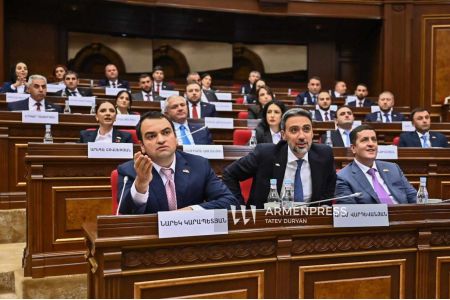 "Strong Armenia": The brawl in parliament was staged to distract public attention from Pashinyan`s failed foreign policy
 Zakharova commented on the scandalous epithets of the governor of Armenia`s Shirak region about "Ivanov"
 Nikolai Bordyuzha proposed excluding Armenia from the CSTO.
 The participation of Artsakh ensembles in an international festival in Vienna was cancelled following the intervention of several foreign embassies
 Expert: It`s time for Armenia to move away from uncertainty and choose between West and East
 The Armenian Foreign Minister commented on the country`s return to work within the CSTO.
 The Artsakh Public Council expressed outrage at the UN Secretary-General`s behavior
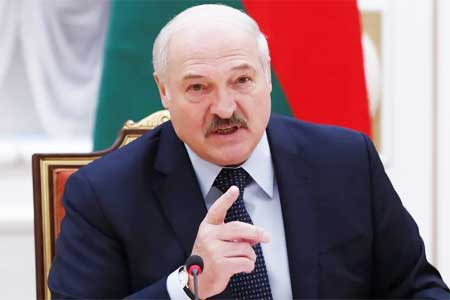 Lukashenko called for Armenia to assume the CIS presidency in 2029
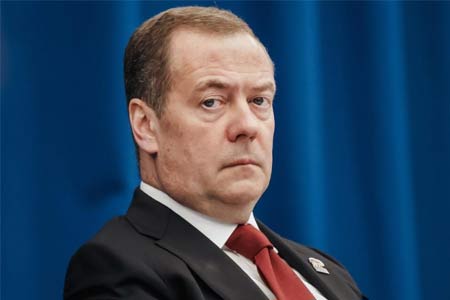 Dmitry Medvedev predicted a Ukrainian-like fate for Armenia amid the country`s shift in foreign policy
 Russian Security Council: In Armenia, they want to force Russian asset owners to dispose of their assets
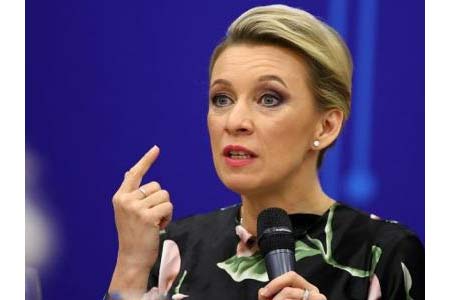 Zakharova: Russia ready to discuss with Armenia the prospects for expanding military cooperation as part of a review of bilateral ties
 Tevanyan: Armenia, like Ukraine and Moldova, is being drawn into the EU’s global war
 Yerevan City Hall is considering introducing a valet parking system in the city
 Expert: The circus surrounding the “Albanization” of Armenian culture in the presence of foreign ambassadors in occupied Artsakh is genocide
 Political scientist: If Russian-Armenian relations are destroyed, Turkey will take Russia`s place