



ArmInfo. The Collective Security Treaty Organization (CSTO), if applied to, will be able to use peacekeeping forces in a peacekeeping operation in the Nagorno-Karabakh conflict zone only by decision of the CSTO Collective Security Council and only upon receipt of the appropriate mandate from the UN Security Council.
There must also be the consent of all conflicting parties to carry out the operation, CSTO spokesman Vladimir Zainetdinov told TASS, answering a relevant question.
The press secretary referred to the 2007 Agreement on CSTO Peacekeeping Activities. According to him, the decision to conduct a peacekeeping operation on the territory of the organization's member states is taken by the CSTO Collective Security Council. In the event of a peacekeeping operation on the territory of a country that is not a member of the CSTO, a decision of the UN Security Council is also required. "The decision is made taking into account the national legislation of the member states on the basis of an official request from a member state to conduct a peacekeeping operation on its territory or a decision of the UN Security Council to conduct a peacekeeping operation on the territory of a state that is not a member of the CSTO," Zainetdinov said.
He also recalled that the only party to the conflict, which is a CSTO member- Armenia - has not yet contacted the organization.
Under the agreement of 2007, the decision of the Collective Security Council to conduct a peacekeeping operation is prepared after approval by the Council of Foreign Ministers, the Council of Defense Ministers and the Committee of Secretaries of the CSTO Security Councils.
As noted in the document, a special group is created by the decision of the CSTO Collective Security Council to assess the military-political situation in the conflict zone and develop proposals on the expediency of the operation and its scale. Separately, the document states that "peacekeeping operations do not replace the settlement of the conflict through negotiations and other peaceful means."














 International Law Specialist: Azerbaijan intends to initiate legal proceedings against Armenia by sentencing Armenian prisoners
 An Armenian Turkologist spoke out against attempts to deny the value of Artsakh and the liberation of Armenia.
 Russian political scientist: Moscow`s reaction to the TRIPP project will largely depend on the trend in Russian-American relations
 Armenian Political Scientist: The approaches, methods, rmphases and content of today’s struggle in Armenia Cannot Remain the Same
 Russian Security Council: In Armenia, they want to force Russian asset owners to dispose of their assets
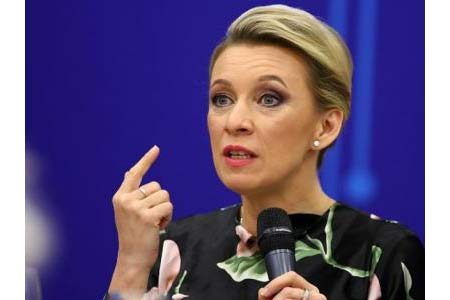 Zakharova: Russia ready to discuss with Armenia the prospects for expanding military cooperation as part of a review of bilateral ties
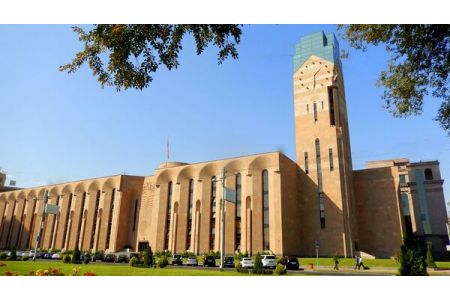 Yerevan City Hall is considering introducing a valet parking system in the city
 Expert: The circus surrounding the “Albanization” of Armenian culture in the presence of foreign ambassadors in occupied Artsakh is genocide
 Political scientist: If Russian-Armenian relations are destroyed, Turkey will take Russia`s place
 Political scientist: The Armenian public is simply obliged to significantly change the entire content of public discourse and struggle
 Cross tattoos are being removed from the skin of Christian prisoners in Azerbaijan by fire, according to a human rights activist.
 Zakharova: Armenia`s likely introduction of visas with Russia will be a step against Yerevan itself
 Putin: Armenia`s recognition of Karabakh as part of Azerbaijan in Prague has given Russia`s position on this issue an ambivalent character
 Putin: Armenia`s adoption of the law on EU accession means an announcement of its withdrawal from the Eurasian Economic Union
 Medvedev: Yerevan will never become an EU member, but it will permanently damage relations with the Eurasian Economic Union, including with Moscow.
 Arrested Armenian oligarch on economy and new jobs
  "In Baku, we gave a worthy rebuff to the false claims regarding the past and present of our people" – Former Artsakh Parliament Speaker from Baku captivity