

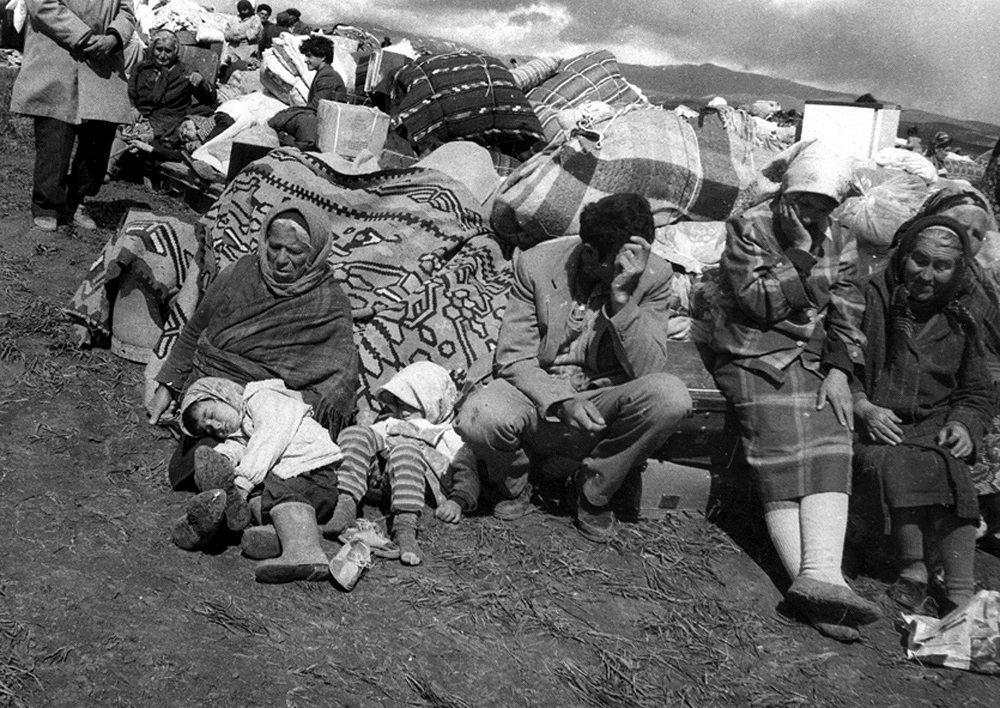
ArmInfo. Fallen into oblivion, but not broken down- June 13 marks the 28th anniversary of the occupation of the Shahumyan region by Azerbaijan. After almost three decades, the inhabitants of Shahumyan did not lose hope of returning to their homes from where they were expelled in 1992 and praying in their churches.
Thus, the representative of the Shahumyan-Getashen Union Zinavor Meghryan believes that the time has come to bring the issue of the occupation of Shahumyan on the agenda of the negotiation process to resolve the Nagorno-Karabakh conflict. "We believe that the time has come, and even belatedly it is necessary to voice the issue of occupation of the Shahumyan region at all platforms. No one today speaks about the Shahumyan inhabitants who were expelled from their homeland, their homes, were subjected to deprivation. For some reason no one has raised this issue during the negotiations. Nobody speaks of hundreds of civilians - from young to adults, brutally murdered during those events," said Meghryan.
In this context, he regretted that the Azerbaijani state propaganda is trying to advance the issue related to the Khojaly tragedy at all platforms, although these two issues are not even comparable, since the incident in Khojaly has controversial interpretations, and it is known that the tragedy was caused by certain Azerbaijani forces in the context of the domestic political struggle. Meanwhile, the representative of the Union continued, there is more than enough factual evidence of the forcible expulsion of Armenians from Shahumyan, as well as facts proving the scale of this tragedy. In this context, he recalled that the Shahumyan people participated at all stages of the struggle for their rights and liberation. "They never left the battlefield, and even when the Shahumyan area fell and was occupied by the enemy, the Shahumyan people created partisan units that played a significant role in the formation of the northern borders of Artsakh, in the form in which they are today. Although we, the the inhabitants of Shahumyan did not manage to achieve our final goal - the liberation of our homeland, but we are united in our desire to return to our native places, "he said.
In this regard, Meghryan regretted that there is no consistent state policy on voicing the problem of the Shahumyan, and the issue of the occupation of the Shahumyan region is being hushed up. "For the past 28 years, the whole Armenian region has been under the occupation of Azerbaijan. There is no consistent state policy in this matter, however, we are determined in the struggle for our rights, for returning to our homes, for getting compensation for damages. This issue is not as much territorial, it has a significant humanitarian aspect. We will fight to ensure that this issue is put on the agenda of the negotiations on the Nagorno- Karabakh conflict. Our task is to draw the attention of the Armenian Foreign Ministry to this issue, so that it contributes to the inclusion of this issue in the agenda of negotiations aimed at the final settlement of the Nagorno-Karabakh conflict, "said the representative of Shahumyan-Getashen Union, adding that their efforts will be aimed at internationalizing this issue, bringing it outside of Armenia, to various international platforms. He added that due to the coronavirus pandemic, a number of public events were postponed, however, in some countries, inhabitants of Shahumyan will hold commemorative events, including on the territory of the Armenian Church in Moscow.
In turn, inhabitant of Shahumyan Rubik Aydinyan, who was forced to leave his native home, believes that they should get the opportunity to return to their homes. "We must return to our homes, this is our homeland. But, this should not be a military route. Our sons should not again go to the line of fire. Our children should never feel what we have felt when bombs were dropped on us from planes. Then they killed everyone indiscriminately, putting no difference between a one-year-old or five-year-old child, "Aydinyan noted.
He added that before the liberation struggle in the Shahumyan region there were several villages populated by Azerbaijanis, and the Armenians and Azerbaijanis lived in peace, there were no problems. "But, when the war began, we were expelled from Shahumyan, we were forced to leave.
Another Shahumyan inhabitant, Vitaliy Mayranyan, who currently lives in Russia, expressed dissatisfaction with the fact that the occupation of his historic homeland has fallen into oblivion. "We want our voices to be heard. Today, when you follow the negotiation process to resolve the Nagorno-Karabakh conflict, you get the feeling that everyone has forgotten about the occupation of Shahumyan. It's clear that Azerbaijan is not interested in this issue. But Armenia and Artsakh need voice it, and pursue a consistent policy in this direction. We are scattered around the world, but continue to be united and will fight for our lands. We all want to visit the graves of our ancestors and pray in our churches. There is a whole layer of Armenian cultural heritage in Shahumyan ", said Vitaliy.
Moreover, he complained about the fact that this issue is not given due attention at the state level in Armenia, and in this context he expressed bewilderment by this circumstance. According to him, for all time only the incumbent Prime Minister Nikol Pashinyan has raised the issue of Shahumyan at a meeting with President of Azerbaijan Ilham Aliyev. To recall, on June 13 marks the 28th anniversary of the occupation of Shahumyan- the ancient Armenian region - the inextricable part of Artsakh, by Azerbaijan. Historically, the territory of the Shahumyan region was one of the five large Armenian principalities of Artsakh, known in archival and other documents as Gulistan. On July 5, 1921 by the decision of the plenum of the Bureau of the Central Committee of the RCP (B), despite the protests of the Armenian population, which at that time was 95% of the region's inhabitants, Artsakh, and its part Gulistan, was transferred to newly-minted Azerbaijan.
During the establishment of the Nagorno-Karabakh Autonomous Region (NKAR) in July 1923, Gulistan and a number of other areas of Artsakh - Khanlar, Dashkesan, Shamkhor - with far-reaching goals were included not in the Autonomy, but in the Azerbaijan SSR. All the years of the existence of the Azerbaijan SSR a policy of pressing the Armenian population was carried out in relation to these areas - repeated redrawing of the borders of the regions, blocking of Armenian villages, artificial inhibition of their economic development, etc..
Since the beginning the Karabakh movement in 1988, all Armenian regions of Artsakh began to be subjected to massive attacks by Azerbaijani OMON, state and party bodies. The first open armed clashes between residents of Artsakh and Azerbaijan occurred precisely in the northern part of Nagorno-Karabakh. January 13, 1990, when the armed detachments of the Popular Front of Azerbaijan and the Azerbaijani police tried to occupy the villages of Kamo, Azad, Getashen and Martunashen of the Khanlar region and the villages of Erkech, Manashid, Buzlukh of the Shahumyan region. On January 15, 1990 by decree of the Presidium of the Supreme Soviet of the USSR a state of emergency is introduced in the NKAR and adjacent areas, incl. Shahumyan.
In January-March 1990 with the help of internal troops of the USSR Ministry of Internal Affairs, the Armenian population of the villages of Azad and Kamo of the Khanlar region was deported. In April 1991 Operation OMON of the Azerbaijan SSR, the Ministry of Internal Affairs of the USSR, and units of the Soviet army launched the operation "Ring" on the deportation of the Armenian villages of the NKAR and the surrounding areas. In April-July, 24 villages were deported in Khanlar, Shahumyan, Hadrut and Shushi regions. On July 4, 1991 by decree of the President of the USSR M. Gorbachev, the state of emergency was canceled in the Shahumyan region. After the withdrawal of the units of the Ministry of Internal Affairs of the USSR, the OMON of Azerbaijan attacked the villages of Erkech, Manashid and Buzlukh, but was repelled by local self-defense units. During July-August 1991 the Ministry of Internal Affairs of the Azerbaijan SSR, together with units of the 23rd Division of the 4th Soviet Army (deployed in Ganja) conducted military operations in the region with the aim of expelling the Armenian population using military equipment, including combat aircraft. In July, the residents of the villages of Erkech, Manashid, Buzlukh, whose population went deep into the region, were deported. Self-defense units provided armed resistance.
On September 2 (after the declaration of the Armed Forces of the Azerbaijan SSR on August 30 by the independence of Azerbaijan), a joint session of the Regional Council of the NKAR and the district council of the Shahumyan region proclaimed the Nagorno-Karabakh Republic and in December 10, 1991, decided to hold a referendum on the issue of NKR independence in accordance with Article 3 of the Law of the USSR of 04.04.1990. "On the procedure for resolving issues related to the exit of the Union Republic from the USSR>. In September 1991, the Shahumyan region was the first of the NKR regions to become an arena of open hostilities between the NKR self-defense units and the forces of the Ministry of Internal Affairs and the national army of Azerbaijan. Azerbaijanis used heavy artillery, tanks and armored vehicles , which had already been transferred to them by the command of the 23rd division of the 4th army, but the Shaumyan's self-defense forces managed to storm the control of the border villages of Erkech, Buzlukh and Manashid.
In September-December 1991 positional battles continued. On December 10 in the NKR, including in the Shahumyan region, a referendum was held, during which the vast majority of residents supported the independence of the NKR. On December 30, elections of MPs of the NKR Supreme Council were held in the region and throughout NKR. And January 13, 1992 for the first time in the territory of the former USSR, weapons of mass destruction were used against civilians - Azerbaijan fired the Shahumyan region center from the BM-21 Grad multiple launch rocket system.
In May-June 1992, the equipment and weapons of units and subunits of the former 4th Army of the Transcaucasian Military District were transferred to Azerbaijan - 4 divisions, a third of the ships and all the bases of the Caspian flotilla, a helicopter squadron, more than 100 combat aircraft, etc., not counting captured ones. Using this weapon and a significant number of military mercenaries, Azerbaijan launched a large-scale attack on the NKR in June 1992. It began with the Shahumyan region, which is extremely important strategically and is closest to the largest military bases of the former USSR in Azerbaijan in Kirovabad (Ganja). June 15, 1992 the entire Shahumyan region was captured by Azerbaijan. In the summer of 1992 Azerbaijanis also captured most of Martakert, part of Martuni, Askeran and Hadrut regions of the NKR. In a few days, 17,000 Armenians were deported from Shahumyan by force, several hundred residents were killed or gone missing.


















 Politician: The Moldovan scenario in Armenia will lead to revolution
 American agenda in South Caucasus has two priorities: TRIPP project and increasing pressure on Iran - expert
 Armenian political scientist outlines two likely goals for tomorrow`s visit by U.S. Secretary of State to Yerevan
  Domestic escalation to lead to external escalation soon - expert
  Opinion: Situation within Armenia and on its borders will largely depend on developments surrounding Iran
 Medvedev likens Pashinyan`s stance on EAEU/ EU referendum to Trotsky`s formula
 Choice between EU and EAEU is choice between unrealizable dream and certainty
 As alternative to Russia`s policy, Armenian authorities directly or indirectly hinting at Turkey and Azerbaijan - MP
 Lukashenko: "We don`t want Armenia to withdraw the EAEU, but we can`t go against the will of the Armenian people"
 Peskov describes Armenia`s pivot toward EU as understandable and transparent
 After Artsakh and the army, Syunik will become the next target - Robert Kocharyan
 Mirzoyan assures: Issue of PoWs and detainees in Baku is constantly on Armenian government`s agenda
 Volodin: We can no longer remain silent about processes unfolding in Armenia