
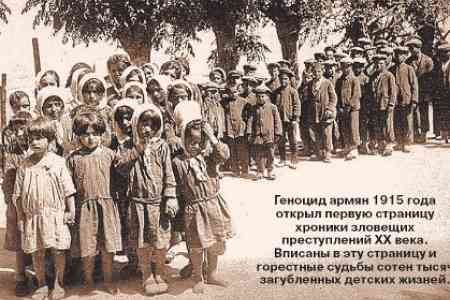
ArmInfo. The recognition and condemnation of the Armenian Genocide is the work of several generations and all Armenians, and a lot of work has been done from this point of view. Armenian Foreign Minister Zohrab Mnatsakanyan stated this on April 21 during a press conference in Yerevan.
According to him, the political message today is that we are in difficult conditions in connection with the coronavirus pandemic, but in other years there were different situations and difficulties, but the memory of the holy martyrs was never stopped and a single exclamation was voiced against genocidal crimes. According to him, the format that was chosen this year contains an important message when Armenians around the world will have the opportunity to participate in this process together and once again with a single voice to remind that even after 105 years, the Armenian people continue to fight for restoration justice, and that recognition of the Armenian Genocide is not a matter that concerns only Armenians. "The recognition of the Armenian Genocide is an important tool, a step towards the prevention of new crimes against humanity," he stressed.
Touching upon the question of changing the slogan "Remember and demand," Mnatsakanyan recalled that the issue of recognition of the Armenian Genocide is an all-Armenian issue, and concerns every Armenian. "The above-mentioned slogan is the pan-Armenian slogan adopted by the Pan-Armenian declaration. This is a pan-Armenian issue and all decisions, including those on changing the slogan, are made on the basis of this logic," the minister said.
Touching upon further steps on the international recognition of the Armenian Genocide, he recalled that 105 years ago the Armenian people were left alone with the criminals, and today should not have been wiped off the face of the earth. "However, the Armenian people won, develops and flourishes in this battle, but the unhealed wound of the rejected justice continues to bleed and remain a serious challenge, and the struggle will continue in this direction," the minister said.
He emphasized that efforts to recognize the Genocide are ongoing, as well as the prevention of new crimes against humanity.
Answering ArmInfo's question about Armenia's steps to prevent new crimes against humanity in the international arena, the minister emphasized that the tradition of taking steps to prevent has been rooted in the Armenian side since 1998, when the UN General Assembly first adopted a resolution on the 50th anniversary of the Convention on genocide. "Since then, Armenia has consistently created a sufficiently deep and meaningful international agenda for the prevention of crimes against humanity," he said, adding that Armenia is initiating various resolutions in various UN structures, which are designed to complement various tools in preventing mass crimes and genocides .
According to him, this year, Armenia, as a member of the UN Human Rights Council, introduced the next resolution, which sums up the activities at past stages and outlines further activities in this direction. The Foreign Minister added that the resolution is now on the agenda, but because of the new type of coronavirus, the Council's work is stalled and as soon as the work resumes, the process will be brought to its logical conclusion. Mnatsakanyan once again emphasized that this issue is among the priorities of Armenia's foreign policy.













 Expert: Israel strikes at Turkey`s military ambitions in Syria
 Expert: Current process is not about peace, but implementing Azerbaijan`s wishlist
 Expert: Real peace unattainable until Armenia-Azerbaijan agreement is signed and ratified
 TRIPP`s proximity to Iranian border could slow its implementation - expert
  Aram Vardevanyan: Public demands solutions, not apology scandals in Parliament
 Arrested Armenian oligarch on economy and new jobs
  "In Baku, we gave a worthy rebuff to the false claims regarding the past and present of our people" – Former Artsakh Parliament Speaker from Baku captivity
  NA Vice Speaker candidate believes his wife`s salary as director of HayPost is the lowest in the company`s history
 RF Permanent Representative: There is no CSTO-Armenia conflict
 Moscow: NATO seeking to "Pull" Armenia away from CSTO Allies
  Political analyst: Russia intends to determine which "Camp" Armenia will choose through a referendum
 Narek Karapetyan will give up his parliamentary salary in favor of charitable contributions.
 Armenian analyst: Developing relations with Europe and the U.S. must not jeopardize relations with regional powers
 Armenia and France discuss further development of strategic partnership and EU cooperation
  To overcome risks Armenia must reduce domestic escalation - expert
  Zatulin: Pashinyan was eager to get back to Russia because he actually lost the elections
 Human rights activist Ruben Melikyan dismissed from YSU
 Zakharova: Armenia`s pro-EU pivot poses economic security risks to EAEU member states