


ArmInfo. The Union of Judges of Armenia has identified risks to the independence and authority of the judiciary in the new Constitution. This is stated in the Organization’s statement.
Citing Article 85 of the Draft, the Union noted that the status of all incumbent judges is replaced with the status of <acting judge>, while their continued tenure is made dependent on the results of a re-evaluation to be conducted within five years by persons elected by political bodies. All members of the re-evaluation commission are elected by the National Assembly, while the commission’s conclusions are not subject to direct judicial review.
<It should be emphasized that no mechanism for subsequent appeal, including the possibility of applying to the Constitutional Court, can in any way neutralize the threat that such a system poses to the fundamental guarantees of the irremovability and independence of judges.
The preservation of constitutional guarantees of judges’ tenure cannot be replaced by providing judicial remedies in the event of their possible violation>, the source states.
Article 58 of the Draft also provides that the election of all ten members of the Supreme Judicial Council is transferred to the jurisdiction of the National Assembly, while the General Assembly of Judges is left only with the nomination of candidates for Council members from among the judges.
The Union emphasized that representatives of the judiciary were not properly represented in the process of drafting and discussing the new Constitution.
The Union of Judges emphasizes that the independence of judges is threatened not only by the possible adoption of such provisions, but also by the very initiation and official promotion at the highest state level of initiatives that call into question the guarantees of the irremovability of incumbent judges and the continuity of their tenure. Such initiatives in themselves may create conditions for indirect pressure on judges and undermine confidence in the constitutional guarantees of the independence of the judiciary. Such approaches contradict the requirements arising from the principle of the rule of law and European standards of judicial independence.
<No objectives of constitutional reforms can justify a general re-evaluation of incumbent judges (vetting or confirmation of status), the abolition of constitutional guarantees of their tenure, or making the continuation of their powers conditional on a new appointment or confirmation of status>, the statement says.
The Union also referred to numerous examples in international practice, noting that the Venice Commission rejected the termination of the powers of all incumbent judges (Ukraine, 2015); the Consultative Council of European Judges regarded the termination of the powers of all judges as part of constitutional reform as a violation of the principle of irremovability (Serbia, 2010); in Armenia, in 2019, with the participation of the Council of Europe, it was established that vetting all incumbent judges <is neither necessary nor useful>; the International Association of Judges expressed deep concern over judicial reform in Mexico (2024).
The constitutional guarantees of the irremovability of judges and the independence of the judiciary, as stated in the statement, cannot be subordinated to political expediency, and their restriction cannot be justified by the need to carry out constitutional reforms.
The Union calls on the Supreme Judicial Council (SJC), as the constitutional guarantor of the independence of courts and judges, to publicly declare the inadmissibility of the aforementioned provisions and demand that they be removed from consideration.
Within the scope of its constitutional powers, the SJC must take the necessary measures to protect the guarantees of the continuity of incumbent judges’ tenure and prevent direct or indirect interference caused by the uncertainty of their status.
The Union of Judges of Armenia also expects authoritative international organizations and relevant European structures to pay attention to the aforementioned initiative threatening the independence of the judiciary.
The Organization also noted that the independence of the judiciary is not a privilege of judges, but a fundamental guarantee of every person’s right to a fair trial.






































 A security sphere expert commented on a video about Papikyan`s achievements during his five years as Defense Minister
 The future of the South Caucasus was discussed in the capital of a country whose problem remains unresolved — Davtyan
 An Armenian orientalist presented possible US actions against Iran
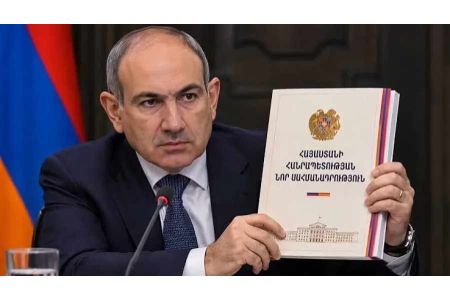 Prime Minister: The Constitution is our collective agreement on the fundamental principles of our internal and external relations
 Ultra-Orthodox Jews continue to desecrate Armenian holy sites in Jerusalem’s Armenian Quarter
 The Yerevan Museum of Russian Art Turns 42
 Armenia wants to host COP-34 in 2029
 Speaker: Armenia has never approached the CSTO regarding the Karabakh issue
 Lavrov: Armenia will not be expelled from the CSTO
 Drmeyan: The ECHR rejected Azerbaijan`s appeal in the case of Artsakh Defense Army Major Hayk Toroyan
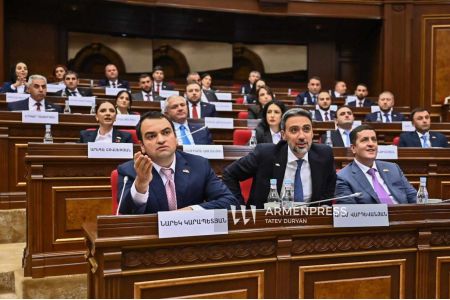 "Strong Armenia": The brawl in parliament was staged to distract public attention from Pashinyan`s failed foreign policy
 Zakharova commented on the scandalous epithets of the governor of Armenia`s Shirak region about "Ivanov"
 Nikolai Bordyuzha proposed excluding Armenia from the CSTO.
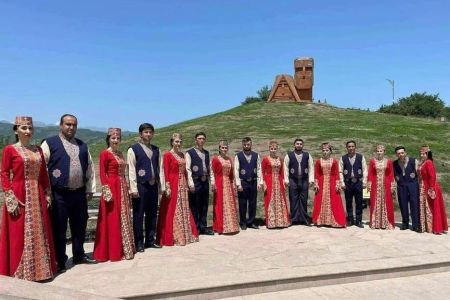 The participation of Artsakh ensembles in an international festival in Vienna was cancelled following the intervention of several foreign embassies
 Expert: It`s time for Armenia to move away from uncertainty and choose between West and East
 The Armenian Foreign Minister commented on the country`s return to work within the CSTO.