

ArmInfo. The Office of the Ombudsman for the Cultural Heritage of Artsakh called on international organizations to condemn attempts by the Azerbaijani side to distort the historical identity of the Amaras Monastery in the Martuni district of the occupied NKR.
The human rights body made the statement in response to reports about a visit to the monastery complex by representatives of Azerbaijan’s Albanian-Udi Christian community, saying that this was yet another manifestation of a systematic policy of distorting, reinterpreting and appropriating the Armenian historical and cultural heritage of Artsakh. "Amaras is one of the significant monuments of Armenian Christian heritage, possessing exceptional historical, spiritual and cultural significance for the Armenian people. Its historical connection with the Armenian spiritual tradition, culture and the centuries-long historical presence of Armenians in Artsakh is confirmed by historical sources, scholarly research and the totality of material evidence. This historical reality cannot be changed through propagandistic publications, politically motivated visits or artificially constructed interpretations," the office said in a statement posted on its Facebook page.
The Azerbaijani media coverage of such visits was described by the body as an element of a broader propaganda strategy aimed at promoting pseudo-historical concepts, denying the Armenian historical and cultural identity of Artsakh’s monuments and legitimizing attempts to appropriate someone else’s cultural heritage. "The systematic promotion of claims about "Albanian heritage" applied to Armenian churches, monasteries and other monuments cannot replace scientific objectivity and historical accuracy. The use of religious communities to promote politically motivated historical narratives, particularly through organized information campaigns, is a matter of serious concern and requires a principled assessment by the international scientific community, relevant organizations and cultural heritage protection institutions," the body stated.
The Office of the Ombudsman for the Cultural Heritage of the NKR further recalled that the historical affiliation of monuments is determined by scholarly research and archaeological, architectural, epigraphic and documentary evidence, rather than political interests, the editorial policies of mass media outlets or state propaganda mechanisms. "The Office of the Ombudsman for the Cultural Heritage of Artsakh states that any attempts to distort the historical identity of Amaras Monastery and present it within politically motivated pseudo-historical narratives deserve resolute condemnation. Such actions must not go unnoticed by international relevant organizations, academic institutions, the expert community and human rights bodies," the body emphasized.
In this regard, the Office of the Ombudsman for the Cultural Heritage of the NKR called on international organizations, relevant expert bodies, the scientific community and cultural heritage protection institutions to prevent the legitimization of historical falsifications, the political appropriation of cultural monuments and manipulations of the historical identity of Armenian heritage in Artsakh, as well as to assist in the objective documentation, monitoring and international public coverage of the ongoing processes. "Amaras is not an object of Azerbaijani propaganda. Armenian cultural heritage cannot be appropriated, renamed or stripped of its historical identity through political manipulation. Historical truth is not subject to political dictates," the human rights body concluded.
It should be noted that following the occupation of Artsakh, Azerbaijan completely destroyed or significantly damaged the following cultural and religious sites. The Kanach Zham Church (Surp Hovhannes Mkrtich) in Shushi was completely destroyed in April 2024; the Ghazanchetsots cemetery in Shushi was completely destroyed; the village of Karin Tak was completely demolished by bulldozers; monuments and busts in Stepanakert, including monuments to Charles Aznavour, Hovhannes Aivazovsky, Hovhannes Tumanyan and Marshal Bagramyan, were dismantled. The Marshal Khudyakov Museum in the village of Mets Tager was destroyed.
As of today, around 4,000 Armenian cultural sites remain under Azerbaijan’s control, including more than 370 churches and 119 ancient fortresses.














 A security sphere expert commented on a video about Papikyan`s achievements during his five years as Defense Minister
 The future of the South Caucasus was discussed in the capital of a country whose problem remains unresolved — Davtyan
 An Armenian orientalist presented possible US actions against Iran
 Expert: Official Yerevan should not base its calculations in relations with Ankara on the "crack" in the Turkish-Azerbaijani alliance
 Speaker: Armenia has never approached the CSTO regarding the Karabakh issue
 Lavrov: Armenia will not be expelled from the CSTO
 Drmeyan: The ECHR rejected Azerbaijan`s appeal in the case of Artsakh Defense Army Major Hayk Toroyan
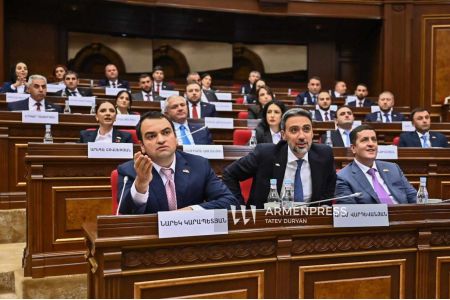 "Strong Armenia": The brawl in parliament was staged to distract public attention from Pashinyan`s failed foreign policy
 Zakharova commented on the scandalous epithets of the governor of Armenia`s Shirak region about "Ivanov"
 Nikolai Bordyuzha proposed excluding Armenia from the CSTO.
 The participation of Artsakh ensembles in an international festival in Vienna was cancelled following the intervention of several foreign embassies
 Expert: It`s time for Armenia to move away from uncertainty and choose between West and East
 The Armenian Foreign Minister commented on the country`s return to work within the CSTO.
 The Artsakh Public Council expressed outrage at the UN Secretary-General`s behavior
 Lukashenko called for Armenia to assume the CIS presidency in 2029
 Dmitry Medvedev predicted a Ukrainian-like fate for Armenia amid the country`s shift in foreign policy
 Russian Security Council: In Armenia, they want to force Russian asset owners to dispose of their assets
 Zakharova: Russia ready to discuss with Armenia the prospects for expanding military cooperation as part of a review of bilateral ties