

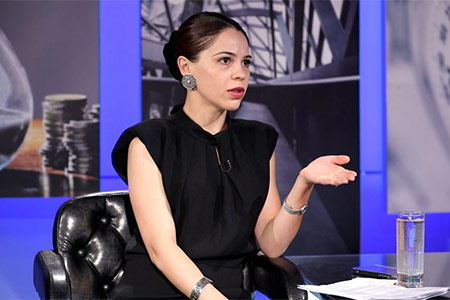
ArmInfo. Former Secretary of the Security Council of Armenia Armen Grigoryan effectively admitted in an interview that satisfying Azerbaijan's demands does not prevent escalation, but, on the contrary, could lead to it. Azerbaijani expert Tatevik Hayrapetyan wrote about this on her Telegram channel, commenting on Grigoryan's latest "revelations."
The expert noted that the former Secretary of the Security Council of Armenia, when discussing why he was unable to prevent the adoption of the law on the country's accession to the EU, said that dangerous events were unfolding in Armenian-Azerbaijani relations in March-April 2025.
Hayrapetyan noted that she remembers this period well. According to her, it was then that the Armenian authorities agreed to Azerbaijan's final two demands for the finalization of the text of the so-called "peace treaty."
"On March 13, the parties announced that Yerevan had accepted Baku's final proposals, and the text had been fully agreed upon. And Armenian Prime Minister Nikol Pashinyan declared his readiness to sign the document," Hayrapetyan recalled.
However, as the expert continued, in response, Azerbaijan launched a large-scale disinformation campaign, which, as the former Security Council Secretary herself now admits, created the threat of a new war. According to her, US mediation saved Armenia from war at the time. "This is essentially a direct admission that satisfying Azerbaijan's demands does not prevent escalation, but, on the contrary, can lead to it. Moreover, without the intervention of a third party, we are unable to defend ourselves. For six years now, we have been told that guarantees are not necessary, that we must negotiate directly and resolve issues independently. The result of this policy is obvious: all the cards end up in Azerbaijan's hands. "Meanwhile, the Armenian security system is not being brought to a state of proper readiness, and the army is being discredited and demoralized," Hayrapetyan believes.
According to her, the former Security Council Secretary's admission also proves something else: Azerbaijan doesn't need a peace treaty. Moreover, as the Azerbaijani expert noted, when the Armenian side agrees to all the terms and offers to sign the document, the risk of war increases again. "Baku is interested in endlessly continuing the process, during which it will weaken the Armenian state. And the Armenian authorities agreed to this 'deal.'" Last August, the agreement (the draft "Agreement on the Establishment of Peace and Interstate Relations" - ed.) was initialed solely thanks to the mediation of the US President. Under other circumstances, Azerbaijani President Ilham Aliyev would not have done this. However, just a year later, he has repeatedly violated the document's provisions without bearing any responsibility. The conclusion is obvious: Azerbaijan is not deterred by unilateral concessions. It can be contained only by external players or a trained and combat-ready Armenian army. The Armenian leadership has failed to ensure security and strengthen its army, setting the country on a path of unilateral concessions that directly threaten Armenia's sovereignty. Azerbaijan's demand to remove the reference to the Declaration of Independence of Armenia from the Constitution is clear evidence of this," the expert is convinced.
She further noted that Azerbaijan itself has repeatedly demonstrated that concessions from the Armenian side do not reduce its appetites, but rather pave the way for new demands and escalation. "I've been talking about this publicly for years, citing specific facts. If the authorities understood this but deliberately continued their course, this is no longer simply a case of miscalculation, but of criminal inaction in matters of state security and anti-state policies. And most importantly: peace cannot be built at the cost of discrediting one's own army and satisfying every demand of the enemy. If, after all this, the authorities continue to present their policy as the only path to peace, Armenian citizens have the right to ask: whose interests does this policy truly serve, and who will bear responsibility for its dangerous consequences for our state?," Hayrapetyan concluded.
As a reminder, on November 11, the former Secretary of the Armenian Security Council (2018-2026) wrote a lengthy article about EU membership and relations with Russia. In the article, Grigoryan discussed Armenia's path to EU membership and the risks of increased dependence on Russia if it continues its path toward European integration.



















 A security sphere expert commented on a video about Papikyan`s achievements during his five years as Defense Minister
 The future of the South Caucasus was discussed in the capital of a country whose problem remains unresolved — Davtyan
 An Armenian orientalist presented possible US actions against Iran
 Expert: Official Yerevan should not base its calculations in relations with Ankara on the "crack" in the Turkish-Azerbaijani alliance
 Speaker: Armenia has never approached the CSTO regarding the Karabakh issue
 Lavrov: Armenia will not be expelled from the CSTO
 Drmeyan: The ECHR rejected Azerbaijan`s appeal in the case of Artsakh Defense Army Major Hayk Toroyan
 "Strong Armenia": The brawl in parliament was staged to distract public attention from Pashinyan`s failed foreign policy
 Zakharova commented on the scandalous epithets of the governor of Armenia`s Shirak region about "Ivanov"
 Nikolai Bordyuzha proposed excluding Armenia from the CSTO.
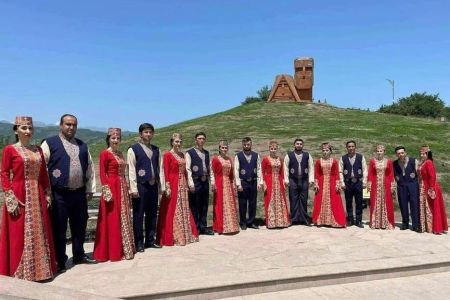 The participation of Artsakh ensembles in an international festival in Vienna was cancelled following the intervention of several foreign embassies
 Expert: It`s time for Armenia to move away from uncertainty and choose between West and East
 The Armenian Foreign Minister commented on the country`s return to work within the CSTO.
 The Artsakh Public Council expressed outrage at the UN Secretary-General`s behavior
 Lukashenko called for Armenia to assume the CIS presidency in 2029
 Dmitry Medvedev predicted a Ukrainian-like fate for Armenia amid the country`s shift in foreign policy
 Russian Security Council: In Armenia, they want to force Russian asset owners to dispose of their assets
 Zakharova: Russia ready to discuss with Armenia the prospects for expanding military cooperation as part of a review of bilateral ties