


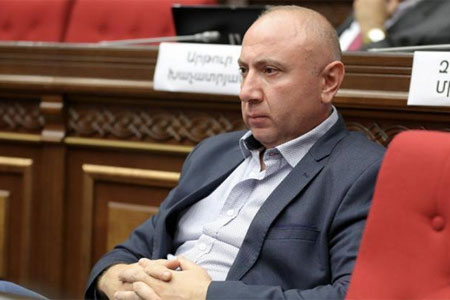
ArmInfo. Agreeing to hold a constitutional referendum at the request of another state could be considered a retreat from the principles of independence. This was stated by Artur Danielyan, a member of the Strong Armenia party council, at a briefing with journalists on November 9 following a meeting of the opposition with lawyers.
According to him, Armenia today finds itself in a situation where legal issues have effectively faded into the background, and virtually any issue important to the country is beyond the scope of legal analysis and is viewed exclusively through the prism of a peace treaty. In this regard, he called for the question to be asked: is there any need for a constitutional referendum at all and what would Armenia's agreement to the agenda imposed by Azerbaijani President Ilham Aliyev mean. "We must understand that the very consent to hold a referendum at the request of another state could be considered a retreat from the principles of independence, the foundation of which is the Declaration of Independence." "Furthermore, agreeing to hold such a referendum would effectively mean recognition by Armenian society that the current Armenian Constitution contains territorial claims against Azerbaijan," Danielyan emphasized.
Furthermore, he noted, even if the referendum takes place and the Armenian people vote against the amendments, Azerbaijan could use its results to make new political accusations against Armenia. Specifically, the politician explained, Baku could claim that the Armenian people are an aggressor, have territorial claims, and are not interested in establishing peace. "Therefore, first of all, we must understand the consequences of agreeing to hold a referendum," the party council member noted.
Danielyan also recalled the results of the parliamentary elections, noting that the Armenian people did not provide the current government with a constitutional majority. "This circumstance should be considered an expression of public will, especially since statements about the need to develop a new Constitution were made even before the elections," the politician believes.
In turn, Liana Gasparyan, a member of the Strong Armenia parliamentary faction, noted that the provisions of the Azerbaijani Constitution also include the territories of the Syunik, Gegharkunik, and Vayots Dzor regions of Armenia as part of the territory of Azerbaijan. "We are trying to explain to our citizens what threats the adoption of a new Constitution could pose for Armenia. In this regard, I would like to remind you that the Constitution of Azerbaijan is based on the Declaration of Independence of 1918, and the modern Republic of Azerbaijan positions itself as the legal successor to the state that existed in 1918-1920. A logical question arises: what will prevent Azerbaijan from making further territorial claims after Armenia adopts the new Constitution? Obviously, there may be no obstacles to this. "Therefore, we call on Armenian citizens to consider the potential threats and understand the consequences of such steps," the MP stated.
Commenting on the remarks of representatives of the ruling Civil Contract faction that the opposition is opposing the new Constitution without having read its text, Gasparyan urged attention to the synchronicity of the statements by the Azerbaijani President and the Armenian Prime Minister. "In 2024, during the UN Climate Summit, Aliyev stated the need not simply to amend the Armenian Constitution, but to completely revise it. Subsequently, Pashinyan also stated that this is not about introducing individual amendments, but about adopting a new Constitution for Armenia," the opposition member recalled.
Speaking about the position of her political force, the MP emphasized that peace must first be established between Armenia and Azerbaijan, and only then can other issues be discussed. "I consider it reckless to discuss any additional issues before the signing of a peace treaty between Armenia and Azerbaijan," Gasparyan concluded.
As a reminder, the draft of the new Constitution of Armenia has not yet been officially published. Initially, the authorities promised to publish the draft constitution before the parliamentary elections, but the deadline was repeatedly postponed, and now the deadline is November or December. According to statements, the new constitution will not include references to the Declaration of Independence of Armenia, despite the fact that the preamble to the constitution is inviolable and cannot be amended or deleted. The opposition accuses the Armenian authorities of complying with Azerbaijan's demands and has repeatedly emphasized that it will not support the process of amending the country's constitution.
It should be noted that a national referendum will be required to approve the new constitution, and the decision to hold it must be made by the National Assembly of Armenia with a vote of at least two-thirds of the deputies. Following the latest parliamentary elections in Armenia, held on June 7, 2026, the Civil Contract Party has a 3/5 majority, which allows it to pass constitutional laws and make appointments. However, the party lacks the 2/3 majority necessary to directly amend the Armenian Constitution. Therefore, to advance this issue, they must gain the support of the opposition.




































 The future of the South Caucasus was discussed in the capital of a country whose problem remains unresolved — Davtyan
 An Armenian orientalist presented possible US actions against Iran
 Expert: Official Yerevan should not base its calculations in relations with Ankara on the "crack" in the Turkish-Azerbaijani alliance
 Speaker: Armenia has never approached the CSTO regarding the Karabakh issue
 Lavrov: Armenia will not be expelled from the CSTO
 Drmeyan: The ECHR rejected Azerbaijan`s appeal in the case of Artsakh Defense Army Major Hayk Toroyan
 "Strong Armenia": The brawl in parliament was staged to distract public attention from Pashinyan`s failed foreign policy
 Zakharova commented on the scandalous epithets of the governor of Armenia`s Shirak region about "Ivanov"
 Nikolai Bordyuzha proposed excluding Armenia from the CSTO.
 The participation of Artsakh ensembles in an international festival in Vienna was cancelled following the intervention of several foreign embassies
 Expert: It`s time for Armenia to move away from uncertainty and choose between West and East
 The Armenian Foreign Minister commented on the country`s return to work within the CSTO.
 The Artsakh Public Council expressed outrage at the UN Secretary-General`s behavior
 Lukashenko called for Armenia to assume the CIS presidency in 2029
 Dmitry Medvedev predicted a Ukrainian-like fate for Armenia amid the country`s shift in foreign policy
 Russian Security Council: In Armenia, they want to force Russian asset owners to dispose of their assets
 Zakharova: Russia ready to discuss with Armenia the prospects for expanding military cooperation as part of a review of bilateral ties
 Tevanyan: Armenia, like Ukraine and Moldova, is being drawn into the EU’s global war