


ArmInfo. The entire republic is under arrest today: social Armenia, legal Armenia, and, most importantly, democratic Armenia. This was stated by Lilit Galstyan, a member of parliament from the opposition Armenia faction and Chair of the National Assembly Standing Committee on the Protection of Human Rights and Public Affairs, at a press conference in Yerevan on November 3.
Moreover, according to her, it can be argued that democracy in Armenia is literally dying, since constitutional and legal guarantees have effectively ceased to apply in the country. "All the obligations enshrined in the Constitution of Armenia are today, figuratively speaking, being tortured. The reality we are facing has nothing in common with the idea of a rule-of-law state. Today, even fundamental human rights are violated in Armenia: the right to life, freedom of speech, freedom of assembly, the presumption of innocence. "It seems that there are practically no rights left that are not violated. And we face this reality every day," the deputy emphasized.
Galstyan then presented a number of data demonstrating the depth of the current crisis. In particular, she noted that 48% of those held in prisons lack court convictions. Moreover, she noted that there are people who have been in custody for 5-6 years, yet court decisions have yet to be issued in their cases. The deputy also highlighted deaths and suicides in penal institutions, calling these figures shameful. "In just one year, 27 deaths were recorded in Armenian prisons, 10 of which were suicides, and another 17 were related to health conditions," the opposition figure noted.
In this regard, Galstyan recalled the inhumane conditions in Nubarashen Prison, emphasizing that this institution should have been closed long ago. Moreover, according to her, inhumane conditions exist not only for prisoners but also for the institution's staff. "In Armenia today, there are penitentiary institutions where it is simply impossible to talk about humanism and humane treatment," Galstyan added.
She paid special attention to the violation of the presumption of innocence and the practice of so-called "prescribed sentences." "We are talking about situations where people are effectively detained without a court verdict, while indictments are already being voiced at the political level. This practice is made possible, in part, by the lack of political accountability on the part of the parliamentary majority. What is happening is further evidence of the crossing of red lines," the MP noted.
According to Galstyan, all of this indicates the gradual transformation of the state into an instrument of repression and the destruction of the legal foundations of the state system. At the same time, as the MP noted, this situation has not gone unnoticed by the international community and is reflected in reports from international organizations. In particular, she referred to the latest PACE report on the parliamentary elections in Armenia. In her opinion, despite the rather cautious nature of the document, it nevertheless addressed issues of political persecution, attempts to silence the opposition, and the actions of law enforcement agencies. "Furthermore, Human Rights Watch drew attention nearly four years ago to the lack of a real separation of powers in Armenia and the excessive concentration of authority in the executive branch. Such practices constitute one of the mechanisms for the formation of a dictatorship and pose a threat of undermining the constitutional order," Galstyan said.
Summing up, the opposition leader emphasized that one of the most important political rights of citizens—the right to free choice and political freedom—has been violated in Armenia today. According to her, when the leaders of the country's three main opposition forces are under arrest or house arrest, this becomes a serious reason to talk about political persecution and repression. "Everything that is happening only confirms the need for concrete actions aimed at liberating Armenia, which today itself finds itself under arrest," the MP concluded.

















 Expert: Economic pressure on Armenia may be virtually painless for other EAEU members, but not for Armenia itself
 Expert on protests in France: Civilizations fade when society loses a vision of the future
 Turkologist: Azerbaijan is not all-powerful—its vulnerabilities should become part of Armenia’s security strategy
 Opinion: The development of the Amulsar mine near the resort town of Jermuk is the beginning of an environmental disaster in Armenia
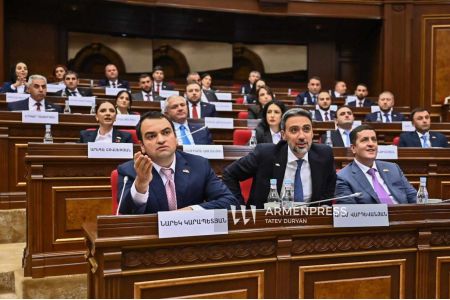 "Strong Armenia": The brawl in parliament was staged to distract public attention from Pashinyan`s failed foreign policy
 Zakharova commented on the scandalous epithets of the governor of Armenia`s Shirak region about "Ivanov"
 Nikolai Bordyuzha proposed excluding Armenia from the CSTO.
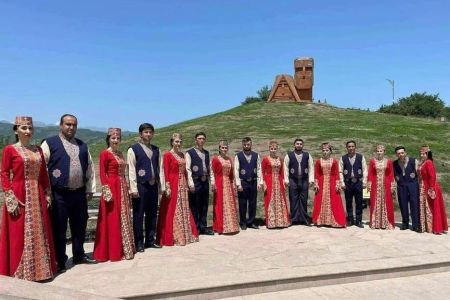 The participation of Artsakh ensembles in an international festival in Vienna was cancelled following the intervention of several foreign embassies
 Expert: It`s time for Armenia to move away from uncertainty and choose between West and East
 The Armenian Foreign Minister commented on the country`s return to work within the CSTO.
 The Artsakh Public Council expressed outrage at the UN Secretary-General`s behavior
 Lukashenko called for Armenia to assume the CIS presidency in 2029
 Dmitry Medvedev predicted a Ukrainian-like fate for Armenia amid the country`s shift in foreign policy
 Russian Security Council: In Armenia, they want to force Russian asset owners to dispose of their assets
 Zakharova: Russia ready to discuss with Armenia the prospects for expanding military cooperation as part of a review of bilateral ties
 Tevanyan: Armenia, like Ukraine and Moldova, is being drawn into the EU’s global war
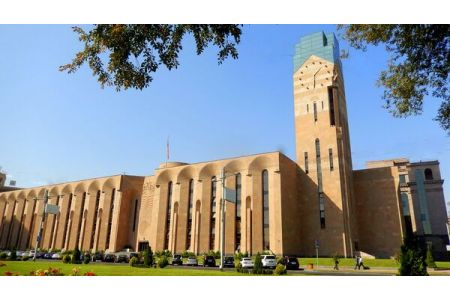 Yerevan City Hall is considering introducing a valet parking system in the city
 Expert: The circus surrounding the “Albanization” of Armenian culture in the presence of foreign ambassadors in occupied Artsakh is genocide