

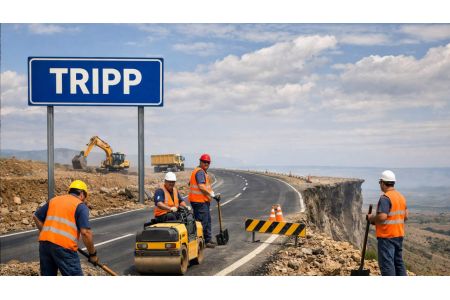
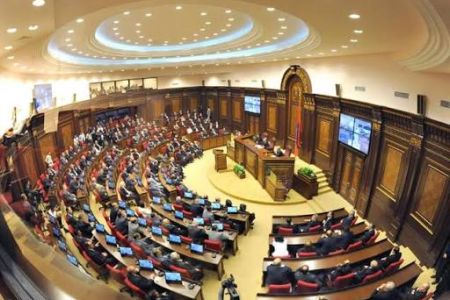
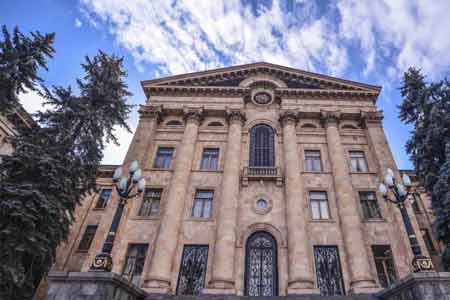
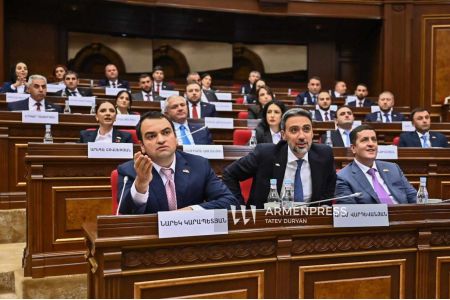
ArmInfo. Discussions began at the plenary session of the National Assembly of Armenia on October 27 regarding the framework agreement on strategic cooperation under the Trump International Peace and Prosperity Initiative (TRIPP), submitted by the Armenian government for ratification.
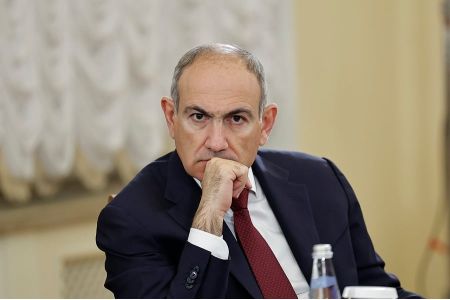
Minister of Foreign Affairs and International Trade Ararat Mirzoyan, who presented the document, recalled that the agreement was discussed in detail at the meeting of the National Assembly Committee on Foreign Relations on October 21. The minister emphasized that the agreement establishes a new, unprecedented level of economic cooperation, while simultaneously enshrining Armenia's sovereignty and jurisdiction over the infrastructure operating under the program. The expected benefits for Armenia from implementing the agreement include the lifting of the blockade, as well as new opportunities for participation in international transportation. Armenia will be able to not only export its products and import necessary goods, but also become an important link in the transport chain between third countries. "We have to sign a shareholder agreement and approve the company's charter. This will likely complete the basic documentation steps necessary for TRIPP to operate. This agreement also aims to regulate these issues," the RA Foreign Minister said. The Minister did not rule out the possibility that the TRIPP project could be launched before the signing of a peace treaty between Armenia and Azerbaijan. He recalled that the text of the peace treaty has already been initialed, and both countries officially state that they do not question its content. However, Baku refuses to sign the document for another reason – demands to amend the Armenian Constitution. According to the Minister, despite the lack of a signed agreement, practical peace has already been established between Armenia and Azerbaijan. "Peace is necessary to launch TRIPP, and it already exists," Mirzoyan emphasized.
The Foreign Minister acknowledged that the sequence of first signing a peace treaty and then implementing joint projects would seem logical. However, according to him, in practice, events do not always unfold according to this pattern. He also did not rule out that the implementation of TRIPP and other joint initiatives could in itself facilitate the signing of a peace treaty between Armenia and Azerbaijan.
It should be noted that, according to the justification for the presented agreement, a development company, TRIPP, is planned to be established in Armenia. A 74% controlling stake will be held by the American side—the TRIPP development company—and 26% by Armenia. The American company must be registered in the state of Delaware as a wholly owned subsidiary of the U.S. International Development Finance Corporation. It must remain under U.S. control at all times, and no third party may acquire ownership rights to it. The company's charter will be governed by Armenian law, and the shareholders' agreement will be governed by the laws of the United States and the State of New York. The TRIPP project includes rail, road, oil and gas pipelines, fiber optic, and power projects. The developer may create specialized subsidiaries for the implementation of individual projects. Changes in company management, share transfers, the creation and ownership of subsidiaries, certain major financial and contractual transactions, the granting of concession rights and final terms, as well as national security and political issues, will be governed by special mechanisms requiring the mutual consent of the parties. In order to facilitate the implementation of transactions necessary for the company and its subsidiaries, Armenia agrees, where necessary, to provide for exceptions from legislation relating to joint stock companies, procurement, and public-private partnerships. The project implementation areas will be determined by mutual agreement of the parties, also taking into account feasibility studies and design studies. Armenia guarantees that the relevant lands are or may become state property and are free from encumbrances and third-party rights, bearing the financial costs of these processes. The developer is granted exclusive rights to use the land and development for an initial period of 49 years. These rights may be transferred to subsidiaries implementing the projects. Upon expiration of the agreement, the parties may, by mutual agreement, extend the rights for another 50 years. In such a case, Armenia's share in the company will increase to 49%. The extension will be Armenia's only compensation in exchange for the increase in share. Upon expiration of the development rights, termination of the company's activities, or by mutual agreement of the shareholders, the company's residual rights will pass to Armenia without any payment or compensation from Armenia. The agreement does not preclude the construction and operation of other infrastructure facilities outside the TRIPP area on the territory of Armenia. The development company will be authorized to select third parties participating in the projects: concessionaires, investors, operators, contractors, and suppliers of engineering, procurement, and construction services. Armenia will retain its status as the sole concession provider.
The agreement also establishes certain tax incentives. In Armenia, dividends paid by the development company to the American company will be exempt from taxation, provided that the latter's ultimate owner is the US government. The development company will also not pay tax in Armenia on dividends received from subsidiaries or on capital gains in the event of the alienation of its shares or the shares of its subsidiaries. Transfers of rights stipulated by the agreement from the Armenian government to the development company and from it to its subsidiaries will also be exempt from tax. Both countries will appoint senior officials to coordinate the cooperation.
The United States intends to complete the necessary procedures, including notification to Congress and approval by the Board of Directors of the International Development Finance Corporation. The United States also intends to provide or facilitate financing, subject to the availability of funds and eligibility requirements, including from public and private investors, on a commercial basis.
Disputes regarding the interpretation or application of the agreement will be resolved through mutual consultations. It enters into force on the date of receipt of the last notification of completion of the necessary internal procedures and may be amended by mutual written agreement of the parties. Either party may terminate the agreement by giving the other party written notice. Termination will take effect one year after the date of notification.
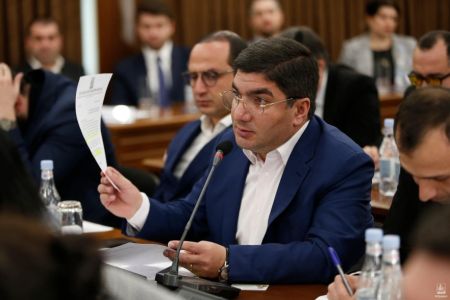
Please note that 41 Members of Parliament have signed up to speak on the agreement.































 Expert: Economic pressure on Armenia may be virtually painless for other EAEU members, but not for Armenia itself
 Expert on protests in France: Civilizations fade when society loses a vision of the future
 Turkologist: Azerbaijan is not all-powerful—its vulnerabilities should become part of Armenia’s security strategy
 Opinion: The development of the Amulsar mine near the resort town of Jermuk is the beginning of an environmental disaster in Armenia
 Expert: The arrest of opposition figures in Armenia for social media posts is a systematic attempt to intimidate the public and suppress dissent.
 Zakharova commented on the scandalous epithets of the governor of Armenia`s Shirak region about "Ivanov"
 Nikolai Bordyuzha proposed excluding Armenia from the CSTO.
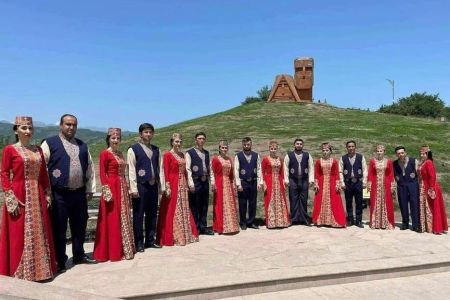 The participation of Artsakh ensembles in an international festival in Vienna was cancelled following the intervention of several foreign embassies
 Expert: It`s time for Armenia to move away from uncertainty and choose between West and East
 The Armenian Foreign Minister commented on the country`s return to work within the CSTO.
 The Artsakh Public Council expressed outrage at the UN Secretary-General`s behavior
 Lukashenko called for Armenia to assume the CIS presidency in 2029
 Dmitry Medvedev predicted a Ukrainian-like fate for Armenia amid the country`s shift in foreign policy
 Russian Security Council: In Armenia, they want to force Russian asset owners to dispose of their assets
 Zakharova: Russia ready to discuss with Armenia the prospects for expanding military cooperation as part of a review of bilateral ties
 Tevanyan: Armenia, like Ukraine and Moldova, is being drawn into the EU’s global war
 Yerevan City Hall is considering introducing a valet parking system in the city
 Expert: The circus surrounding the “Albanization” of Armenian culture in the presence of foreign ambassadors in occupied Artsakh is genocide
 Political scientist: If Russian-Armenian relations are destroyed, Turkey will take Russia`s place