
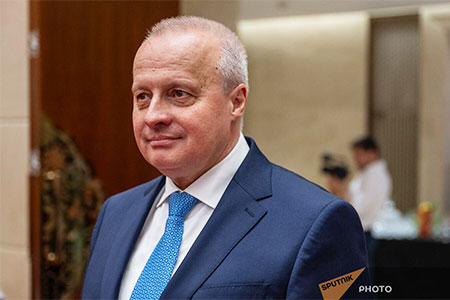
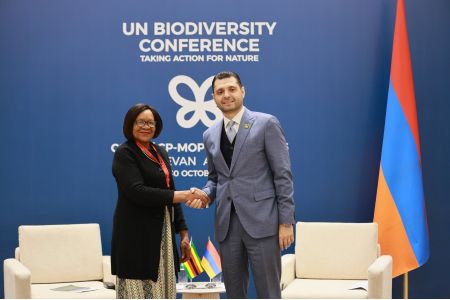
ArmInfo. Dialogue in the field of ecology is being conducted between Russia and Armenia in a bilateral format. Russian Ambassador to Armenia Sergey Kopyrkin stated this in a conversation with journalists on October 26 on the sidelines of the 17th Conference of the Parties to the UN Convention on Biological Diversity (COP17).
According to him, this is quite a traditional area of bilateral cooperation. "In addition to what was discussed at today’s session, we see that our specialists, representatives of the corporate sector and government agencies are ready for international contacts, ready
to share the developments that exist—and they really do exist—and to adopt international experience. After all, nature is a transnational concept, a transnational reality, and without international cooperation this is impossible. And what is happening here these days shows that this is a matter for all humanity," the Russian diplomat said.
During his welcoming address at the session in the Russian pavilion at COP17 on the topic "State and Business Together," Kopyrkin called the event in Yerevan important both as an international event and from the perspective of the Russian Federation’s international relations. In this context, he said it was no coincidence that the Russian delegation was one of the largest at the meeting. The diplomat recalled that the Russian delegation at COP17 is headed by presidential aide, Special Presidential Representative for Climate and Water Resources, Ruslan Edelgeriyev.
"All this, of course, demonstrates how high on the scale of priorities of the Russian Federation and its leadership are issues related to the protection of nature and the climate. This is natural, given the enormous natural potential that the Russian Federation possesses and the responsibility that rests with the country in this regard globally," Kopyrkin said, expressing his conviction that the participation of the Russian delegation in this meeting was a good opportunity not only to share Russia’s comprehensive experience in the field of nature protection, but also to strengthen and develop international ties, which are naturally necessary given that environmental issues have no national borders.












 Expert: Economic pressure on Armenia may be virtually painless for other EAEU members, but not for Armenia itself
 Expert on protests in France: Civilizations fade when society loses a vision of the future
 Turkologist: Azerbaijan is not all-powerful—its vulnerabilities should become part of Armenia’s security strategy
 Opinion: The development of the Amulsar mine near the resort town of Jermuk is the beginning of an environmental disaster in Armenia
 Expert: The arrest of opposition figures in Armenia for social media posts is a systematic attempt to intimidate the public and suppress dissent.
 The Armenian Foreign Minister commented on the country`s return to work within the CSTO.
 The Artsakh Public Council expressed outrage at the UN Secretary-General`s behavior
 Lukashenko called for Armenia to assume the CIS presidency in 2029
 Dmitry Medvedev predicted a Ukrainian-like fate for Armenia amid the country`s shift in foreign policy
 Russian Security Council: In Armenia, they want to force Russian asset owners to dispose of their assets
 Zakharova: Russia ready to discuss with Armenia the prospects for expanding military cooperation as part of a review of bilateral ties
 Tevanyan: Armenia, like Ukraine and Moldova, is being drawn into the EU’s global war
 Yerevan City Hall is considering introducing a valet parking system in the city
 Expert: The circus surrounding the “Albanization” of Armenian culture in the presence of foreign ambassadors in occupied Artsakh is genocide
 Political scientist: If Russian-Armenian relations are destroyed, Turkey will take Russia`s place
 Political scientist: The Armenian public is simply obliged to significantly change the entire content of public discourse and struggle
 Cross tattoos are being removed from the skin of Christian prisoners in Azerbaijan by fire, according to a human rights activist.
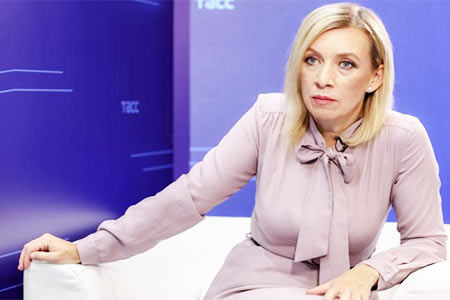 Zakharova: Armenia`s likely introduction of visas with Russia will be a step against Yerevan itself
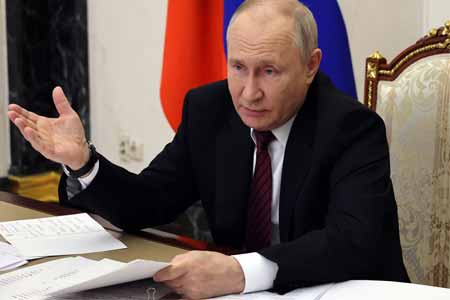 Putin: Armenia`s recognition of Karabakh as part of Azerbaijan in Prague has given Russia`s position on this issue an ambivalent character
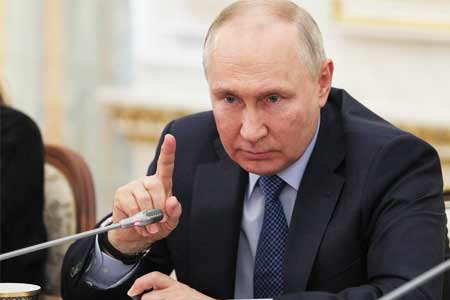 Putin: Armenia`s adoption of the law on EU accession means an announcement of its withdrawal from the Eurasian Economic Union