

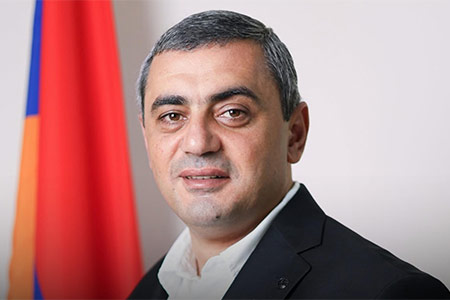
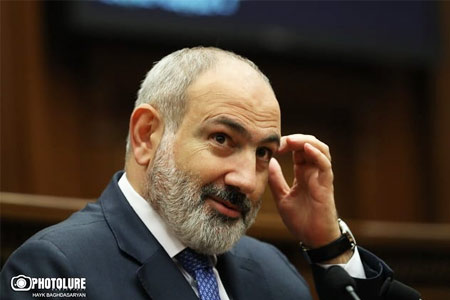
ArmInfo. Armenia faces three possible scenarios for the development of its domestic political situation: the adoption of a new Constitution, early parliamentary elections, or the removal of Prime Minister Nikol Pashinyan from power through impeachment. This opinion was expressed by Armen Ashotyan, Deputy Chairman of the Republican Party of Armenia (RPA), reacting to Pashinyan's statement about the possibility of early elections.
"Today, after the government meeting, Pashinyan voiced what was already obvious: if he fails to ensure the adoption of a new Constitution in parliament within a year, he may call
early elections. At the same time, the bulk of the opposition declares that it will launch a street fight only once and at the appropriate moment." "These two statements, in essence, are the key scenarios for how events will develop in Armenia over the coming year," the RPA Deputy Chairman wrote on his Facebook page.
According to Ashotyan, the main constitutional tool for removing Pashinyan is impeachment, which can be used exactly one year after the current National Assembly takes office. He also claims Pashinyan has the same period, that is, one year, to call snap elections if necessary. "Therefore, if neither side manages to win within the coming year, events will unfold in such a way that Armenia will face three possible scenarios. The first is the adoption of an 'Aliyev' constitution. "This scenario is possible if the Armenian Prime Minister manages to lure the six missing mandates from the parliamentary opposition and put the new version of the constitution to a referendum," the RPA deputy chairman noted.
The second scenario, according to him, is snap elections. Ashotyan explained that this could be realized if Pashinyan, on the one hand, fails to secure the six missing votes, and on the other, if the ratings of the parliamentary and extra-parliamentary opposition fall so much that they give him hope of winning more votes in snap elections. "And impeachment—when, under pressure from street struggles in parliament, we manage to secure the necessary majority with deputies from the ruling Civil Contract faction," Ashotyan added.
Under these conditions, he said, the opposition's strategic goal is clear: to prevent "political cattle rustling," that is, the poaching of deputies, to maintain and, if possible, increase its current rating in society, in order to prevent a decline in the opposition's vote in the event of early elections. "And to keep the spark of struggle alive through local, thematic, and ongoing actions, so that, if necessary, it can ignite a major conflagration." "I hope that the opposition's work in this direction will at least prevent the advancement of an unacceptable version of the Constitution and the strengthening of Pashinyan's power in Armenia through early elections, and in the most optimistic scenario, will lead to a change of power through impeachment," Ashotyan concluded.
It should be noted that during a briefing on October 22, the Prime Minister of Armenia did not rule out holding early parliamentary elections if he fails to convince the parliamentary opposition to vote in favor of submitting the new Constitution to a referendum.
As a reminder, following the results of the regular parliamentary elections in Armenia held on June 7, 2026, the Civil Contract party has a 3/5 majority, which allows it to pass constitutional laws and make appointments. However, the party does not have the 2/3 majority necessary to directly amend the Constitution. It should be added that since the occupation of Artsakh, Baku has frequently demanded changes to the Armenian Constitution, citing its alleged territorial claims against Azerbaijan. Azerbaijan presents the fulfillment of these and other demands as a precondition for concluding a "peace treaty."


















 Expert: Economic pressure on Armenia may be virtually painless for other EAEU members, but not for Armenia itself
 Expert on protests in France: Civilizations fade when society loses a vision of the future
 Turkologist: Azerbaijan is not all-powerful—its vulnerabilities should become part of Armenia’s security strategy
 Opinion: The development of the Amulsar mine near the resort town of Jermuk is the beginning of an environmental disaster in Armenia
 Expert: The arrest of opposition figures in Armenia for social media posts is a systematic attempt to intimidate the public and suppress dissent.
 The Armenian Foreign Minister commented on the country`s return to work within the CSTO.
 The Artsakh Public Council expressed outrage at the UN Secretary-General`s behavior
 Lukashenko called for Armenia to assume the CIS presidency in 2029
 Dmitry Medvedev predicted a Ukrainian-like fate for Armenia amid the country`s shift in foreign policy
 Russian Security Council: In Armenia, they want to force Russian asset owners to dispose of their assets
 Zakharova: Russia ready to discuss with Armenia the prospects for expanding military cooperation as part of a review of bilateral ties
 Tevanyan: Armenia, like Ukraine and Moldova, is being drawn into the EU’s global war
 Yerevan City Hall is considering introducing a valet parking system in the city
 Expert: The circus surrounding the “Albanization” of Armenian culture in the presence of foreign ambassadors in occupied Artsakh is genocide
 Political scientist: If Russian-Armenian relations are destroyed, Turkey will take Russia`s place
 Political scientist: The Armenian public is simply obliged to significantly change the entire content of public discourse and struggle
 Cross tattoos are being removed from the skin of Christian prisoners in Azerbaijan by fire, according to a human rights activist.
 Zakharova: Armenia`s likely introduction of visas with Russia will be a step against Yerevan itself
 Putin: Armenia`s recognition of Karabakh as part of Azerbaijan in Prague has given Russia`s position on this issue an ambivalent character
 Putin: Armenia`s adoption of the law on EU accession means an announcement of its withdrawal from the Eurasian Economic Union