

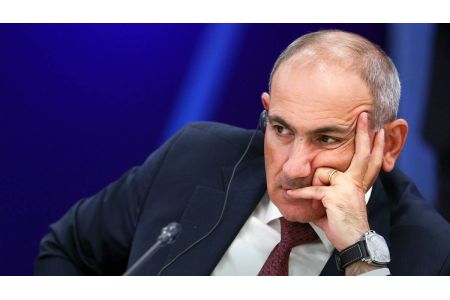
ArmInfo. Azerbaijan's connection to Nakhijevan through Armenia will be ensured on a reciprocal basis within the framework of the Trump Route for International Peace and Prosperity (TRIPP) project.
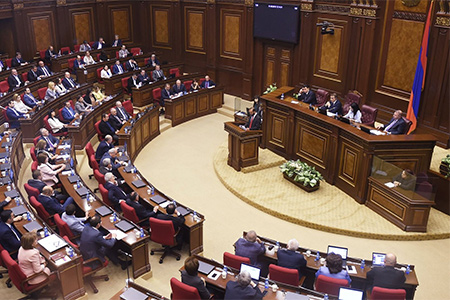
On October 7, during a question-and-answer session in parliament, Armenian Prime Minister Nikol Pashinyan answered a question from National Assembly member Artur Khachatryan from the opposition Armenia faction about the steps being taken to ensure the unimpeded movement of Armenian goods and the transmission of electricity through Azerbaijan.
In response, Pashinyan assured that the same efforts are being made to ensure domestic communication between the territories of Azerbaijan through Armenia. "Today, this connection does not yet exist, since there is no corresponding communication, that is, there is no road or railway line. The same applies to the Republic of Armenia. One of the goals of the TRIPP is to ensure communication between the northern and southern parts of our country. We are also interested in establishing a connection with the Syunik region through Azerbaijan, particularly Nakhijevan," the Armenian prime minister stated. According to him, the Armenian side is negotiating the restoration of the Soviet-era railway through Meghri. "And when we achieve institutionalized peace and a point where there is peace on a socio-psychological level, I am confident that at some point we will discuss extending this railway line to Kapan, since, as you know, it ran through Azerbaijani territory during the Soviet era." "That is, through Meghri, it entered Azerbaijani territory, and only then from there back to Kapan," Pashinyan noted.
He then clarified that this project is also important for the operation of the Zangezur Copper and Molybdenum Combine (ZCMC), the Kapan Mining and Processing Plant, and for reducing road congestion. "And I would like to note that it will soon be a year since rail service through Azerbaijan opened for Armenia, and it is also important to note that during this time, deliveries have been made, and there are also opportunities for importing goods," Pashinyan added.
Then the MP clarified that his question concerned specifically intrastate transportation. Specifically, he asked how, on a reciprocal basis, various shipments, including electricity transmission, would be carried out from Meghri to other regions of Armenia through Azerbaijan, for example, through Nakhichevan. In response, Pashinyan admitted that he was having difficulty understanding what exactly he was being asked and, in his opinion, the opposition was asking him ambiguous questions. When asked why the framework agreement for the TRIPP project was concluded only between Armenia and the United States but would not be submitted to the Azerbaijani parliament for ratification, the prime minister explained that this was because such agreements are concluded between two governments. "There has never been a precedent in history for an agreement signed between two countries to also be ratified in a third country," Pashinyan said ironically.
As a reminder, on August 8, 2025, Armenian Prime Minister Nikol Pashinyan and Azerbaijani President Ilham Aliyev signed a joint seven-point "Declaration of Peace" in Washington. It provides for a joint appeal to the Organization for Security and Cooperation in Europe (OSCE) to terminate the OSCE Minsk process and related structures, as well as the creation of a transport corridor through Armenian territory that will connect Azerbaijan with its Nakhijevan exclave, surrounded by Armenia, Turkey, and Iran. And already on January 14, 2026, the Armenian Foreign Ministry published a framework document signed with the American side in Washington on the implementation of the "Trump Route for International Peace and Prosperity" (TRIPP). The 12-page document presents the main goals of the project and the mechanisms for its functioning. Among other things, the document emphasizes that Armenia intends to sanction and support the creation of the TRIPP Development Company. It is expected that the company will be responsible for the development of the TRIPP project, having received an initial right to development for a period of 49 years. Armenia intends to offer the United States 74% of the shares of TRIPP Development Company, retaining 26%. The partnership is expected to be extended for another 50 years, with an additional ownership stake granted to the Armenian government, bringing its stake to 49%.















 Azerbaijani Studies Expert: While Azerbaijan Prepares Its Generation for War, Aliyev’s Aide Calls on Armenia to Prepare Armenian Society for “Peace”
 Turkologist: Azerbaijan will never, under any circumstances, stop pressuring the Armenian people
 Political scientist: We need to move away from the question of "when" and replace it with more important questions
 International Law Specialist: Azerbaijan intends to initiate legal proceedings against Armenia by sentencing Armenian prisoners
 Dmitry Medvedev predicted a Ukrainian-like fate for Armenia amid the country`s shift in foreign policy
 Russian Security Council: In Armenia, they want to force Russian asset owners to dispose of their assets
 Zakharova: Russia ready to discuss with Armenia the prospects for expanding military cooperation as part of a review of bilateral ties
 Tevanyan: Armenia, like Ukraine and Moldova, is being drawn into the EU’s global war
 Yerevan City Hall is considering introducing a valet parking system in the city
 Expert: The circus surrounding the “Albanization” of Armenian culture in the presence of foreign ambassadors in occupied Artsakh is genocide
 Political scientist: If Russian-Armenian relations are destroyed, Turkey will take Russia`s place
 Political scientist: The Armenian public is simply obliged to significantly change the entire content of public discourse and struggle
 Cross tattoos are being removed from the skin of Christian prisoners in Azerbaijan by fire, according to a human rights activist.
 Zakharova: Armenia`s likely introduction of visas with Russia will be a step against Yerevan itself
 Putin: Armenia`s recognition of Karabakh as part of Azerbaijan in Prague has given Russia`s position on this issue an ambivalent character
 Putin: Armenia`s adoption of the law on EU accession means an announcement of its withdrawal from the Eurasian Economic Union
 Aram Vardevanyan: Public demands solutions, not apology scandals in Parliament
 Arrested Armenian oligarch on economy and new jobs