
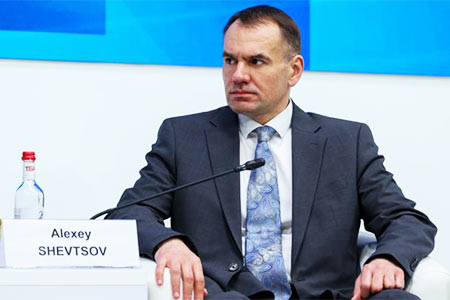
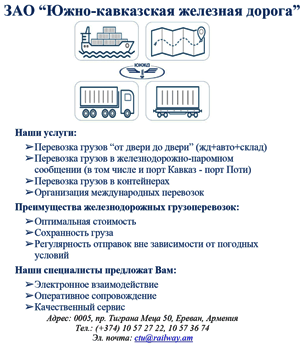
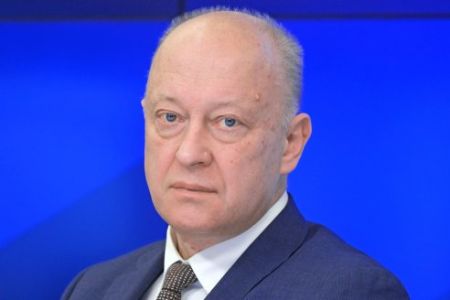
ArmInfo. There is currently no talk of building new roads either between Armenia and Iran or on the Meghri section of the former Transcaucasian Railway, which has now become fashionable to call the "Trump Route." This was stated in a comment by Deputy Secretary of the Russian Security Council Alexei Shevtsov, published on the Security Council website.
He recalled that the railway along the southern border of the USSR was built back in the 1930s, and during Soviet times, it was a vital part of the region's economic life, providing freight and passenger transportation between the USSR and Iran, the USSR and Turkey, and throughout the Union.
"It was, without exaggeration, an all-Union project, and was personally overseen by Lavrenty Beria, after whom the railway even bore his name for a time. Trains ran along it to Tehran via Julfa and to Kars via Gyumri; "It was possible to travel from Baku to Yerevan without transfers. Freight turnover between the USSR and Iran via Julfa reached 3.5 million tons during peak years, with up to 350 railcars handled at the station per day," he said in response to a question about how the Russian side views the restoration of rail service and the construction of cross-border railways between Iran and Armenia as impacting the implementation of the Trump Route. According to him, the situation has changed, but the initial data remains the same. Shevtsov added that as a result of the events of the 1990s, many railways in the region ceased to be used and maintained, and essentially fell into disrepair. The Deputy Secretary of the Russian Security Council noted that their restoration requires significant investment, and this investment, in turn, requires a long-term payback.
"At the same time, it is undeniable that the restoration of transport communications in the South Caucasus, primarily railways, will contribute to the economic development of the entire region. Russia has always supported this. A clear confirmation of this is our country's commitment to implementing the North-South route, which will improve the transport and logistics situation and increase revenues from freight transit, i.e., will have an overall positive impact on the economies of the countries through which it passes. The simplest way to restore rail service between Armenia and Iran is to reinstate transit through Nakhichevan, which requires at least a political decision. Furthermore, and this is no less important, a guaranteed volume of freight traffic is necessary to cover the cost of operating the railway," he stated. As a reminder, on August 8, 2025, Armenian Prime Minister Nikol Pashinyan and Azerbaijani President Ilham Aliyev signed a seven-point joint "Declaration of Peace" in Washington. It provides for a joint appeal to the Organization for Security and Cooperation in Europe (OSCE) to terminate the OSCE Minsk Process and related structures, as well as the creation of a transport corridor through Armenian territory that will connect Azerbaijan with its Nakhichevan exclave, surrounded by Armenia, Turkey, and Iran. And on January 14, 2026, the Armenian Foreign Ministry published a framework document signed with the American side in Washington for the implementation of the Trump Route for International Peace and Prosperity (TRIPP). The 12-page document presents the project's main goals and operating mechanisms. Among other things, the document emphasizes that Armenia intends to sanction and support the creation of the TRIPP Development Company. The company is expected to be responsible for developing the TRIPP project, receiving an initial development right for a period of 49 years. Armenia intends to offer the United States a 74% stake in the TRIPP Development Company, while retaining 26%. This partnership is expected to be extended for another 50 years, with an additional ownership stake granted to the Armenian government, bringing its stake to 49%.












 Political scientist: We need to move away from the question of "when" and replace it with more important questions
 International Law Specialist: Azerbaijan intends to initiate legal proceedings against Armenia by sentencing Armenian prisoners
 An Armenian Turkologist spoke out against attempts to deny the value of Artsakh and the liberation of Armenia.
 Russian political scientist: Moscow`s reaction to the TRIPP project will largely depend on the trend in Russian-American relations
 Armenian Political Scientist: The approaches, methods, rmphases and content of today’s struggle in Armenia Cannot Remain the Same
 Russian Security Council: In Armenia, they want to force Russian asset owners to dispose of their assets
 Zakharova: Russia ready to discuss with Armenia the prospects for expanding military cooperation as part of a review of bilateral ties
 Tevanyan: Armenia, like Ukraine and Moldova, is being drawn into the EU’s global war
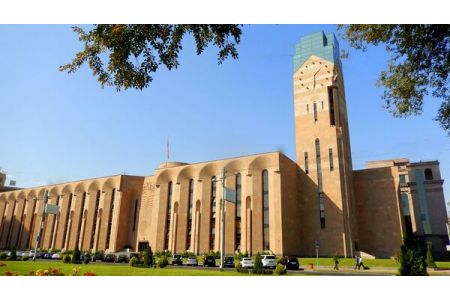 Yerevan City Hall is considering introducing a valet parking system in the city
 Expert: The circus surrounding the “Albanization” of Armenian culture in the presence of foreign ambassadors in occupied Artsakh is genocide
 Political scientist: If Russian-Armenian relations are destroyed, Turkey will take Russia`s place
 Political scientist: The Armenian public is simply obliged to significantly change the entire content of public discourse and struggle
 Cross tattoos are being removed from the skin of Christian prisoners in Azerbaijan by fire, according to a human rights activist.
 Zakharova: Armenia`s likely introduction of visas with Russia will be a step against Yerevan itself
 Putin: Armenia`s recognition of Karabakh as part of Azerbaijan in Prague has given Russia`s position on this issue an ambivalent character
 Putin: Armenia`s adoption of the law on EU accession means an announcement of its withdrawal from the Eurasian Economic Union
 Medvedev: Yerevan will never become an EU member, but it will permanently damage relations with the Eurasian Economic Union, including with Moscow.
 Arrested Armenian oligarch on economy and new jobs
  "In Baku, we gave a worthy rebuff to the false claims regarding the past and present of our people" – Former Artsakh Parliament Speaker from Baku captivity