

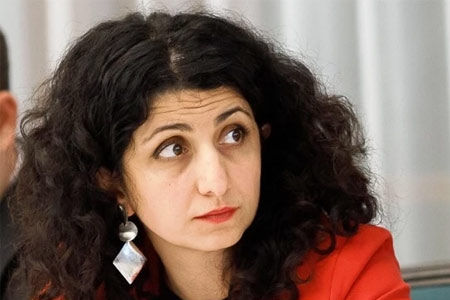
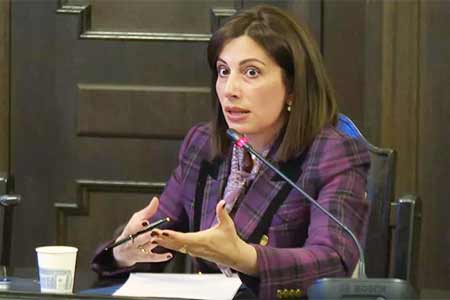
ArmInfo. Over the past two or three years, the Armenian side has missed several opportunities to more actively raise the issue of Armenian prisoners of war on international platforms and secure their return. This was stated on September 28 at a press conference in Yerevan entitled "Three Years in Prison: Peace and Armenian Prisoners," by human rights expert and representative of the NGO "Protection of Rights Without Borders."
In particular, she responded to statements made by Arpi Davoyan and Maria Karapetyan, members of parliament from the Civil Contract party. Davoyan drew a historical parallel, stating that after the end of World War II, the return of prisoners of war took up to ten years, while Karapetyan stated that the issue of returning Armenian prisoners should be raised at international meetings "in the calmest possible tone," lest foreign partners get the impression that Armenia is trying to damage Azerbaijan's reputation.
"I don't share the position that we should lower the bar so much that there's no room to lower it even further. The example cited is one of the worst recorded in history. After all, it was after World War II that amendments were made to the Geneva Conventions, including clarification of the rules regarding the return of prisoners of war for whom a court verdict had already been issued,"
- the expert recalled.
Meanwhile, as Melikyan noted, Azerbaijan actively utilizes provisions of international law that can be interpreted to its advantage. According to her, to a third party unfamiliar with all the circumstances of the case, such arguments may appear convincing. She recalled that the Geneva Conventions and international humanitarian law provide for the possibility of accountability for war crimes, genocide, and crimes against humanity. "This is precisely how Azerbaijan is attempting to justify the sentences handed down to Armenian prisoners of war, presenting them as individuals who have committed war crimes. And it is precisely here that the Armenian side—both the authorities and other actors—should have consistently explained to the international community the circumstances of these trials and pointed out the lack of grounds to consider them fair trials. That is, we should not use the worst example to justify our inaction. On the contrary, the law requires that prisoners be returned after the end of the active phase of the armed conflict." "Over the past two or three years, the Armenian side has missed several opportunities to more actively raise this issue on international platforms and seek the return of prisoners," Melikyan believes.
Commenting on the statement about possible reputational damage to Azerbaijan, Melikyan noted that she has observed a gradual softening of the language used by Armenian delegations on international platforms. According to her, the Armenian side increasingly speaks less and less directly about the issue, does not demand justice and the return of prisoners, and limits itself to statements about its expectation of their return. In this regard, Melikyan recalled that the Warsaw Conference on the Human Dimension will be held in Warsaw in a few days (from October 5 to 15, 2026 - ed.). In her opinion, at this platform, too, the Armenian delegation can limit itself to softer language and not focus on the fact that Armenian prisoners continue to be held in Baku. Meanwhile, the expert recalled, there are still individuals in Azerbaijan who should have been punished for war crimes, which has not yet happened. "A number of international organizations have previously called on Azerbaijan to conduct appropriate investigations and ensure that those responsible are held accountable. This is being discussed significantly less today, in part because the Armenian side itself has stopped actively raising the issue. It is much easier for a third party to avoid responsibility if one of the parties is not demanding," the human rights expert explained. In this regard, the expert called on the Armenian authorities to more actively raise the issue of prisoners in international forums, as this, in her opinion, could create additional opportunities for mediation by third countries and international organizations if a direct resolution is not possible. "No one is saying that the Armenian side should adopt an exclusively accusatory tone, especially given its constraints in the public sphere, including as a result of a lack of negotiating capacity." "However, the lack of sufficient instruments of direct pressure does not mean that the issue should not be raised at the diplomatic level," Melikyan emphasized.
In turn, international law specialist Taron Simonyan, founding partner of the law firm ELL PARTNERSHIP, noted that the state is obligated to participate in such processes and protect its citizens. According to him, this is the state's constitutional duty, and failure to fulfill this duty, in his opinion, can be considered a violation of constitutional obligations. Speaking about
statements by members of parliament from the Civil Contract party, Simonyan noted that they should exercise greater rigor in their wording, since in certain cases, statements by officials can be attributed to the state. According to him, in international
practice, even a statement by a member of parliament can, albeit indirectly, be considered the position of the state. "We cannot even justify our inability to resolve these issues or our inaction by promoting ignorance. If we compare the current situation with the post-World War II period and use this comparison to justify the prolonged detention of prisoners, then by the same logic we can turn to even more distant historical periods when prisoners of war were enslaved or executed," Simonyan emphasized.
Meanwhile, he said, Armenia could appeal to the International Court of Justice and seek Azerbaijan's accountability. In this regard, he recalled that an interim ruling has already been issued in one of the cases as part of the dispute between the parties. "There are also international conventions that can be used to protect relevant rights, and Azerbaijan is a party to several such international treaties. But the question is why these instruments are not being used." Failure to use this toolkit is committing a crime against one's own people," Simonyan concluded.




















 Armenian Political Scientist: The approaches, methods, rmphases and content of today’s struggle in Armenia Cannot Remain the Same
 Political scientist: Armenians will live peacefully in their homeland only when they can once again set national goals for themselves, such as Artsakh
 Zakharova: Russia ready to discuss with Armenia the prospects for expanding military cooperation as part of a review of bilateral ties
 Tevanyan: Armenia, like Ukraine and Moldova, is being drawn into the EU’s global war
 Yerevan City Hall is considering introducing a valet parking system in the city
 Expert: The circus surrounding the “Albanization” of Armenian culture in the presence of foreign ambassadors in occupied Artsakh is genocide
 Political scientist: If Russian-Armenian relations are destroyed, Turkey will take Russia`s place
 Political scientist: The Armenian public is simply obliged to significantly change the entire content of public discourse and struggle
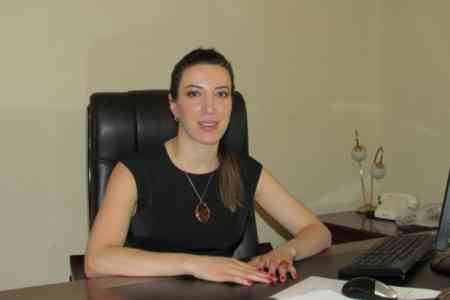 Cross tattoos are being removed from the skin of Christian prisoners in Azerbaijan by fire, according to a human rights activist.
 Zakharova: Armenia`s likely introduction of visas with Russia will be a step against Yerevan itself
 Putin: Armenia`s recognition of Karabakh as part of Azerbaijan in Prague has given Russia`s position on this issue an ambivalent character
 Putin: Armenia`s adoption of the law on EU accession means an announcement of its withdrawal from the Eurasian Economic Union
 Medvedev: Yerevan will never become an EU member, but it will permanently damage relations with the Eurasian Economic Union, including with Moscow.
 Aram Vardevanyan: Public demands solutions, not apology scandals in Parliament
 Arrested Armenian oligarch on economy and new jobs
  "In Baku, we gave a worthy rebuff to the false claims regarding the past and present of our people" – Former Artsakh Parliament Speaker from Baku captivity